

Seoul and Tehran named streets for each other — then their paths diverged
-

- MICHAEL LEE
- [email protected]
![Photos of people killed during the protests that rocked Iran earlier this year can be seen on the left side of the Teheran-ro street marker in Gangnam District, southern Seoul, on March 8. [MICHAEL LEE]](https://koreaseafood.online/data/photo/2026/03/08/42e07d6a-699f-46d0-88dd-8d749da381e6.jpg)
Photos of people killed during the protests that rocked Iran earlier this year can be seen on the left side of the Teheran-ro street marker in Gangnam District, southern Seoul, on March 8. [MICHAEL LEE]
[EXPLAINER]
Outside exit 1 of Gangnam Station in southern Seoul, along a wide boulevard lined with glass skyscrapers, stands a modest stone marker engraved with the name of the street in Korean and Farsi: Teheran-ro, christened in 1977 after Iran’s capital during a visit by then–Tehran Mayor Gholam-Reza Nikpey.
At the time, the gesture symbolized the rapidly growing relationship between South Korea and Iran. Today, however, the Teheran-ro marker is covered in posters of people killed during recent protests that rocked Iran — a reminder not only of the opposing political trajectories taken by Seoul and Tehran over the past five decades, but also of the gradual fraying of their relationship amid Washington’s pressure on allies to isolate Tehran and Iran’s suspected military ties to North Korea.
The conflict that erupted on Feb. 28 between Israel and the United States on one side and Iran on the other has once again drawn attention to Seoul’s complicated position in the Middle East, where South Korea maintains a long, if increasingly strained, relationship with Tehran while also deepening its defense partnerships with other states in the region.
Officials in Seoul have responded to the outbreak of hostilities with cautious language that reflects those competing interests. Shortly after the first U.S. and Israeli airstrikes on Iran, the South Korean Foreign Ministry called on “all parties to make utmost efforts to de-escalate tensions.” The government has also expressed concern for the safety of South Korean nationals in the region and the stability of global energy supplies.
While the ministry avoided endorsing Israel’s stated rationale of preventing Iran from acquiring nuclear weapons, it emphasized that Seoul remains “firmly committed to upholding the international nonproliferation regime” and “participating in efforts to resolve the Iranian nuclear issue.”
Seoul’s carefully worded statements belie its complex set of interests. South Korea faces a nuclear-armed North Korea, depends heavily on oil from the Persian Gulf and has built expanding defense partnerships across the Middle East. Those realities give Seoul strong incentives to pursue regional stability and restraint by the warring parties.
Yet the consequences of the crisis are also being felt far beyond the Gulf. For Iranian nationals living in South Korea, the escalating confrontation has stirred anxiety as they follow developments in their homeland.
![Iranian residents of South Korea chant slogans in support of U.S. and Israeli airstrikes that killed Iranian Supreme Leader Ali Khamenei at a rally in Gwanghwamun Square, central Seoul, on March 8. [MICHAEL LEE]](https://koreaseafood.online/data/photo/2026/03/08/0300b0b8-0514-4345-a129-c0847434b7d9.jpg)
Iranian residents of South Korea chant slogans in support of U.S. and Israeli airstrikes that killed Iranian Supreme Leader Ali Khamenei at a rally in Gwanghwamun Square, central Seoul, on March 8. [MICHAEL LEE]
How have Iranians in South Korea reacted?
The ongoing hostilities have divided the roughly 1,300 Iranians living in South Korea, who have held duelling rallies in Seoul in recent days.
For some, the death of Iran’s theocratic ruler, Ayatollah Ali Khamenei, in the opening salvo of the current conflict gave cause for celebration. During a rally on Sunday, Iranian residents called for the restoration of the country’s pre-1979 monarchy as they waved the flags of the United States, Israel and prerevolutionary Iran in front of Gyeongbok Palace in downtown Seoul. For some participants, the U.S. and Israeli strikes represented the possible beginning of the end of the Islamic Republic.
![Iranian residents of South Korea wave banners based on the design of Iran's prerevolutionary flag as they call for the restoration of Reza Pahlavi, the son of the last Shah Mohammad Reza Pahlavi, as their country's monarch during a rally in Gwanghwamun Square, central Seoul, on March 8. [MICHAEL LEE]](https://koreaseafood.online/data/photo/2026/03/08/91dcccba-49dd-41ed-a1a3-7de1f9cf9cca.jpg)
Iranian residents of South Korea wave banners based on the design of Iran's prerevolutionary flag as they call for the restoration of Reza Pahlavi, the son of the last Shah Mohammad Reza Pahlavi, as their country's monarch during a rally in Gwanghwamun Square, central Seoul, on March 8. [MICHAEL LEE]
“Under the mullahs, our suffering has been endless and invisible,” said one Iranian resident who asked to remain anonymous for fear of reprisal, referring to Iran’s ruling clerics.
“We don’t want a government that lines the pockets of its allies in Gaza and Yemen but steals from us and crushes our voices at home,” she added. “We want to be free and have better relations with the world.”
Other Iranians have condemned the human cost of the bombings on their country. Filmmaker Komeil Soheili, who has lived in South Korea for seven years, said that he opposes both the Iranian government and the war itself at a rally in front of the U.S. Embassy in Seoul on March 2.
“I am against the dictatorship in Iran, but that does not justify war,” he explained. “These are real bombs dropping on real people. I do not believe bombs will create democracy.”
Even Iranians who support the strikes targeting Iran’s government expressed concern for the safety of friends and family back home.
“We worry constantly for the safety of civilians,” said another participant at Sunday’s rally. “We are not the mullahs, and we hope the world knows there is a difference.”
What has changed in South Korea–Iran relations over time?
For much of the late twentieth century, Iran ranked among South Korea’s most important partners in the Middle East. The relationship rested largely on energy and trade, reinforced by both countries’ close ties with the United States before 1979. During the 1973 Arab oil embargo, Iran was the only oil-producing country in the Middle East that continued supplying crude to South Korea, helping sustain Seoul’s rapid industrialization in the 1970s and 1980s.
South Korean companies also found opportunities in Iran’s infrastructure sector. Construction firms, manufacturers and engineering companies expanded their presence there with encouragement from both governments, and more than 200,000 South Koreans worked in Iran in the 1970s.
![Seoul Mayor Koo Ja-choon, left, and Tehran Mayor Gholamreza Nikpey unveil the Teheran-ro street marker in Gangnam District, southern Seoul, on June 2, 1977. [JOONGANG ILBO]](https://koreaseafood.online/data/photo/2026/03/08/aedc81e1-dc17-4b23-a45e-c8da937aef40.jpg)
Seoul Mayor Koo Ja-choon, left, and Tehran Mayor Gholamreza Nikpey unveil the Teheran-ro street marker in Gangnam District, southern Seoul, on June 2, 1977. [JOONGANG ILBO]
Even after the 1979 Islamic Revolution overthrew the U.S.-backed Shah of Iran, Mohammad Reza Pahlavi, relations between Seoul and Tehran remained friendly. South Korea continued to import Iranian oil and avoided overt political confrontation with the new government. By the early 2000s, Iran was still one of South Korea’s largest suppliers of oil.
Over time, however, the relationship grew more complicated.
“One of the core tenets of the Islamic Republic of Iran is anti-Americanism, which cannot sit easily with South Korea, which regards its alliance with the United States as the cornerstone of its foreign policy,” said Middle East expert Jang Ji-hyang, director of the Asan Institute’s Regional Studies Center, in an interview with the Korea JoongAng Daily on Friday.
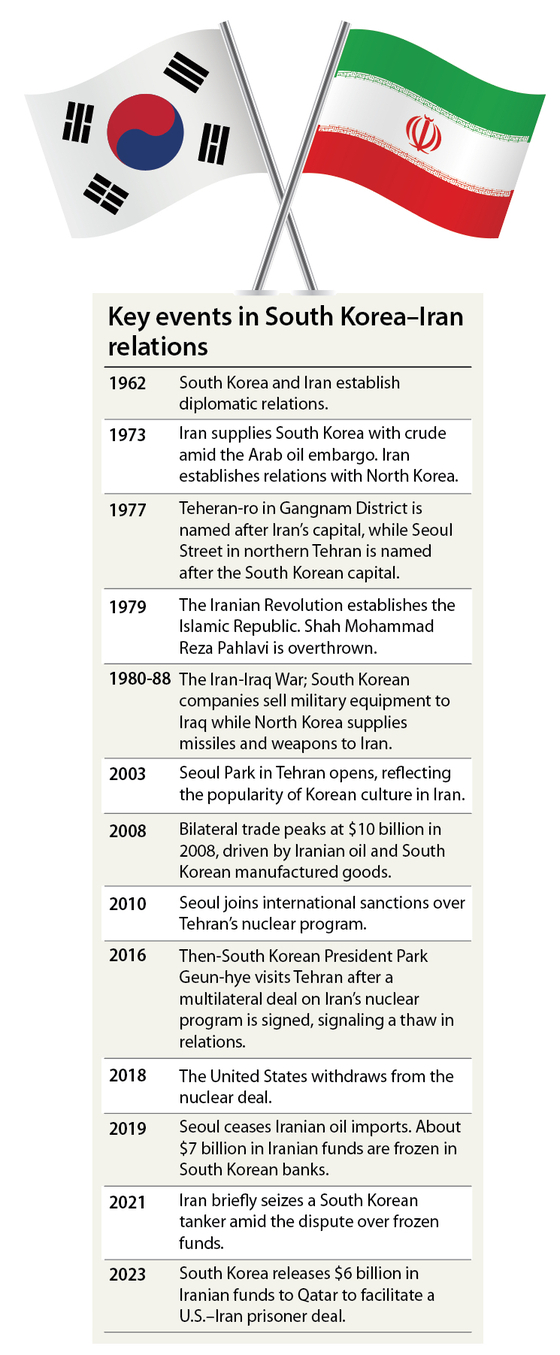
As international scrutiny over Iran’s nuclear program intensified, Seoul could no longer maintain a policy of business as usual with Tehran, especially as South Korea was seeking global compliance with sanctions targeting North Korea’s nuclear and missile programs, according to Jang. That shift, coupled with pressure from Washington, led Seoul to impose its first set of sanctions on a raft of Iranian companies and individuals despite warnings from Tehran that such measures would damage bilateral ties.
Suspicions of military cooperation between North Korea and Iran also emerged as Tehran expanded its so-called Axis of Resistance across the Middle East by arming and training regional proxies, such as Hezbollah in Lebanon and Hamas in the Gaza Strip.
Jang noted that the use of North Korean-manufactured missiles by Hamas in 2014 and again in 2023 deepened discomfort in Seoul that Tehran and Pyongyang could be exchanging nuclear and missile technology out of shared hostility toward Washington.
“These discoveries, as well as the suspected deployment of North Korean military advisers to Iran’s ally Syria during the civil war in that country, have only heightened suspicions about Pyongyang and Tehran’s relationship,” she said.
By the late 2010s, economic ties between South Korea and Iran had diminished sharply. Soon after the United States withdrew from the multilateral Joint Comprehensive Plan of Action in 2018 and reinstated sweeping sanctions on Iran, South Korea froze billions of dollars in Iranian funds linked to past oil purchases. Iran responded by seizing a South Korean oil tanker in the Strait of Hormuz in 2021.
Diplomatic channels nonetheless remained open, and both Seoul and Tehran have periodically expressed interest in restoring trade if sanctions ease. Their relationship has also served as a conduit for indirect U.S.-Iran engagement. In 2023, South Korea transferred $6 billion in frozen Iranian assets to accounts in Qatar as part of an arrangement that secured the release of five Americans imprisoned in Iran.
How have Seoul’s other Middle East ties shaped its stance?
While South Korea’s ties with Iran have weakened, its defense relationships with other Middle Eastern partners have grown steadily.
South Korean defense companies have exported a wide range of weapons systems to oil-producing Gulf states, including artillery, armored vehicles, naval platforms and missile interception systems.
One of the most prominent examples is the Cheongung II surface-to-air missile system, which the United Arab Emirates and Saudi Arabia agreed to purchase in separate multibillion-dollar deals in 2022 and 2024. Designed to intercept incoming aircraft and ballistic missiles, their interest in bolstering their air defenses proved well-founded when Iran began firing missiles at its Gulf neighbors during the latest outbreak of hostilities.
At the same time, Seoul has deepened cooperation with Israel in high-tech industries and defense research. In addition to a bilateral FTA that entered into force in 2022, Seoul operates Israel Aerospace Industries’ Green Pine radar to track ballistic missile launches and has examined integrating Israel’s Trophy active protection system into its K2 Black Panther tanks.
Although South Korea has drawn closer to several of Iran’s regional rivals with these partnerships, Seoul has avoided aligning itself openly with any side in the Middle East. Jang noted that the administration of South Korean President Lee Jae Myung views these relationships primarily in terms of economic cooperation, technological exchange and defense exports.
The ongoing confrontation between Israel and Iran has thus forced South Korea to maintain a delicate balancing act. While maintaining strong ties with Israel and expanding defense partnerships across the Gulf, Seoul has sought to frame its response in terms of restraint and concern about a wider regional escalation.
Jang warned, however, that Seoul’s current position of neutrality in the conflict could backfire.
“The Gulf states are incensed that they have been targeted by Tehran despite their entreaties to the United States not to attack Iran. South Korea should more clearly stand on the side of its Gulf partners and against the Iranian nuclear program, rather than simply calling for stability,” she said. “A simple return to calm may not be sustainable if hardliners in Iran remain in power and push to acquire nuclear weapons.”
![South Korean President Lee Jae Myung, right, reviews an honor guard with UAE President Mohammed bin Zayed Al Nahyan during the official welcoming ceremony for his state visit at the Presidential Palace in Abu Dhabi on Nov. 18, 2025. [YONHAP]](https://koreaseafood.online/data/photo/2026/03/08/d2f8c5d8-392a-436e-88c8-34093d1048f7.jpg)
South Korean President Lee Jae Myung, right, reviews an honor guard with UAE President Mohammed bin Zayed Al Nahyan during the official welcoming ceremony for his state visit at the Presidential Palace in Abu Dhabi on Nov. 18, 2025. [YONHAP]
What broader interest does Seoul have in Middle Eastern stability?
For South Korea, the ramifications of the conflict extend well beyond its diplomatic standing. The country imports the vast majority of its crude oil from the Persian Gulf, making stability in the region a matter of economic security as well as foreign policy. The crisis could also complicate Seoul’s efforts to manage tensions on the Korean Peninsula.
“The military campaign is not limited to denuclearization and disarmament but also looks like a regime change operation,” said Leif-Eric Easley, a professor of international studies at Ewha Womans University in Seoul.
Easley noted that President Lee used his speech on March 1 — the day after the first strikes on Iran — to call for “peace, coexistence and shared prosperity,” signaling his administration’s emphasis on laying the groundwork for improved inter-Korean relations despite tensions spiraling elsewhere.
The South Korean president also pledged that Seoul would respect Pyongyang’s political system, refrain from hostile acts and avoid pursuing unification through absorption. But Easley said developments in the Middle East could lead the North to question whether the United States shares that commitment with South Korea.
“U.S. allies may not say so publicly, but many partners will have serious questions about these strikes under international law and the norms of a rules-based order,” he said.
He also noted that South Koreans “may see Iran’s strikes on U.S. bases across the Middle East and wonder about the vulnerability of U.S. bases in their own country during a possible future conflict in Asia.”
BY MICHAEL LEE [[email protected]]


with the Korea JoongAng Daily
To write comments, please log in to one of the accounts.
Standards Board Policy (0/250자)