

Galaxy S26 debuts make-or-break moment for Samsung’s chip capabilities
Published: 23 Feb. 2026, 05:00
-

- LEE JAE-LIM
- [email protected]
Audio report: written by reporters, read by AI
![A concept render of Galaxy S26 Ultra, left, and Exynos 2600 mobile chips [EVAN BLASS, SAMSUNG ELECTRONICS]](https://koreaseafood.online/data/photo/2026/02/23/3262a8d8-08ed-4ecf-beca-2105243be295.jpg)
A concept render of Galaxy S26 Ultra, left, and Exynos 2600 mobile chips [EVAN BLASS, SAMSUNG ELECTRONICS]
[EXPLAINER]
In the absence of headline-grabbing hardware changes, the upcoming Galaxy S26 series is poised to become a key test of Samsung's chip capabilities as its own chipset will be fitted into the new model for a certain markets.
The decision reflects a bid at redemption for Samsung, after the in-house Exynos processor has been sidelined over Qualcomm's Snapdragon in its premium smartphones because of underwhelming performance and heat management problems.
The stellar sales record of its predecessor, Galaxy S25, only add to pressure on the electronics giant, since many widely linked its performance to Qualcomm’s Snapdragon-powered processing gains.
Since 2020, Samsung has faced criticism over some Exynos-powered devices running hotter and draining battery faster than Snapdragon-equipped versions. Over time, Qualcomm’s Snapdragon chips became the preferred option for many users.
Despite pessimistic consumer response in the past, Samsung has returned to the dual chipset strategy. The base and Plus models will likely feature either the Exynos 2600 or Snapdragon 8 Elite Gen 5 depending on the region, while the Ultra variant will likely run entirely on Snapdragon.
Why is the success of Galaxy S26 so critical for Samsung?
If the Galaxy S26 models powered by Exynos 2600 perform well, it would be a big win — not just for Samsung’s smartphone business, but for its entire chip business divisions from chip design to foundry manufacturing business.
Right now, Samsung’s mobile division buys high-end processors from Qualcomm, and those chips are getting more expensive. At the same time, AI-driven demand is tightening supply across the semiconductor industry, pushing up component prices as memory bottleneck deepens, fueling more chip shortage for system chips as well. The Korean company spent 10.93 trillion won ($7.56 billion) on application processors (AP) during the first three quarters of last year, according to the company's latest quarterly financial report, already matching its total spending for all of 2024. Over the same nine-month period, costs jumped 25.5 percent year-on-year from 8.71 trillion won recorded in the first three quarters of 2024.
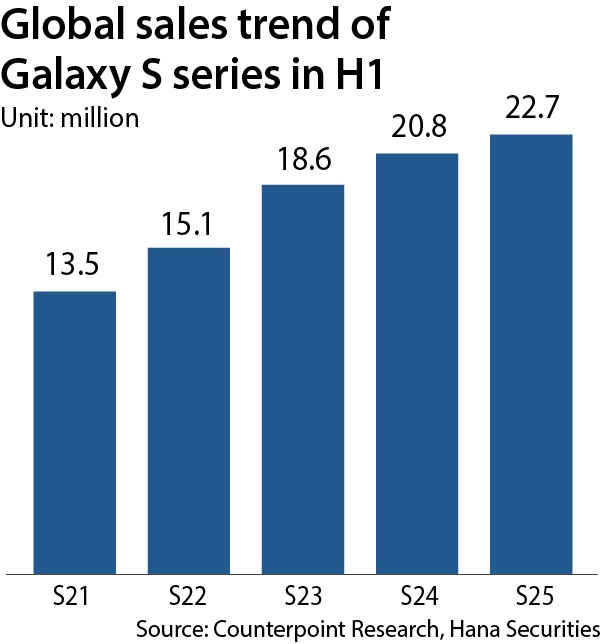
If Samsung can successfully use more of its own Exynos chips, the money paid out to Qualcomm can instead stay within the company, flowing between its chip design arm, System LSI, its foundry unit and its smartphone division. In simple terms, Samsung would be paying itself, not an outside supplier.
“Rising component costs — including memory prices — have weighed on margins at the smartphone and networks divisions, and the earnings gap between business units is expected to widen further throughout 2026,” observed Son In-jun, an analyst at Heungkuk Securities.
Even though the Exynos 2600 will be shipped globally, Snapdragon-powered models are still expected to account for a larger share of the Galaxy S26 lineup.
Heungkuk Securities forecasts the smartphone division’s operating profit margin to fall to 4 percent in 2026, down six percentage points from last year. Margins stood at 10 percent in 2025, supported by unusually strong sales of the Galaxy S25 series.
According to Counterpoint Research, global sales of the S25 reached 4.5 million units in October 2025 alone, which matched the peak sales seen during the first two months after immediate launch.
What drove the popularity remains unclear, but one noticeable factor is that the S25 lineup used Qualcomm’s latest Snapdragon chips across all models, yet Samsung kept prices in line with the previous S24 series.
![A rendered image of upcoming Galaxy S26 Ultra [EVAN BLASS]](https://koreaseafood.online/data/photo/2026/02/23/44a2a8f0-f512-4bdf-ab69-56bce5564a58.jpg)
A rendered image of upcoming Galaxy S26 Ultra [EVAN BLASS]
That strategy, however, may not be sustainable. As chip prices continue to rise, relying entirely on Qualcomm becomes more costly, which is why Exynos 2600 matters so much now.
If the S26 proves that Samsung’s in-house chip can match Snapdragon in performance, efficiency and heat management, it opens the door to greater independence and importantly, better margins.
In the long run, a successful Exynos comeback could even pave the way for future Galaxy phones powered entirely by Samsung-designed chips and manufactured by Samsung, while proving the company can stand toe-to-toe with Qualcomm in technology.
So what is so different about Exynos 2600 compared to the past or Qualcomm's competing chipset?
In one word, heat control.
One of the most noticeable upgrades is a new packaging design called the Heat Path Block (HPB). Think of as if its giving the chip a built-in cooling shortcut. In the past, overheating was one of the biggest complaints about Exynos processors.
When a smartphone chip works harder—running games, AI features or multiple apps at once — it consumes more power, and more power creates more heat. Too much heat, in the end, forces the phone to slow down, a process known as throttling, to prevent damage. That’s when users feel their phone getting hot and performance dipping.
To address this, Samsung’s System LSI division inserts a rectangular copper HPB inside the chip package, directly above the processor die. Copper transfers heat about three times more efficiently than silicon, the main material used in chips. In simple terms, it helps heat escape faster, keeping the processor cooler and more stable under heavy use.
The changes don’t stop there. According to Kiwoom Securities analyst Park Yu-ak, development of the next-generation Exynos 2700 is also progressing smoothly using an upgraded 2-nanometer process, leading to improved production yields and stronger benchmark performance amid growing pressure on Samsung’s smartphone division to reduce chip costs.
“The Exynos 2700 is expected to see a significant surge in adoption,” Park said. “It is slated to enter full-scale mass production in the second half of 2026 and account for around 50 percent of the Galaxy S27 lineup, compared with roughly 25 percent for Exynos chips in the Galaxy S26.”
Early benchmark results for the nascent Exynos 2700, however, are still well below Snapdragon 8 Elite Gen 5. Graphics processing scores for Exynos 2700 leaked on Geekbench show a score of 15,618, compared to Snapdragon's 23,479.
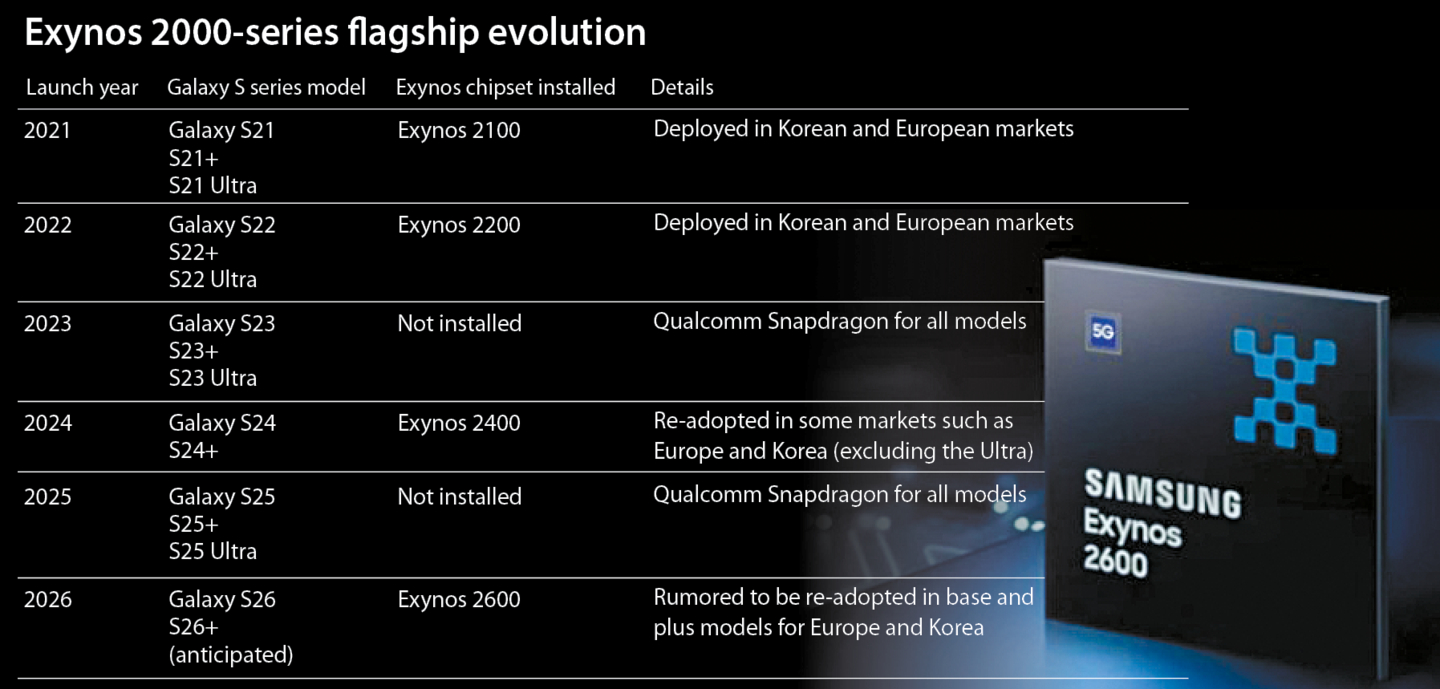
What are interesting rumored upgrades for the Galaxy S26 lineup?
As with previous generations, Samsung is expected to use Exynos and Snapdragon processors depending on region.
For base and plus models, one of the biggest shifts is memory. After boosting random-access memory (RAM) to 12GB in the Galaxy S25, that standard is anticipated to be kept across both base and plus models. This means smoother multitasking and better performance when running demand apps or AI features.
The S25 series is also rumored to feature faster LPDDR5X memory that operates roughly 10 to 20 percent quicker than its predecessor. This improvement is aimed at strengthening on-device AI.
For Ultra, memory configurations may vary. Lower storage versions may carry 12GB of RAM, while the 1-terabyte model could come with 16GB.
A price hike for the S26 this time seems inevitable, gathered from leaks from multiple reports. For the 256GB base model, the price tag is expected to rise about 99,000 won compared to S25, while the 512GB version could see a surge of 209,000 won. The 512GB Ultra model in particular is projected to be sold for nearly 2 million won in retail price.
By comparison, the Galaxy S25 base model was priced at 1.155 million won for the 256GB model and 1.298 million won for the 512GB version.
Preorders for the flagship lineup in Korea will run from Feb. 27 to March 5, with the official release scheduled for March 11.
BY LEE JAE-LIM [[email protected]]


with the Korea JoongAng Daily
To write comments, please log in to one of the accounts.
Standards Board Policy (0/250자)