

Foreign shoppers emerge as key growth engine for Korean department stores
Published: 23 Feb. 2026, 14:23
Updated: 23 Feb. 2026, 16:47
![People walk through The Hyundai Seoul in Yeouido, western Seoul. [THE HYUNDAI]](https://koreaseafood.online/data/photo/2026/02/23/430591b7-5d06-4a87-9954-98fe53106f8b.jpg)
People walk through The Hyundai Seoul in Yeouido, western Seoul. [THE HYUNDAI]
Foreign shoppers are emerging as a key growth engine for Korea’s department stores, helping major retailers counter sluggish domestic consumption.
The country's three major department store operators — Lotte Department Store, Shinsegae Department Store and Hyundai Department Store — have seen record-breaking sales from foreign customers. Industry sources expect each company's annual revenue from foreigners to surpass 1 trillion won ($692 million) this year.
As the popularity of K-culture fuels inbound tourism and travel patterns shift from group tours to independent trips, more visitors now shop on their own schedules and spend more freely.
Shinsegae Department Store’s annual sales to foreign customers reached the mid-600 billion won range in 2025 — an all-time high and 3.5 times the figure from 2023. This January alone, the company earned more than 90 billion won in sales from foreign customers.
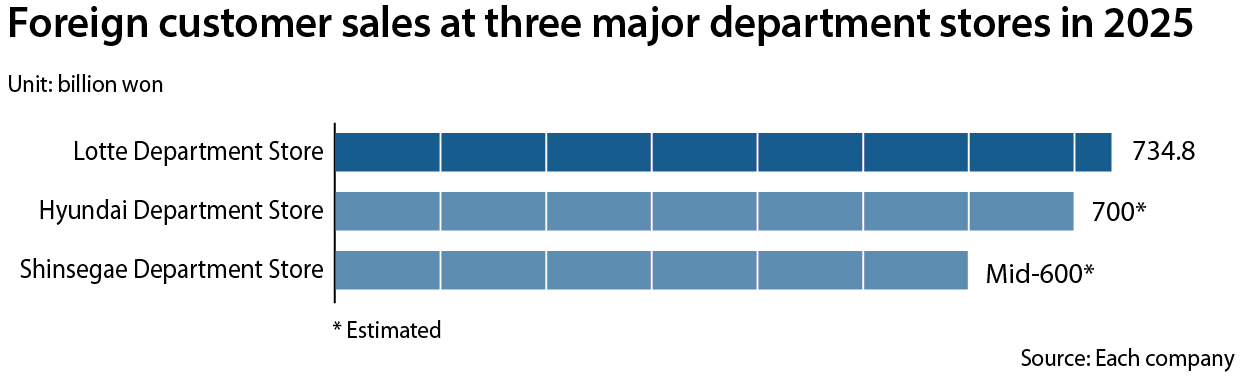
Lotte Department Store and Hyundai Department Store also set records last year, with sales to foreign customers reaching 734.8 billion won and 700 billion won, respectively. All three operators improved their results even though spending by Korean customers remained weak, as foreign shoppers made up the shortfall.
Lunar New Year sales surge
The Lunar New Year holiday period — from Feb. 15 to last Sunday in China — delivered particularly sharp gains.
Sales to foreign customers at Shinsegae’s main branch and its Gangnam District and Centum City branches rose 276 percent from Feb. 14 to Wednesday compared to last year’s Lunar New Year holiday period from Jan. 26 to 30. Sales to Chinese customers at the company’s main branch surged 416 percent.
![The Shinsegae Department Store's main branch is seen in central Seoul on Dec. 28, 2025. [YONHAP]](https://koreaseafood.online/data/photo/2026/02/23/136e2b0a-88d9-438a-8d3d-8f7acc643021.jpg)
The Shinsegae Department Store's main branch is seen in central Seoul on Dec. 28, 2025. [YONHAP]
The Hyundai Seoul in western Seoul reported a 210 percent on-year increase in sales to Chinese customers over the same period.
Lotte Department Store’s sales to foreign customers rose 120 percent from Feb. 13 to Wednesday compared to last year’s Lunar New Year holiday period from Jan. 24 to 29.
“[This year’s] sales to customers from China and Taiwan increased 260 percent and marked the strongest Lunar New Year performance on record,” a Lotte Department Store representative said.
Foreign shoppers take larger share
For the three department store operators, sales from international customers accounted for nearly 20 percent of total revenue last year — a stark contrast to three to four years ago, when foreign shoppers comprised only single-digit percentages of total revenue at Lotte Department Store, Shinsegae Department Store's main branches and The Hyundai Seoul.
![A sale notice for November 2025 appears on an information kiosk at Lotte Department Store’s main branch in Jung District, central Seoul. [YONHAP]](https://koreaseafood.online/data/photo/2026/02/23/394c2e82-7f13-4f36-acdb-869deafdb11a.jpg)
A sale notice for November 2025 appears on an information kiosk at Lotte Department Store’s main branch in Jung District, central Seoul. [YONHAP]
Additionally, many foreign customers spend more per transaction than their Korean counterparts.
At Lotte Department Store’s Busan branch, luxury goods sales to Chinese customers during this year’s Lunar New Year holiday jumped more than 300 percent from a year earlier. Shinsegae has also seen more foreign customers join its top S-VIP tier reserved for those who spend more than 30 million won annually at the operator’s stores.
Rebound in tourism and weaker won fuel growth
A general increase in foreign visitors to the country has added to this growth. Korea welcomed 18.94 million foreign visitors last year, the highest figure on record, and some projections suggest the total could exceed 20 million for the first time this year.
Young Chinese travelers have even coined the phrase “Seoul disease” to describe the lingering attachment they feel after visiting the city. Posts on Chinese social media often read, “Seoul disease has flared up again,” alongside videos of shopping trips to Korean department stores.
The weakening won is another driving factor.
![Exchange rates are posted at a currency exchange booth in Jung District, central Seoul, on Jan. 28. [NEWS1]](https://koreaseafood.online/data/photo/2026/02/23/5c2cf53d-6296-409f-8ede-3e1fee7e84bf.jpg)
Exchange rates are posted at a currency exchange booth in Jung District, central Seoul, on Jan. 28. [NEWS1]
“Tourists often find department store prices affordable after converting them to their home currencies, which has encouraged more visitors to buy luxury and high-end products at department stores rather than at duty-free shops,” an industry source said.
Department stores have also adjusted their strategies, expanding experiential pop-ups and food and beverage options while strengthening membership benefits for foreign shoppers.
“As foreign tourists increasingly drive sales, department stores will intensify competition through branch-specific marketing strategies to attract foreign customers,” said Lee Hong-joo, a professor in the department of consumer economics at Sookmyung Women’s University.
This article was originally written in Korean and translated by a bilingual reporter with the help of generative AI tools. It was then edited by a native English-speaking editor. All AI-assisted translations are reviewed and refined by our newsroom.
BY LIM SUN-YOUNG [[email protected]]


with the Korea JoongAng Daily
To write comments, please log in to one of the accounts.
Standards Board Policy (0/250자)