

Second with the name, first with so much else: Freestyle skier Lee Seung-hun carves out identity in Milan
Published: 21 Feb. 2026, 07:35
Updated: 21 Feb. 2026, 18:34
-
- CHO YONG-JUN
- [email protected]
![Lee Seung-hun in action during his second run in the Men's Freeski Halfpipe Qualification on Feb. 20 at the Milan-Cortina Olympic 2026. [REUTERS/YONHAP]](https://koreaseafood.online/data/photo/2026/02/21/8549a1f5-3404-4e3c-8084-61e6ffdc0853.jpg)
Lee Seung-hun in action during his second run in the Men's Freeski Halfpipe Qualification on Feb. 20 at the Milan-Cortina Olympic 2026. [REUTERS/YONHAP]
Freestyle skier Lee Seung-hun's rise was overshadowed by a simple case of mistaken identity. Sharing the same name as a multimedal-winning speed skater can do that to you in Korea.
But the 20-year-old finally managed to carve his own identity into the snow at the 2026 Milan-Cortina Winter Olympics.
Lee finished 12th in the men’s freeski halfpipe at the 2026 Milan-Cortina Winter Olympics on Friday, a best-ever finish for a Korean athlete in the sport. He was also the only Asian player to compete in the finals.
His final ranking, however, only tells half of the full story. Lee made history as the first Korean athlete to ever advance to an Olympic freeski halfpipe final earlier in the day, qualifying 10th with a flawless first run that earned him 76.00 points. Though he ultimately registered a DNS — did not start — for the evening final due to injuries sustained while warming up, his journey at the Olympics proved that Korea's winter sports future extends far beyond the ice rink.
![Lee Seung-hun reacts after competing in the freestyle skiing men's freeski halfpipe qualification run 1 during the Milan-Cortina 2026 Winter Olympic Games on February 20 [AFP/YONHAP].](https://koreaseafood.online/data/photo/2026/02/21/36f1bde6-e37c-4416-85a6-5896d9746e38.jpg)
Lee Seung-hun reacts after competing in the freestyle skiing men's freeski halfpipe qualification run 1 during the Milan-Cortina 2026 Winter Olympic Games on February 20 [AFP/YONHAP].
Skiing — and, in fact, most snow-related sports — have long taken a back seat to ice-based sports in Korea, with most of the country's medalists reaching podiums from the rink, not the slopes.
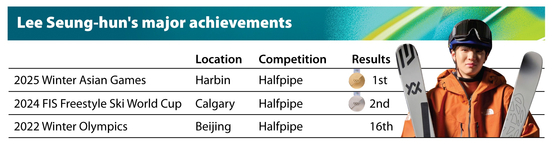
As if competing for attention against Olympic legends on blades wasn't enough, Lee also had to compete for his own name — until, that is, he brought home a historic gold medal from the 2025 Harbin Winter Asian Games.
![Freestyle skier Lee Seung-hun poses with his 2025 Harbin Asian Games Gold Medal in Incheon International Airport on Feb. 17, 2025. [NEWS1]](https://koreaseafood.online/data/photo/2026/02/21/585de635-b07e-4ff7-b019-53b0c689065a.jpg)
Freestyle skier Lee Seung-hun poses with his 2025 Harbin Asian Games Gold Medal in Incheon International Airport on Feb. 17, 2025. [NEWS1]
Lee didn't start out as a skier. He had only been on inline skates before giving skiing a go in the fifth grade. But his ascent was steep: Just two months after learning to ski, he was chosen by the Korea Ski and Snowboard Association to join the junior national team. By 2021, he had already secured a silver medal at the FIS Junior World Championships’ halfpipe, a first for a Korean skier.
His rapid climb in the sport was all the more impressive due to the simple nature of the discipline: The freeski halfpipe event involves skiers flinging themselves into the air off 22-foot-high walls on a U-shaped ramp, performing "dangerous air tricks," as Lee described the event.
That danger is what makes the sport appealing, according to Lee, who described the sport as "filled with thrills for both the athletes and the viewers, and a sport fun for the eyes" in an interview with Olympics.com.
A year after winning the silver at the FIS juniors, Lee made his Olympic debut in Beijing. The 2022 Games served as a reality check: The then-16-year-old finished 16th — an impressive feat for a Korean skier, but for Lee, just the start.
![Lee Seung-hun competes in a Halfpipe Freeski event in 2024 [SCREEN CAPTURE]](https://koreaseafood.online/data/photo/2026/02/21/7f119927-26db-4af7-bd0c-484c7e041074.jpg)
Lee Seung-hun competes in a Halfpipe Freeski event in 2024 [SCREEN CAPTURE]
That experience paid off as Lee went on to claim a series of "firsts" for Korean skiing: a bronze at the 2024 FIS World Cup in Calgary was the first World Cup podium finish for a Korean freeskier, and the gold at the Harbin Asian Games was the first Korean freestyle gold at the Asian Games.
“I was desperate for that medal,” he said. “And I saw the Asian Games as a place where I must win, which gave me a lot of pressure.”
All the firsts were the culmination of Lee's dedication. He spent over 200 days abroad each year for training, and even went as far as exclusively using his weaker left hand in everyday life, such as with spoons, to increase familiarity with the arm, which plays a critical role in balancing while executing tricks.
"I ended up breaking four to five skis each year during practice, and I even went to the extent of only using my left hand, so I can fly better on both sides."
Lee Seung-hun in action during his second run in the Men's Freeski Halfpipe Qualification on Feb. 20 at the Milan-Cortina Olympic 2026. [REUTERS/YONHAP]
Lee delivered four double corks during his first run at the qualifications on Friday, peaking with a double cork 1440. This clean run earned him a score of 76.00 points. Lee, however, fell as he attempted to unleash his secret weapon, the double cork 1800, which involves a five-rotation spin on a slant, during his second run.
The skier's first run was enough to secure 10th place and advance him to the 12-man final, despite the fall. Lee's historic run unfortunately ended during a practice session ahead of the finals, when he sustained an injury attempting the very same 1800-degree rotation, forcing him to withdraw after a DNS and officially ending his Olympics in 12th place.
“You can’t master a jump in a day,” he said in an interview with Maeil Business Newspaper. Lee had previously said the double cork 1620 took him three full years to master.
Double cork 1620 is a 4.5 rotation spin at a slant that brings the skier's legs over their head twice before hitting the powder.
“And while there are a lot of days where it doesn’t work out the way you want it to, I’ll endure those days and overcome the difficulties.”
![Lee Seung-hun in 2024 [SCREEN CAPTURE]](https://koreaseafood.online/data/photo/2026/02/21/a38f5ec0-8956-4a60-9d55-0b82d0dfe4eb.jpg)
Lee Seung-hun in 2024 [SCREEN CAPTURE]
BY CHO YONG-JUN [[email protected]]


with the Korea JoongAng Daily
To write comments, please log in to one of the accounts.
Standards Board Policy (0/250자)