

Special counsels call down fire and brimstone in insurrection cases, but courts refuse to make it rain
-
- MICHAEL LEE
- [email protected]
![Special counsel Cho Eun-suk announces the results of his team's investigation into former President Yoon Suk Yeol's short-lived imposition of martial law at a press conference at the Seoul High Prosecutors' Office in Seocho District, southern Seoul, on Dec. 15, 2025. [NEWS1]](https://koreaseafood.online/data/photo/2026/02/19/0f70f79e-9307-41f5-83ce-4d6053584fad.jpg)
Special counsel Cho Eun-suk announces the results of his team's investigation into former President Yoon Suk Yeol's short-lived imposition of martial law at a press conference at the Seoul High Prosecutors' Office in Seocho District, southern Seoul, on Dec. 15, 2025. [NEWS1]
[EXPLAINER]
When the National Assembly appointed a series of special counsels to investigate former President Yoon Suk Yeol and his associates over their suspected involvement in his short-lived declaration of martial law on Dec. 3, 2024, ruling Democratic Party (DP) lawmakers described the move as the first step toward an official reckoning with the Yoon administration.
The four special counsels appointed since June follow a long line of independent prosecutors empowered by the legislature to handle cases deemed too politically sensitive for the regular prosecution service. Granted authority to assemble their own teams, conduct raids and file indictments, such probes have been used in past high-profile scandals to bolster public confidence.
The charges filed by the special counsels — insurrection, abuse of authority, obstruction of official duties, stock manipulation, illegal political funding and bribery — have been portrayed by the DP as part of a broader pattern of malfeasance that culminated in an attempt to suspend Korean democracy.
But with the Seoul Central District Court set to deliver its first ruling in Yoon’s insurrection trial on Thursday, the special counsels face mounting criticism that they overestimated the strength of their cases against key suspects.
In trials involving Yoon and key figures in his inner circle — including former Prime Minister Han Duck-soo, former Interior Minister Lee Sang-min, former first lady Kim Keon Hee and former Defense Intelligence Command chief Noh Sang-won — special counsels have often sought prison terms exceeding ten years, only for courts to hand down shorter sentences or reject core charges outright.
The gap between the sentences requested by special counsels and the punishments actually handed down by judges has raised the question of whether the special counsels have prioritized the political optics of their mission over establishing the guilt of the accused.
![Former President Yoon Suk Yeol speaks at a hearing of his trial on insurrection charges at the Seoul Central District Court in Seocho District, southern Seoul, on Dec. 29, 2025. [YONHAP]](https://koreaseafood.online/data/photo/2026/02/19/f346e1e5-37a3-4488-92a7-df17ffe6f444.jpg)
Former President Yoon Suk Yeol speaks at a hearing of his trial on insurrection charges at the Seoul Central District Court in Seocho District, southern Seoul, on Dec. 29, 2025. [YONHAP]
Why is the death penalty even on the table for Yoon?
Nowhere has the tension between prosecutorial ambition and judicial reality been more visible than in special counsel Cho Eun-suk’s decision to seek the death penalty for Yoon in his insurrection trial, where the first verdict is due Thursday.
Cho’s office argued that Yoon’s martial law declaration constituted a serious attempt to undermine constitutional governance, even though it was rescinded within hours and did not result in bloodshed. He contended that Yoon should be subject to a particularly harsh punishment as a former prosecutor general who understood the constitutional limits on emergency powers but nevertheless ignored the legal requirements for declaring martial law.
To underscore the gravity of the case, Cho argued that Yoon’s punishment should at least match the death sentences handed down to former presidents Chun Doo Hwan and Roh Tae-woo for their 1980 coup.
Legal analysts, however, note that Korea has not carried out an execution since 1997 and that courts have historically reserved capital punishment for crimes involving premeditated murder or mass casualties. As such, Cho’s request for the death penalty is widely seen as more symbolic — reflecting how the special counsel team interprets the political weight of the case — than a likely sentencing outcome.
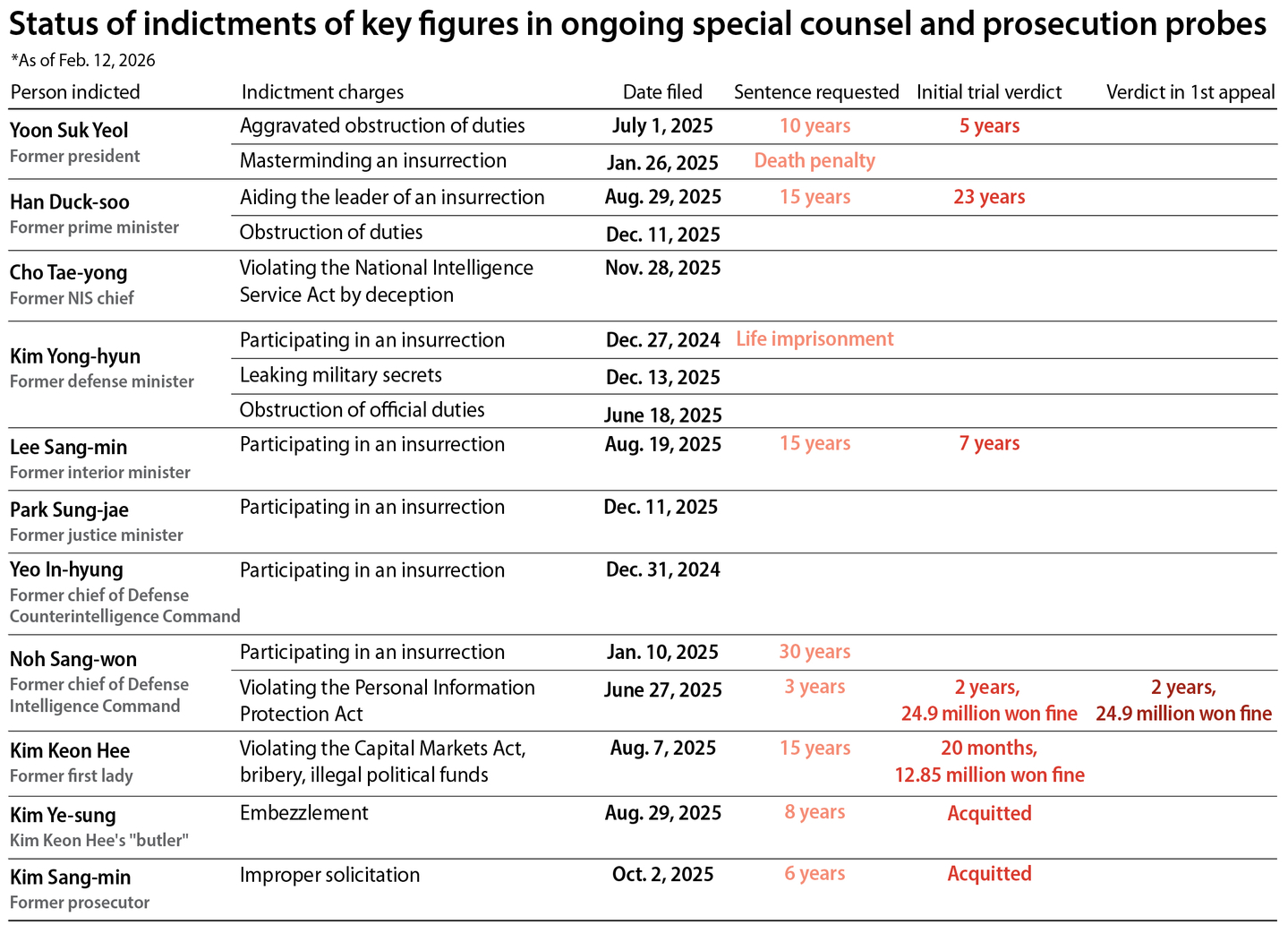
An earlier, separate case against Yoon, decided last month, illustrates how sharply sentencing can diverge from the prosecutor's request.
In that trial, Cho sought a combined 10-year prison term on charges that Yoon obstructed the duties of public officials and abused his authority in declaring martial law and handling its aftermath. Cho’s team made their sentencing request based on their calculation that Yoon should face five years in prison for blocking the Corruption Investigation Office for High-ranking Officials from taking him into custody and another five years for alleged document irregularities and interference with investigative procedures.
However, the Seoul Central District Court only handed Yoon a five-year sentence. It found him guilty on several abuse-of-power and obstruction counts but acquitted him on others, ruling that certain allegations by Cho’s office did not meet statutory thresholds or lacked sufficient proof of direct coercion. While the court described Yoon’s conduct as a serious breach of constitutional responsibility, it cited mitigating factors, including his lack of a prior criminal record.
The difference between the requested sentence and the actual punishment underscores how courts evaluate specific legal elements rather than the broader narrative prosecutors advance.
![Former Interior Minister Lee Sang-min arrives at the first hearing of his trial on charges of participating in an insurrection at the Seoul Central District Court in Seocho District, southern Seoul, on Oct. 17, 2025. [JOINT PRESS CORPS]](https://koreaseafood.online/data/photo/2026/02/19/a14aeb6e-b2ce-4581-ad96-804cb654421d.jpg)
Former Interior Minister Lee Sang-min arrives at the first hearing of his trial on charges of participating in an insurrection at the Seoul Central District Court in Seocho District, southern Seoul, on Oct. 17, 2025. [JOINT PRESS CORPS]
When does documentary evidence change the outcome?
The same tension emerged in the case of former Interior Minister Lee Sang-min, for whom prosecutors sought a 15-year sentence. They argued that Lee played a pivotal role in implementing Yoon’s decree by discussing enforcement measures with subordinates, such as cutting off water and electricity to certain liberal media outlets.
But the Seoul Central District Court rejected some of their arguments and sentenced Lee to just seven years in prison. It found him guilty of involvement in Yoon’s insurrection attempt and perjury by lying about his directives to lower-ranking officials. At the same time, it acquitted him on a key abuse-of-authority count, ruling that his alleged actions did not meet the statutory definition of the offense. As in Yoon’s case, the court narrowed the scope of liability and reduced the sentence accordingly.
A similar dynamic has played out in proceedings involving Noh Sang-won, the former Defense Intelligence Command chief accused of playing a behind-the-scenes role in preparations for martial law. Prosecutors portrayed Noh as a key figure who helped translate political intent into military planning. Courts, however, focused on what documentary evidence and testimony could concretely establish about his authority, intent and specific actions. In the first verdict of his trial and the subsequent appeal, Noh received a two-year sentence.
The exception to this pattern has been former Prime Minister Han Duck-soo, who was sentenced to 23 years in prison — exceeding the 15-year term requested by the special counsel — after being convicted of aiding and abetting an insurrection attempt, abusing his authority and falsifying official documents tied to the martial law declaration.
In its ruling, the court emphasized that Han’s role in reviewing, preparing and processing official documents lent institutional legitimacy to an unlawful act. Because his conduct was documented and directly tied to formal government procedures, the court treated it as especially grave.
![Former Prime Minister Han Duck-soo arrives at the Seoul Central District Court in Seocho District, southern Seoul, to attend the reading of the verdict in his trial on charges of aiding an insurrection on Jan. 21. [NEWS1]](https://koreaseafood.online/data/photo/2026/02/19/661f7cf1-cc22-4af2-b736-b7d10f8e9519.jpg)
Former Prime Minister Han Duck-soo arrives at the Seoul Central District Court in Seocho District, southern Seoul, to attend the reading of the verdict in his trial on charges of aiding an insurrection on Jan. 21. [NEWS1]
Why have so many quid pro quo allegations collapsed?
If the martial law-related cases highlight how courts weigh documentary evidence, the corruption cases show how expansive prosecutorial theories can unravel without clear proof of exchange.
That dynamic is evident in the case of former first lady Kim Keon Hee. Special counsel Min Joong-ki sought a 15-year prison sentence on charges that she violated the Capital Markets Act in connection with the Deutsche Motors stock manipulation case and violated laws against illegal political funding and bribery by accepting luxury goods after her husband’s election.
Min alleged that Kim knowingly participated in or benefited from coordinated trading designed to inflate share prices, citing the use of her accounts by individuals later convicted in the Deutsche Motors case.
![Former first lady Kim Keon Hee attends a hearing of her trial on charges of bribery and violating the Capital Markets Act at the Seoul Central District Court in Seocho District, southern Seoul, on Dec. 3, 2025. [NEWS1]](https://koreaseafood.online/data/photo/2026/02/19/6e89dbd7-e5d0-4016-bcbf-4304a6409a1a.jpg)
Former first lady Kim Keon Hee attends a hearing of her trial on charges of bribery and violating the Capital Markets Act at the Seoul Central District Court in Seocho District, southern Seoul, on Dec. 3, 2025. [NEWS1]
But the Seoul Central District Court acquitted Kim of the stock manipulation charges, concluding that Min’s team had not established beyond a reasonable doubt that she actively directed or knowingly participated in a price manipulation scheme. It also dismissed several counts of illegal political funding and bribery for lack of proof that she granted specific official favors in exchange for gifts.
Instead, Kim was convicted on narrower bribery-related charges involving two gifts — a Chanel handbag and a Graff diamond necklace — and sentenced to 20 months in prison, a fraction of the 15-year term sought by Min.
Two other rulings in cases brought by Min’s office that are related to the former first lady underscore how courts view the prosecution’s arguments about inferred intent.
On Feb. 11, the Seoul Central District Court acquitted Kim Ye-seong — often described in domestic media as Kim Keon Hee’s “butler” — of embezzling 2.43 billion won ($1.7 million) from the sale of 4.6 billion won in shares of IMS Mobility and handing the intercepted funds to Cho Young-tak, the company’s CEO. The court ruled that the payment to Cho, which Kim Ye-seong framed as a loan, did not show “intent to unlawfully appropriate” because the transaction generated 4.6 billion won in investment for Cho’s company.
![Kim Ye-seong, who is often described in media reports as former first lady Kim Keon Hee's "butler," arrives at the office of special counsel Min Joong-ki in Jongno District, central Seoul, on Aug. 12, 2025. [NEWS1]](https://koreaseafood.online/data/photo/2026/02/19/7ba1da6f-203f-488c-bdcb-ccff84392035.jpg)
Kim Ye-seong, who is often described in media reports as former first lady Kim Keon Hee's "butler," arrives at the office of special counsel Min Joong-ki in Jongno District, central Seoul, on Aug. 12, 2025. [NEWS1]
In a separate case, the court acquitted former senior prosecutor Kim Sang-min of violating the Improper Solicitation and Graft Act, finding that he had not provided an expensive painting to the first lady in exchange for a nomination favor. Judges said the evidence presented by Min’s office did not overcome Kim Sang-min’s claim that he merely acted as an intermediary by buying the painting from the artist Kim Jin-woo, who is Kim Keon Hee’s brother, and that prosecutors failed to prove beyond a reasonable doubt that an improper solicitation had taken place.
A similar pattern emerged in the trials of Myung Tae-kyun and former People Power Party lawmaker Kim Young-sun. Prosecutors sought five-year prison terms for both, alleging that Kim paid Myung to secure her nomination in a 2022 regional election and the 2024 general election, in violation of the Political Funds Act and bribery statutes.
However, the Changwon District Court acquitted both defendants on the central political funds and bribery counts. It ruled that their transactions did not meet statutory definitions of illegal political contributions and that prosecutors failed to demonstrate a clear agreement linking payments to specific acts.
Myung was convicted only of trying to conceal evidence for instructing an acquaintance to hide electronic devices he used to communicate with Kim and other conservative politicians and received a suspended six-month sentence. Kim, meanwhile, was acquitted on the principal allegations.
Legal analysts say the ruling underscores the difficulty of proving complex financial crimes without direct evidence of intent and quid pro quo. They say that the special counsel stacked multiple suspicions into a sweeping corruption narrative that proved difficult to sustain under the required standard of proof.
![Special counsel Min Joong-ki announces the results of his investigation into former first lady Kim Keon Hee in Jongno District, central Seoul, on Dec. 29, 2025. [KANG JUNG-HYUN]](https://koreaseafood.online/data/photo/2026/02/19/400b5635-799a-4195-9051-afc3c2157065.jpg)
Special counsel Min Joong-ki announces the results of his investigation into former first lady Kim Keon Hee in Jongno District, central Seoul, on Dec. 29, 2025. [KANG JUNG-HYUN]
So, what does this say about the special counsel model?
Taken together, the cases reveal a consistent pattern. Special counsels framed these prosecutions as responses to a constitutional crisis and sought penalties commensurate with that framing. Their sentencing demands signal deterrence and moral gravity.
Courts, however, applied a narrower legal standard. Judges examined each statutory element — intent, exchange, authority and causation — and imposed punishment based on what was proven beyond a reasonable doubt. Where documentary evidence and direct institutional action were clear, as in Han’s case, sentences were severe and even exceeded prosecutorial requests. But in cases where the prosecution’s arguments relied on implied intent or broad inferences, sentences were reduced or charges dismissed.
Critics argue that the special counsel system has encouraged prosecutorial maximalism and inflated public expectations that courts are unwilling or unable to meet. Supporters counter that prison terms for a former president, a former prime minister and a former first lady — along with ongoing appeals in the insurrection case — demonstrate that accountability, even if narrower than demanded, remains tangible.
As the country awaits the first ruling in Yoon’s insurrection trial, one conclusion is already clear: that even after a near-rupture of constitutional democracy, Korean prosecutors still face the burden of proving violations of specific criminal statutes to obtain the sentences they seek. In the courtroom, it is evidence, not narrative, that ultimately determines the scale of punishment.
The Korea JoongAng Daily will cover the sentencing live from 2 p.m.
BY MICHAEL LEE [[email protected]]


with the Korea JoongAng Daily
To write comments, please log in to one of the accounts.
Standards Board Policy (0/250자)