

'Team Kim' put Korean curling on the map. '5G' seeks to boost the signal in Cortina.
-
- YOON SEUNG-JIN
- [email protected]
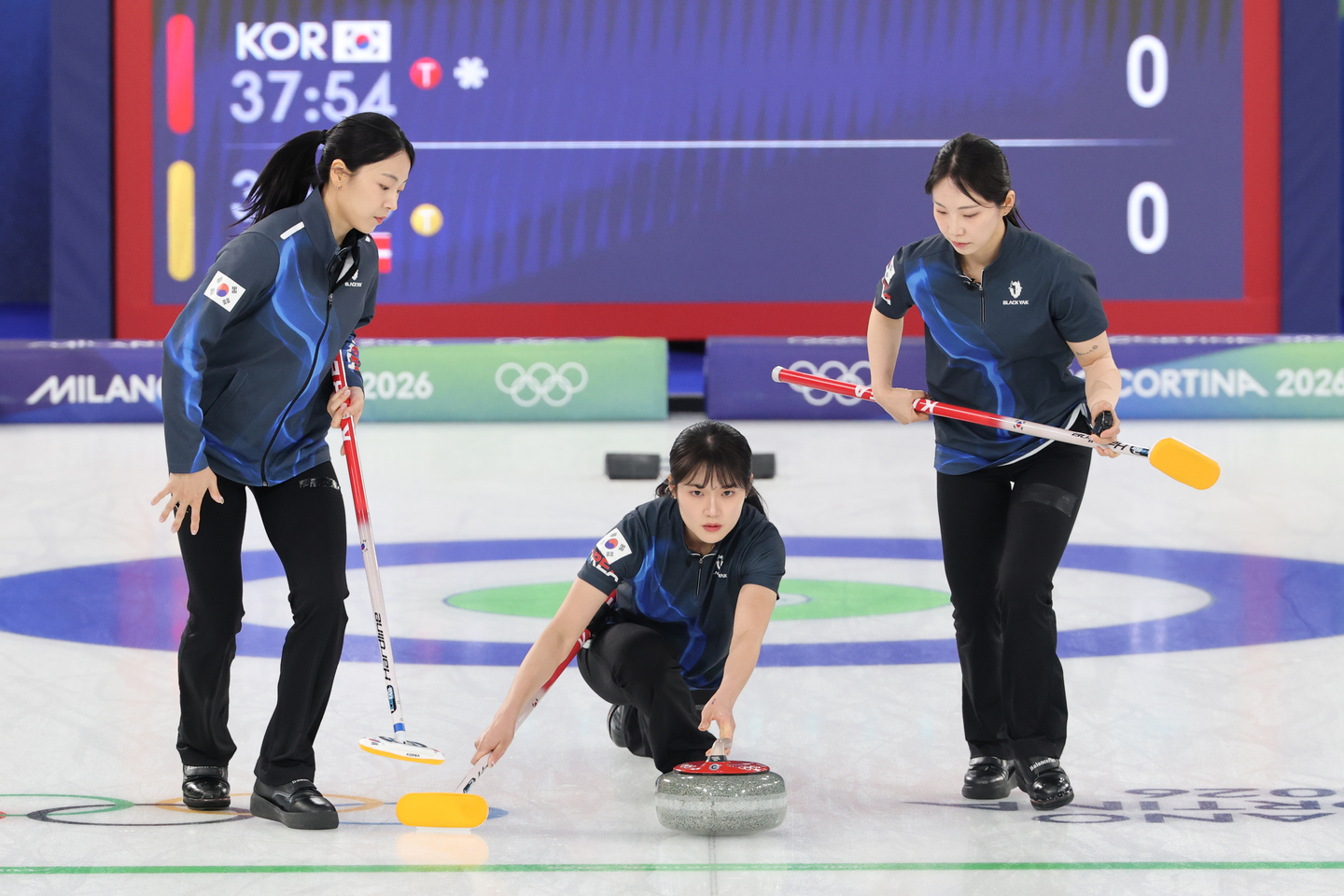
Seol Ye-eun delivers a stone during the women’s round-robin match between Korea and Denmark at the 2026 Milan?Cortina Winter Olympics at the Cortina Curling Olympic Stadium, on Feb. 14.
After seeing the breadth of coverage in Korea on the country's women's curling team, known as “5G,” at the Milan-Cortina 2026 Winter Olympics, where Gim Eun-ji, Kim Su-ji, Kim Min-ji, Seol Ye-eun and Seol Ye-ji are chasing glory, one could be forgiven for thinking that the country has a long legacy of success in the sport.
Such attention belies curling’s relatively short history in Korea. Such enthusiasm for the relatively obscure sport was inconceivable just a decade ago, when the country had little international presence.
Curling arrived in Korea in 1994 with the establishment of the Korean Curling Federation. Unlike the state-sponsored elite-athlete systems common in other Olympic disciplines, the sport remained closer to a neighborhood pastime, played by hobbyists rather than trained professionals, despite the presence of a federation. There were no dedicated facilities, let alone a professional league.
![From left: Kim Min-ji, Seol Ye-eun, Gim Eun-ji, Kim Su-ji and Seol Ye-ji pose with their gold medals during the women’s curling medal ceremony at the Harbin Winter Asian Games, held at Harbin Pingfang District Curling Arena in China, on Feb. 14, 2025. [YONHAP]](https://koreaseafood.online/data/photo/2026/02/18/835d5802-a117-41b4-beb8-4361238d5c84.jpg)
From left: Kim Min-ji, Seol Ye-eun, Gim Eun-ji, Kim Su-ji and Seol Ye-ji pose with their gold medals during the women’s curling medal ceremony at the Harbin Winter Asian Games, held at Harbin Pingfang District Curling Arena in China, on Feb. 14, 2025. [YONHAP]
That began to change in 2007, when the country’s first dedicated curling facility was built in Uiseong, North Gyeongsang Province. There, five teenagers — Kim Eun-jung, Kim Yeong-mi, Kim Seon-yeong, Kim Kyeong-ae and Kim Cho-hee — started taking interest in the unfamiliar sport. They first picked up curling as a casual after-school activity, with Kim Eun-jung and Kim Yeong-mi later recalling, “There wasn’t much else to do after class.”
What began as a neighborhood hobby soon grew into something unexpectedly serious, producing results that defied expectations.
As a high school amateur team, the Kims piled up strong results and quickly made their mark, sweeping junior-level competitions nationwide. After graduating, they continued their surge, eventually earning a spot at the Olympic trials for the 2014 Winter Games, where they competed against the nation’s top teams for a berth in Sochi.
![Team Kim waves to the crowd after defeating Denmark in the women’s curling round-robin match at the 2018 PyeongChang Winter Olympics at the Gangneung Curling Centre in Gangneung, Gangwon, on Feb. 21, 2018. [YONHAP]](https://koreaseafood.online/data/photo/2026/02/18/c9dcc6c0-ec85-4ba1-ad9a-848fe2762b18.jpg)
Team Kim waves to the crowd after defeating Denmark in the women’s curling round-robin match at the 2018 PyeongChang Winter Olympics at the Gangneung Curling Centre in Gangneung, Gangwon, on Feb. 21, 2018. [YONHAP]
The team narrowly lost out to the Gyeonggi Provincial Office’s team, and the defeat weighed heavily on the team’s skip, Kim Eun-jung.
“Many people around us trusted us, and the Sochi trials didn’t go well. I really wondered if curling was right for me,” she later recalled during an interview in PyeongChang four years later.
Still, their shared dream of competing on home ice eventually pulled the team back together, with Kim later recalling in an interview, “I can’t let my teammates’ dreams collapse because of me.”
The team captured the 2017 Asia-Pacific Curling Championships and silver at the Sapporo Asian Winter Games that same year, ready to rise on home ice in the 2018 PyeongChang Winter Olympics.
![Kim Eun-jung, center, delivers a stone during the round-robin match against the United States at the Beijing 2022 Winter Olympics. The game was held at the National Aquatics Centre in Beijing, China, on Feb. 14, 2022. [JOONGANG ILBO]](https://koreaseafood.online/data/photo/2026/02/18/63e13929-c287-448a-a58e-a12741e47a3a.jpg)
Kim Eun-jung, center, delivers a stone during the round-robin match against the United States at the Beijing 2022 Winter Olympics. The game was held at the National Aquatics Centre in Beijing, China, on Feb. 14, 2022. [JOONGANG ILBO]
In the round-robin stage of the 2018 Olympics, Korea finished at the top of the standings, highlighted by a 7-6 win over Sweden along with key victories over other elite opponents that secured a semifinal berth. In the semifinals, "Team Kim" faced Japan.
In a match that went into extra ends, Kim Eun-jung’s squad prevailed 8–7, avenging an earlier round-robin loss and punching their ticket to the final — the first time an Asian women’s team had reached an Olympic curling gold-medal game, where they ultimately took silver after falling 3–8 to Sweden.
That success sparked a nationwide curling frenzy in Korea.
Riding the wave of popularity from the PyeongChang Winter Olympics — where more than 70 percent of respondents in a Gallup Korea survey picked curling as the most impressive sport of the Games — Korea launched its first domestic circuit, the Korea Curling League, in the 2019–20 season.
![From left: Kim Kyeong-ae, Kim Yeong-mi, Kim Seon-yeong and Kim Eun-jung of the Korean women's national curling team, ″Team Kim,″ speak during a press conference at the Seoul Olympic Parktel in Songpa District, southern Seoul, on Nov. 15, 2018. The PyeongChang 2018 silver medalists brought to light allegations of long-term mistreatment and verbal abuse by their coaching staff through a formal statement. [YONHAP]](https://koreaseafood.online/data/photo/2026/02/18/22a6f2dc-5ced-4d5f-86f5-02f43825422d.jpg)
From left: Kim Kyeong-ae, Kim Yeong-mi, Kim Seon-yeong and Kim Eun-jung of the Korean women's national curling team, ″Team Kim,″ speak during a press conference at the Seoul Olympic Parktel in Songpa District, southern Seoul, on Nov. 15, 2018. The PyeongChang 2018 silver medalists brought to light allegations of long-term mistreatment and verbal abuse by their coaching staff through a formal statement. [YONHAP]
The post-Olympic fervor, however, was tainted by revelations of years of abuse and the embezzlement of prize money by their coaching staff, including officials from the North Gyeongsang Sports Council.
The controversy thrust the team into limbo, with training restrictions limiting its ability to practice.
After about two years, the team finally found a new home at Gangneung City Hall in Gangwon, where it could begin challenging for the next Olympics.
The team regrouped to represent Korea at the 2022 Beijing Winter Olympics, where they posted four wins and five losses, narrowly missing the semifinals and finishing their second Olympic campaign in fifth place.
Seeking a third consecutive Olympic appearance, Team Kim entered the national selection trials for the Games in Milan but were eliminated in the semi-final. With their exit, the torch was passed to “5G” of Gyeonggi, the new powerhouse of Korean curling. In the selection trial, 5G finished the preliminary round-robin in the first place with seven wins and one loss. After defeating the Jeonbuk Provincial Office 9–6, the team went on to beat Chuncheon City Hall to clinch a ticket to their first Olympic appearance.
The new quintet set off for Milan in a bid to prove that the sport was still alive and well in Korea.
After falling to the United States 8-4 in the opening match on Thursday, 5G rebounded with a 7-2 win over hosts Italy, then defeated Britain 9-3 on Friday before suffering a 6-3 loss to Denmark the following day.
After the loss to Denmark, Kim Min-ji told reporters, “It was a tough game and we gave it our all, but there were some disappointing moments today.”
“Still, we’re in the round-robin stage and everything is very tightly contested. We won’t miss our chances to the end, and we’ll prepare the way we always do to be ready for the next match.”
Sunday sets the stage for Korea to take on its fiercest sporting rival, Japan.
BY YOON SEUNG-JIN [[email protected]]


with the Korea JoongAng Daily
To write comments, please log in to one of the accounts.
Standards Board Policy (0/250자)