

Over nine in 10 Koreans view nation's political polarization as 'serious,' poll reveals
Published: 11 Feb. 2026, 18:18
Updated: 11 Feb. 2026, 19:29
![Lee Seok-yeon, chair of the Presidential Committee on National Cohesion, announces a survey result at Government Complex Seoul in central Seoul on Feb. 11. [YONHAP]](https://koreaseafood.online/data/photo/2026/02/11/116c5252-7136-4996-971c-fa169e8d1aef.jpg)
Lee Seok-yeon, chair of the Presidential Committee on National Cohesion, announces a survey result at Government Complex Seoul in central Seoul on Feb. 11. [YONHAP]
Over 90 percent of Koreans believe the nation suffers from “serious” political and ideological divisions, according to poll numbers released on Wednesday.
The Presidential Commission of National Cohesion, chaired by Lee Seok-yeon, commissioned Gallup Korea to conduct a poll on Korea’s ideological, economic, generational, gender and regional divisions.
Pollsters surveyed 7,000 adults nationwide between Nov. 28 and Dec. 24 of last year.
Koreans clearly believe ideological polarization is serious, the survey revealed, with six in 10 regarding the political divide as the nation’s most urgent problem that needs to be resolved . In particular, 90.6 percent of respondents recognized ideological polarization as a conflict, 81.3 percent had negative feelings about it, and 71.1 percent had personally experienced it — all of which were higher than for Korea’s other major social divisions.
Personally announcing the survey results in Seoul on Wednesday, commission chair Lee said, “Political conflict breeds public distrust, which leads to feelings of powerlessness and rage, and ultimately ends with people avoiding discussions.”
He added that the recent political conflict was characterized by “confirmation bias dividing people and spreading partisan thinking, making the conflict worse.”
However, Lee ruled out unity with political forces supporting former President Yoon Suk Yeol, who was ousted last year after a botched attempt to declare martial law in December 2024.
“We cannot move forward together with the insurrectionist forces and the forces that actively aligned with them,” he said.
Regarding People Power Party chief Jang Dong-hyeok’s remarks warning that repudiating Yoon would plant the “seeds of division,” Lee said he advised Jang to “announce his party was firmly separating itself from the insurrectionist forces” to rebuild the conservative movement. “Declare this to the people, even today,” he said.
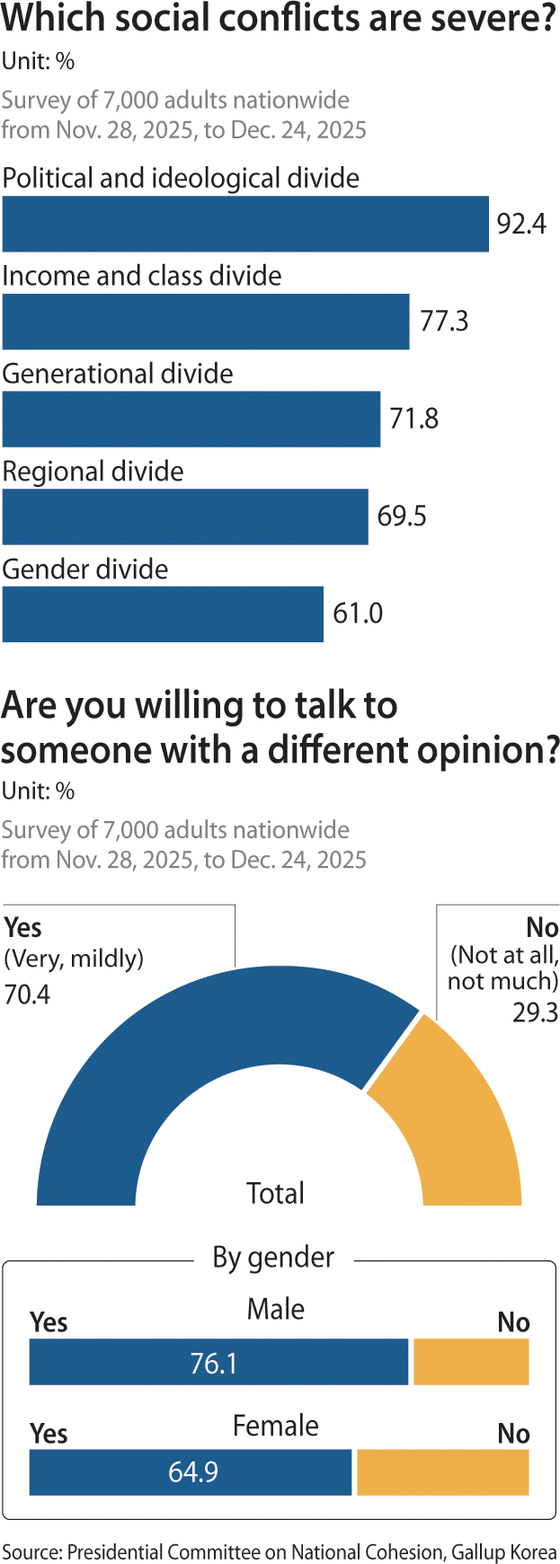
After political and ideological divisions, respondents identified income-based conflict as the next most serious at 77.3 percent, followed by generational conflict at 71.8 percent, regional conflict at 69.5 percent and gender conflict at 61 percent.
When asked which conflict should be resolved most urgently after political divisions, 17.6 percent cited income disparities, 9.2 percent cited gender conflict, 6.9 percent cited regional conflict, and 6.8 percent cited generational conflict.
The survey also highlighted notable age differences in perceptions of gender conflict.
Among respondents aged 18 to 29, 75.5 percent said gender conflict was most serious, a higher share than in other age groups.
Respondents in their 30s also reported the highest rate of negative personal experiences related to gender conflict at 32.7 percent.
![Protestors sit near an axe sculpture bearing the date of December 3 during a rally to mark the first anniversary of former President Yoon Suk Yeol's December 3, 2024 martial law declaration, in front of the National Assembly in Yeouido, western Seoul on Dec. 3, 2025. [REUTERS/YONHAP]](https://koreaseafood.online/data/photo/2026/02/11/9708431c-4e10-4a43-aa41-c8da54f85a3d.jpg)
Protestors sit near an axe sculpture bearing the date of December 3 during a rally to mark the first anniversary of former President Yoon Suk Yeol's December 3, 2024 martial law declaration, in front of the National Assembly in Yeouido, western Seoul on Dec. 3, 2025. [REUTERS/YONHAP]
When asked about emotions they feel when encountering social conflict, 26.6 percent cited anger, followed by disgust at 22 percent and sadness at 16.4 percent. Women reported anger most frequently and identified fear as the second-most-common emotion.
Despite the divisions, 70.4 percent of respondents said they are willing to speak with someone who holds different views. Men reported a higher willingness at 76.1 percent, compared to 64.9 percent among women. Younger respondents also showed greater openness to dialogue.
“Even amid serious conflict, our people have not given up on dialogue,” Lee said.
This article was originally written in Korean and translated by a bilingual reporter with the help of generative AI tools. It was then edited by a native English-speaking editor. All AI-assisted translations are reviewed and refined by our newsroom.
BY YOON SUNG-MIN [[email protected]]


with the Korea JoongAng Daily
To write comments, please log in to one of the accounts.
Standards Board Policy (0/250자)