

Korea sees poetry boom as younger readers rediscover the literary form
Published: 13 Jan. 2026, 07:00
Updated: 13 Jan. 2026, 11:14
-

- LEE JIAN
- [email protected]
Audio report: written by reporters, read by AI
![Actor Lee Chung-ah recommends a poetry collection in a YouTube video uploaded in November 2025. [SCREEN CAPTURE]](https://koreaseafood.online/data/photo/2026/01/13/4a9b4461-f250-4b85-9943-4f163f38ec53.jpg)
Actor Lee Chung-ah recommends a poetry collection in a YouTube video uploaded in November 2025. [SCREEN CAPTURE]
“If the look in one's eyes has to serve a purpose, then it’s to boldly express that person's true feelings.”
The line, a poetry verse translated from Korean, was posted as a caption on Instagram by girl group aespa member Karina in October 2025. The K-pop star has previously mentioned that one of her favorite gifts to give is poetry books.
A year earlier, actor Kim Yoo-jung shared a poetry collection in a behind-the-scenes “What’s In My Bag” video. “I just bought this one,” she said, showing the book to the camera. “I’m really curious to read it and see what the hype is about.”
Karina and Kim are part of a growing group of Gen Z Koreans who are rediscovering poetry.
![Girl group aespa member Karina uploads an Instagram post, with the caption quoting a poem, in October 2025. [SCREEN CAPTURE]](https://koreaseafood.online/data/photo/2026/01/13/315ccd35-d1a3-42fe-a7b6-11d742644fd1.jpg)
Girl group aespa member Karina uploads an Instagram post, with the caption quoting a poem, in October 2025. [SCREEN CAPTURE]
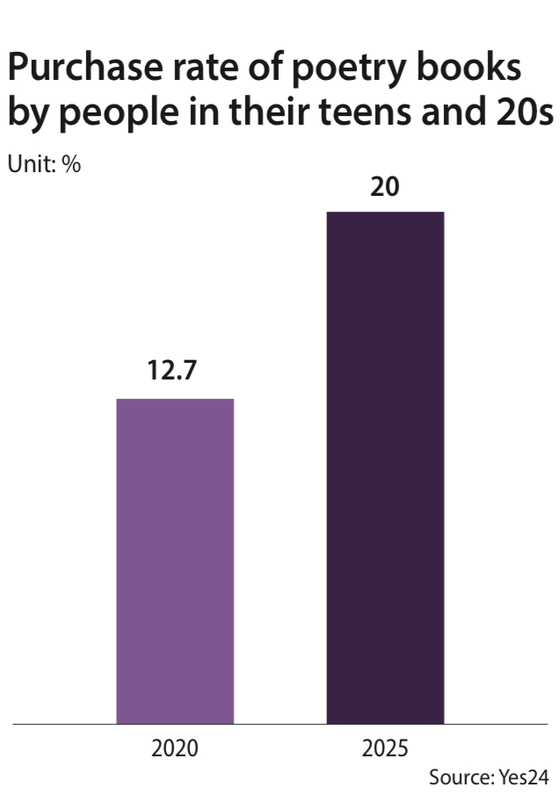
Poetry has traditionally sold best among older readers, particularly those in their 50s. But recently, a growing number of much younger readers have begun to explore the literary form. Data from local bookseller Yes24 shows that the share of poetry purchases from readers in their teens and 20s has steadily increased over the past six years, reaching nearly 20 percent in 2025 — almost double the level recorded in 2020.
A year-end report by digital reading platform Millie’s Library likewise highlighted poetry’s growing popularity among younger users, comparing poems to “snacks” — short, and so easy to consume quickly, but still emotionally rich.
Once dismissed by younger generations as cringey or overly sentimental, poetry is finding new life among Gen Z readers, who are drawn to its raw honesty, brevity and ability to be easily digitized. For many, poetry functions less as a traditional literary form and more as a medium for self-expression and connection — a shift that is reshaping bestseller lists, reading habits and the broader literary landscape.
f
Jeong Young-hwan, a university student who occasionally uploads screenshots of poems to social media, said poems feel refreshingly heartfelt and are accessible. “Some lines resonate with me deeply,” he said. “And I can easily post them online so that other people can read and relate to them too.”
There are over one million Instagram posts under the Korean hashtag “Instapoetry,” a portmanteau of “Instagram” and “poetry.”
![Instagram posts under the Korean hashtag "Instapoetry" [SCREEN CAPTURE]](https://koreaseafood.online/data/photo/2026/01/13/7dfde007-6d7a-43f2-8ea4-b6e5b75c17fd.jpg)
Instagram posts under the Korean hashtag "Instapoetry" [SCREEN CAPTURE]
Social media platforms and online self-publishing channels have also encouraged young readers not just to consume but to write poetry. Many Gen Z writers have turned to poetry as a way to articulate their thoughts on and experiences with their identity, emotions and daily life — sometimes to notable commercial success.
Poetry collections by young poets, once largely confined to bestseller lists for teens and young adults, are now appearing on overall rankings.
In 2025, three poetry collections by young writers entered the top 10 of Yes24’s third-quarter bestseller list, a sharp contrast to 2023, when established poets dominated the upper tier.
Twenty-eight-year-old writer Go Sun-kyung’s “A Tomato Firmer Than the Heart” (2025) and “Shower Gel and Soda Water” (2023) ranked third and fifth, respectively, and “Tomato Cup Ramen” (2024) by 19-year-old Cha Jung-eun placed ninth.
Yes24 said teenage readers accounted for 60.9 percent of sales for “Tomato Cup Ramen,” 51.9 percent for “Shower Gel and Soda Water” and 45.9 percent for “A Tomato Firmer Than the Heart,” underscoring the growing influence of younger readers on poetry sales.
Other young poets — including Baek Eun-byeol, the writer behind “As Long as I Remember” (2024); Yoo Sun-hye, behind “Please Try Reading Love and Extinction the Other Way Around” (2024); Yoo Soo-yeon, behind “Lovingly and Gently Fading Away” (2024); and Lee Jae-ya, behind “Outside of Sincerity” (2025) — also placed within the top 30 poetry bestsellers throughout last year.
![Former President Moon Jae-in recommends a poetry anthology written by teenagers in a YouTube video posted in November 2025. [SCREEN CAPTURE]](https://koreaseafood.online/data/photo/2026/01/13/758335b5-4753-4610-b597-de2e4beb048e.jpg)
Former President Moon Jae-in recommends a poetry anthology written by teenagers in a YouTube video posted in November 2025. [SCREEN CAPTURE]
The trend has not gone unnoticed by older generations. Former President Moon Jae-in launched a YouTube channel about books in November 2025, opening with a recommendation for “Now We Go Home” (2025), a poetry collection written by teenagers living in a youth recovery center — a court-mandated alternative to juvenile detention — in South Gyeongsang.
New poetry collections are also beginning to target young readers more directly. “There May Be Love in It as Well, and Qualities That Are Uniquely Human” (2025), for example, is the first Korean poetry collection published under the science fiction genre, reflecting the form’s expanding boundaries.
International recognitions
![″Autobiographie des Todes″ (2025) by Kim Hye-soon [SCREEN CAPTURE]](https://koreaseafood.online/data/photo/2026/01/13/7d80705c-e9ce-408c-a527-7ed08c6795f7.jpg)
″Autobiographie des Todes″ (2025) by Kim Hye-soon [SCREEN CAPTURE]
The wider demographic intrigue of poetry also stems from recent overseas recognition, which has sparked renewed curiosity about the form for Koreans of all ages, with overall poetry sales rising by 7 percentage points between 2024 and the end of 2025, according to Yes24.
At the forefront is poet Kim Hye-soon, who was honored in Germany for the German translation of her “Autobiography of Death” (2016). It won the International Literature prize from the Haus der Kulturen der Welt in July 2025. The award recognizes outstanding contemporary works translated into German and was shared with her translators, Uljana Wolf and Sool Park.
Kim’s “Phantom Pain Wings” (2019) was also awarded by the National Book Critics Circle, a nonprofit founded by book critics working in U.S. media and publishing. The same collection was nominated as one of five “Best Poetry of 2023” by The New York Times.
Poet Lee Soo-myung’s sixth poetry collection, “Just Like” (2014), won the Lucien Stryk Asian Translation Prize, administered by the American Literary Translators Association, in November 2025. Established in 2010 and named after the American poet and translator Lucien Stryk, the prize is awarded annually to an outstanding work of Asian poetry published in English.
Part of a bigger reading shift
![Actor Park Jeong-min, right, recommends a poetry book on a YouTube channel in December 2025. [SCREEN CAPTURE]](https://koreaseafood.online/data/photo/2026/01/13/e08216ba-c564-45d9-8d2f-84bf66cf207e.jpg)
Actor Park Jeong-min, right, recommends a poetry book on a YouTube channel in December 2025. [SCREEN CAPTURE]
The poetry boom is part of a broader cultural movement in Korea, often described as “text hip” or the growing perception that reading itself is fashionable again.
Millie’s Library’s December 2025 report noted that readers in their teens and 20s are driving a clear increase in the consumption of reading-related content. Their interests extend beyond poetry to classics as well: Publishing house Minumsa said in March 2025 that readers in their 20s made up the largest audience for its “World Literature Series” comprising 100 titles.
As reading becomes a form of self-discovery and personal taste, new buzzwords have emerged, including dokpamin, meaning reading-induced dopamine, and odokwan, short for “today's reading completed.” Practices such as transcribing favorite passages by hand, group exchange readings and consuming slim poetry collections as if they were snacks are also spreading rapidly among younger readers.
“Reading no longer stays confined to a single format,” a Millie’s Library spokesperson said. “Among younger generations in particular, trying new genres such as poetry and sharing or transcribing them digitally have made the reading experience itself far richer and more varied.”
BY LEE JIAN [[email protected]]


with the Korea JoongAng Daily
To write comments, please log in to one of the accounts.
Standards Board Policy (0/250자)