

Not-so-friendly neighbors: Koreans increasingly avoid hallway interactions
Published: 25 Dec. 2025, 17:00
![An apartment hallway is seen in Hwasun County, South Jeolla on July 3, 2023. [YONHAP]](https://koreaseafood.online/data/photo/2025/12/25/8335b6c4-2a6c-43be-9817-6baa0d8b20d6.jpg)
An apartment hallway is seen in Hwasun County, South Jeolla on July 3, 2023. [YONHAP]
Gone are the days of “Love thy neighbor.” These days, just knowing your neighbor seems out of the question. Increasingly, residents in Korea avoid even brief encounters with people living next to them, reflecting mounting worries about privacy, safety and personal boundaries.
A worker living in an apartment in Goyang, Gyeonggi, said they always "listen carefully before stepping out of their front door."
If they hear voices or footsteps in the hallway, they wait until the hall is clear. Although they have lived there for years, they only know that the couple across the hall appears to be young. They have never spoken.
“When I hear the elevator close, that’s when I open the door and step out,” they said. “I don’t even want to nod at anyone — it feels bothersome, and I’d rather avoid it. I don’t want others entering my life, and I have no desire to reveal anything about my routine.”
In an era where others are seen as a source of distress, the traditional concept of "friendly neighbors" has all but dissipated — it is no longer considered strange to not know who lives next door. Some even go out of their way to avoid eye contact or physical proximity in shared spaces like elevators and hallways.
![Apartments are seen from Mount Namsam in central Seoul on Aug. 8, 2024. [NEWS1]](https://koreaseafood.online/data/photo/2025/12/25/651fa071-291d-4ef8-9103-955f00611f8c.jpg)
Apartments are seen from Mount Namsam in central Seoul on Aug. 8, 2024. [NEWS1]
The consequences are beginning to show. A recent post on an online community drew widespread attention when a resident shared a note from their neighbor.
It read: “If you hear my door open or any signs of movement, please wait a moment before coming out. I believe this is a basic unspoken rule we should respect.”
The note sparked debate. Some criticized it as excessive, asking, “Why not just say hello?”
Others argued that people who are this sensitive should not live in apartment buildings. But some expressed empathy, noting that "some people feel genuine discomfort or even fear when encountering their neighbors."
Even attempts to uphold old-fashioned norms can lead to rejection.
“I once greeted a neighbor in the elevator and got no response,” said a worker surnamed Shim, who moved into a new apartment in Seoul two years ago. “It was so awkward that I don’t say anything anymore.”
![A sales notice is posted on an apartment building in Seoul on April 2. [YONHAP]](https://koreaseafood.online/data/photo/2025/12/25/fde594e5-fb75-43f9-87b9-bc23bcf15c82.jpg)
A sales notice is posted on an apartment building in Seoul on April 2. [YONHAP]
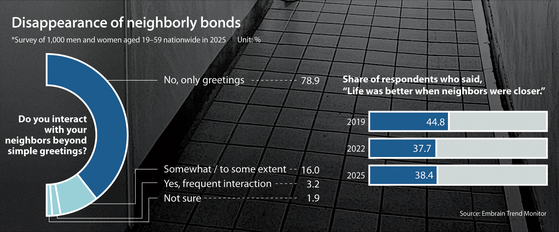
A nationwide survey conducted by Embrain Trend Monitor offers data to back the sentiment. Of 1,000 adults aged 19 to 59, 78.9 percent said they do not interact with neighbors beyond basic greetings. More than half, or 55.9 percent, agreed that the idea of neighbors as close companions no longer applies in Korean society.
Respondents cited reasons such as having little opportunity to run into neighbors, at 48.3 percent, and feeling no particular discomfort despite a lack of interaction, at 46.2 percent, for not making an effort to engage.
For many, particularly women and those living alone, avoidance is rooted in safety concerns.
“If someone exits the elevator and walks in the same direction as me, I get startled,” said a woman surnamed Ji who lives alone in an apartment in Yongin, Gyeonggi.
She said that after hearing about violent crimes in residential buildings, she actively began avoiding encounters with neighbors.
![Apartments are seen from Mount Namsan in central Seoul on Nov. 28. [YONHAP]](https://koreaseafood.online/data/photo/2025/12/25/7b8ec6d2-ed05-472f-9e0d-e1b00a08c220.jpg)
Apartments are seen from Mount Namsan in central Seoul on Nov. 28. [YONHAP]
That fear is far from rare.
“As a woman living alone, I can’t help but worry about becoming a target," said a worker surnamed Jung who lives in Mapo District, western Seoul. "It’s scary to think someone might find out where I live and that I live alone.”
As relationships with family, friends and neighbors grow more distant, feelings of social isolation are on the rise.
“Living anonymously in a city can offer a sense of freedom, but in a society like Korea’s — where extended families are vanishing, and people live in densely packed housing — the loss of neighborly ties can deepen feelings of loneliness and isolation,” said Paik Jong-woo, a professor of psychiatry at Kyung Hee University Hospital. “Our society may seem functional most of the time, but when personal crises strike, the lack of human connection can increase risks to mental health, including suicide.
"Governments and local authorities should take a more active role, as seen in countries like Britain, where isolated individuals are encouraged to build social connections and are offered incentives to take part in community activities."
If you or someone you know is feeling emotionally distressed or struggling with thoughts of suicide, LifeLine Korea can be contacted at 1588-9191 or the Crisis Counseling Center at 1577-0199. The Seoul Global Center offers English-language counseling, contact 02-2075-4180 (+1) to arrange a session. Other international helplines can be found at www.befrienders.org.
This article was originally written in Korean and translated by a bilingual reporter with the help of generative AI tools. It was then edited by a native English-speaking editor. All AI-assisted translations are reviewed and refined by our newsroom.
BY SHIN SUNG-SIK, RHEE ESTHER, JUNG JONG-HOON, CHAE HYE-SEON AND NAM SOO-HYOUN [[email protected]]


with the Korea JoongAng Daily
To write comments, please log in to one of the accounts.
Standards Board Policy (0/250자)