

LG fell victim to a presidential push out of chips. Now it's back with Jim Keller on AI.
Published: 16 Sep. 2025, 07:00
Audio report: written by reporters, read by AI
![LG Group Chairman Koo Kwang-mo, right, poses with Tenstorrent CEO Jim Keller in Silicon Valley in June, last year. [LG ELECTRONICS]](https://koreaseafood.online/data/photo/2025/09/16/b7ce0f48-1486-4aa8-ab67-3744b6734030.jpg)
LG Group Chairman Koo Kwang-mo, right, poses with Tenstorrent CEO Jim Keller in Silicon Valley in June, last year. [LG ELECTRONICS]
[CHIP REPORT ④]
Korea's semiconductor industry is undergoing a dramatic shake-up fueled by the explosive rise of generative AI. Market leaders are losing ground while once-overlooked underdogs are gaining momentum. This Chip Report series unpacks the forces driving this shift and explores how the industry's new hierarchy is likely to take shape in the years ahead.
LG, now best known for its home appliances, was once a major player in memory semiconductors until the late 1990s, but had long stepped away from the business.
In 2024, however, Korea’s tech industry took notice of an unexpected photo — one that hinted at the electronics giant’s quiet return to the chip segment.
LG Group Chairman Koo Kwang-mo was seen smiling beside Jim Keller, CEO of AI chip startup Tenstorrent, in Silicon Valley. Keller is considered a towering figure in semiconductor design, having developed AMD’s Zen CPU architecture, Apple’s A4 and A5 mobile processors and Tesla’s AI chips for autonomous vehicles. His new company is seen as a potential challenger to Nvidia’s dominance in AI chips.
The image of Koo and Keller sent a clear message: LG is back in the chip game.
The photo drew particular attention because Koo, an unassuming leader who rarely appears in public-facing initiatives, had personally visited Keller. “It’s more than just a technical exchange,” said one industry source. “It motivates developers internally and signals externally that LG is placing real emphasis on system semiconductors.”
For some inside the company, the moment may have rekindled a long-held sense of regret. LG once ranked among the world’s top five semiconductor manufacturers — until it was forced to relinquish its chip business during a major government-led restructuring effort.
The cost of stepping away
![Then-President-elect Kim Dae-jung, center, meets with the leaders of Korea’s four major conglomerates on Jan. 13, 1998. From left: then-LG Chairman Koo Bon-moo, then-United Liberal Democrats Chairman Park Tae-joon, then-Hyundai Motor Chairman Chung Mong-koo, Kim Dae-jung, then-Samsung Chairman Lee Kun-hee and then-SK Chairman Chey Jong-hyun. [JOONGANG ILBO]](https://koreaseafood.online/data/photo/2025/09/16/76a407b7-126a-42fc-bd16-447b53cf8053.jpg)
Then-President-elect Kim Dae-jung, center, meets with the leaders of Korea’s four major conglomerates on Jan. 13, 1998. From left: then-LG Chairman Koo Bon-moo, then-United Liberal Democrats Chairman Park Tae-joon, then-Hyundai Motor Chairman Chung Mong-koo, Kim Dae-jung, then-Samsung Chairman Lee Kun-hee and then-SK Chairman Chey Jong-hyun. [JOONGANG ILBO]
On the afternoon of Jan. 6, 1999, then-LG Chairman Koo Bon-moo visited the Blue House. The meeting was essentially a one-on-one with former President Kim Dae-jung, attended only by the president's economic adviser.
Koo cautiously expressed a desire to retain LG Semicon, but President Kim remained silent. After a long pause, Koo understood there would be no room for reconsideration and conceded to the sale of the chip business.
The former president then responded for the first time. “You’ve made a difficult decision. If there’s anything the government can do to help, we will support you.” The meeting ended in 30 minutes.
What followed became known as the “big deal” — a government-directed exchange of business units among conglomerates to reduce overlapping investments. At the time, Korea’s DRAM market was led by Samsung Electronics, followed by Hyundai Electronics and LG Semicon, which held 8.4 percent of the domestic market and was ranked fifth globally.
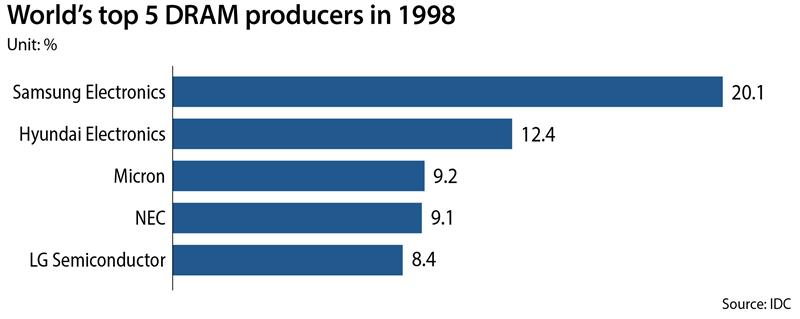
But after the 1997 Asian financial crisis, the newly elected Kim Dae-jung administration pushed for consolidation, leaving Samsung untouched while ordering Hyundai and LG to merge their chip operations. LG’s semiconductor journey, which began in 1979 with the acquisition of Daehan Semiconductor and the creation of Goldstar Semiconductor, came to an abrupt end.
Returning home that evening, Koo Bon-moo reportedly said, “I gave up everything. Hyundai will take it all.” He never attended another Federation of Korean Industries event for 14 years, in protest of the organization’s role in coordinating the restructuring process.
Rediscovering chips in LG's backyard
Fast-forward to July 2023, LG Electronics quietly unveiled an in-house AI chip for appliances: the DQ-C. The chip, three years in the making, powers features such as voice-activated control via deep learning.
While LG is not officially in the semiconductor business, internally it has been designing chips for years — primarily through its System-on-Chip (SoC) Center, which employs some 600 engineers. For years, the center operated discreetly, but its role became more visible as AI became integral to consumer electronics.
![LG’s in-house AI chip for appliances, unveiled in 2023. [LG ELECTRONICS]](https://koreaseafood.online/data/photo/2025/09/16/45e3e667-71f7-4ecb-b20a-fdc101d6f82e.jpg)
LG’s in-house AI chip for appliances, unveiled in 2023. [LG ELECTRONICS]
On a recent visit to the center’s fifth-floor lab in southern Seoul’s Yangjae-dong, engineers were testing a wireless solution for TVs, powered by a self-designed chip. “We started AI research back in 2015, even before the AlphaGo craze,” said SoC Center chief Kim Jin-gyeong. “Now that AI chips are essential for appliances, we’re finally hitting our stride.”
The turning point came with a visual recognition algorithm designed to estimate calories in photos of food. “When we ran it on a phone, it overheated and underperformed,” Kim recalled. “So we thought — why not make a chip optimized for these kinds of tasks?”
![LG Electronics’ SoC Center chief Kim Jin-gyeong speaks during an interview at the center in Yangjae-dong, southern Seoul, on June 23. [LG ELECTRONICS]](https://koreaseafood.online/data/photo/2025/09/16/1b2b83e7-7870-4716-bfa5-750e7f72fc1d.jpg)
LG Electronics’ SoC Center chief Kim Jin-gyeong speaks during an interview at the center in Yangjae-dong, southern Seoul, on June 23. [LG ELECTRONICS]
That idea led to a new generation of chips for voice and video recognition, picture quality optimization and now increasingly for washers, refrigerators and air conditioners. “Using chips tailored to our products helps us realize the technologies we want — and also improves margins,” Kim said. “It reduces costs and boosts performance.”
Still, he warned, the window is narrow. “We’re still two to three years ahead of China, but it's catching up fast.”
LG is also targeting automotive semiconductors, a core growth area under its vehicle component division. Sources say the junior Koo’s meeting with Keller was part of an effort to integrate Tenstorrent’s AI chip design into LG’s vehicle semiconductor road map.
Hanwha and Doosan join the race
LG is not the only conglomerate revisiting semiconductors.
“Large groups are looking at semiconductors not just for growth potential but for their strategic importance,” said Kim Chang-wook, a partner at Boston Consulting Group (BCG). “This sector is unrivaled in its influence — both economically and symbolically.”
Hanwha Group’s machinery affiliate renamed itself Hanwha Semitech earlier this year, signaling a clear commitment to semiconductors. In March, the company won a 42 billion won ($30.2 million) contract to supply thermal compression bonders — key equipment for high bandwidth memory — to SK hynix. Until recently, the market was dominated by Hanmi Semiconductor.
Hanwha began developing its bonder in 2020 and succeeded in securing its first client within five years.
The chip push is also tied to the group’s generational transition. While Hanwha Chairman Kim Seung-yeon's oldest son, Kim Dong-kwan, leads defense and energy, and second son Dong-won oversees finance, while third son Dong-sun recently joined Hanwha Semitech as head of future vision, expanding his influence into semiconductors and robotics in addition to serving as vice president of Hanwha Galleria.
“The name change was a declaration — we’re aiming to become a comprehensive semiconductor equipment company,” said Kim Wan-sik, head of planning at Hanwha Semitech. “It reflects the vice president's vision.”
Hanwha also backed its ambition with action: it offered SK hynix a performance guarantee worth up to 100 billion won in case of delivery failure — a bold move showcasing confidence in its technology.
The Hanwha chairman underscored the commitment in a visit to the group’s research and development center in Pangyo, Gyeonggi, last year. “Semiconductors are a national strategic industry,” he said. “They drive innovation and global competitiveness."
Doosan is also gaining traction. Its electronics unit, which produces materials for chips and telecom equipment, began supplying copper-clad laminates to Nvidia last year, pushing annual revenue past 1 trillion won for the first time.
Some question whether these late entrants are too far behind.
“Semiconductors evolve rapidly — it’s not a field you can enter from zero,” said Kim of BCG. “But if you’ve acquired foundational capabilities through mergers and acquisitions, timing becomes less of an issue.”
Doosan, long associated with heavy industry, is pivoting to precision tech.
Since Chairman Park Jeong-won took the helm in 2016, the company has moved quickly. In 2022, it acquired semiconductor testing firm Tesna for 460 billion won. That June, Park visited its factory in Anseong, Gyeonggi and pledged to invest 1 trillion won over five years to become a top-five global player in chip testing.
This article was originally written in Korean and translated by a bilingual reporter with the help of generative AI tools. It was then edited by a native English-speaking editor. All AI-assisted translations are reviewed and refined by our newsroom.
BY SHIM SEO-HYUN, LEE GA-RAM, PARK HAE-LEE, YI WOO-LIM [[email protected]]


with the Korea JoongAng Daily
To write comments, please log in to one of the accounts.
Standards Board Policy (0/250자)