

Union resistance in Korea, U.S. threatens to sink 'MASGA'
Published: 03 Sep. 2025, 16:50
Updated: 03 Sep. 2025, 18:11
-

- LEE JAE-LIM
- [email protected]
Audio report: written by reporters, read by AI
![Union members of HD Hyundai Heavy Industries stage a rally at the company's Ulsan shipyard on Aug. 29. [KOREAN METAL WORKERS' UNION]](https://koreaseafood.online/data/photo/2025/09/03/e481e615-cbcc-4e9c-99c8-e9c0218e776e.jpg)
Union members of HD Hyundai Heavy Industries stage a rally at the company's Ulsan shipyard on Aug. 29. [KOREAN METAL WORKERS' UNION]
[NEWS ANALYSIS]
Korea’s $150 billion initiative to help revive the U.S. shipbuilding industry has elevated the sector to a key area of bilateral cooperation, but growing backlash from labor unions in both countries poses a tangible challenge.
Compounding the matter is the recent passage of the pro-labor “Yellow Envelope Bill” in Korea, which curtails excessive corporate damage claims against unions and workers during strikes.
Despite U.S. President Donald Trump explicitly highlighting shipbuilding cooperation at the outset of the bilateral summit, investor sentiment moved in the opposite direction. On Aug. 26, shares of Hanwha Ocean, HD Korea Shipbuilding & Offshore Engineering, HD Hyundai Heavy Industries (HD HHI) and Hanwha Engine fell between 2 and 6 percent, while robotics stocks surged.
Analysts attributed the divergence to concerns over labor unrest following the passage of the Yellow Envelope Bill. A J.P. Morgan report released the same day singled out the automotive and shipbuilding sectors as particularly vulnerable, with labor negotiations in shipbuilding potentially dragging on starting next year. Experts note that the amendment expands the scope of collective action beyond wages and working conditions to include management decisions such as restructuring and layoffs as well as mergers and acquisitions (M&A).
Although the revised Trade Union and Labor Relations Adjustment Act will not formally take effect until March 2026, nor have details yet been ironed out, unions are already mobilizing. Workers at HD Hyundai affiliates are staging a four-day walkout from Tuesday, demanding wage increases and protesting job insecurity they fear may arise from the planned merger of HD Hyundai Heavy Industries and HD Hyundai Mipo in December. Management argues that the merger will consolidate resources and strengthen global competitiveness, citing the bilateral shipbuilding initiative — dubbed Make American Shipbuilding Great Again, or MASGA — as a key driver.
![A “ Make American Shipbuilding Great Again ” hat, referring to a Korea-U.S. shipbuilding cooperation program, is seen at a ship-naming ceremony held at Hanwha Philly Shipyard in Philadelphia on Aug. 26. [JOINT PRESS CORPS]](https://koreaseafood.online/data/photo/2025/09/03/d5d33e24-6aeb-47da-83fb-be71240e91c8.jpg)
A “ Make American Shipbuilding Great Again ” hat, referring to a Korea-U.S. shipbuilding cooperation program, is seen at a ship-naming ceremony held at Hanwha Philly Shipyard in Philadelphia on Aug. 26. [JOINT PRESS CORPS]
In the United States, maritime unions are pushing back against proposed legislation that would carve out exceptions to the protectionist Jones Act, which currently bars foreign shipyards — like those in Korea — from working on U.S.-flagged vessels.
Domestic friction over MASGA
The unions of HD HHI and HD Hyundai Mipo have criticized the companies for prioritizing a merger plan over improving labor conditions.
“This is nothing less than a declaration of war, refusing to recognize the union and choosing to run the company as they please,” the two unions said in a joint statement. “A new opportunity for HD Hyundai Heavy Industries and HD Hyundai Mipo should not come from a merged entity, but from building a workplace where labor is respected together with the union.”
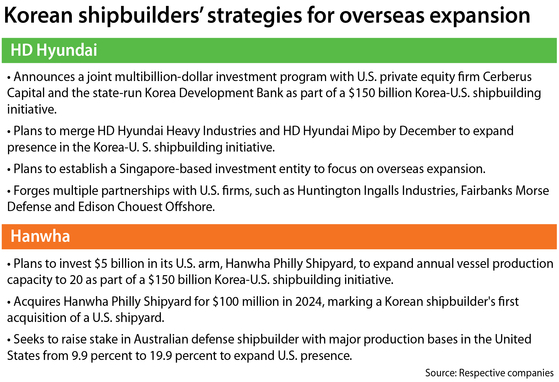
The unions vowed to demand a full disclosure of merger details and warned that unresolved concerns about job security would trigger further pushback. A report by investment firm Lightwood Partners underscored risks to the capital market, particularly with M&A activity, noting that unions may intervene directly in merger processes with the pending labor law revision.
“In such cases, M&A deals may effectively be canceled, or companies may be forced to provide significant compensation to labor unions,” the report said. Shutdown costs could escalate quickly, especially in industries like shipbuilding and automobiles, where labor unions have historically wielded considerable power. Experts caution that such disruptions could ripple through industrial supply chains, given shipbuilding’s deep reliance on subcontractors and suppliers.
“The industry has only just begun to recover thanks to growing demand for environmentally friendly and autonomous vessels, combined with MASGA opportunities and naval maintenance contracts,” said Prof. Kim Myung-hyun of Pusan National University’s naval architecture & ocean engineering department. “It is worrisome that an unintended consequence of the Yellow Envelope Bill could be that shipbuilding, the very industry now regaining its footing, ends up suffering the most.”
![The State of Maine vessel is berthed next to a crane at Hanwha Philly Shipyard in Philadelphia on Aug. 26 during its naming ceremony. [YONHAP]](https://koreaseafood.online/data/photo/2025/09/03/97843b29-af88-4313-a649-ddaa1f8ed949.jpg)
The State of Maine vessel is berthed next to a crane at Hanwha Philly Shipyard in Philadelphia on Aug. 26 during its naming ceremony. [YONHAP]
U.S. union resistance
Challenges to MASGA are not confined to Korea. In the United States, the century-old protectionist Jones Act — which requires that vessels operating in U.S. coastal trade be built domestically — remains a central obstacle. Although efforts to amend the law have gained renewed attention under the Trump administration, progress has stalled.
Further complicating matters, two organized labor organizations in the United States, the Metal Trades Department (MTD) and the Marine Engineers’ Beneficial Association (MEBA), have mounted strong opposition to the Merchant Marine Allies Partnership Act, a bill introduced by Rep. Ed Case, Democrat of Hawaii, and James Moylan, a Republican representing the territory of Guam in the House. The proposal would allow U.S.-flagged vessels built in allied countries such as Korea to participate in coastwise U.S. trade under a limited Jones Act exemption. It would also exempt U.S. companies from the current 50 percent import duty, provided major repairs or modifications are carried out in allied shipyards.
U.S. unions have denounced the measure as a direct threat to U.S. shipyard jobs.
“The Jones Act is more than an economic policy — it’s a national security lifeline,” the MTD said in a statement. “In times of crisis, we depend on a robust domestic fleet and the skilled men and women who crew and maintain it. Allowing foreign-built vessels to dominate our coastwise trade is a short-term cost-cutting measure with long-term consequences we can’t afford.”
Together with MEBA, the union has launched a public campaign to block the bill. U.S. labor resistance is particularly strong because the proposed law explicitly seeks to open the door for foreign shipyards to become a central part of the domestic shipbuilding framework of the United States — an idea that has until now been sidelined or only hinted at in other bills. For unions that view the Jones Act as both an economic safeguard and a national security pillar, the stakes are nothing less than the future of U.S. shipyard jobs and industrial sovereignty.
BY LEE JAE-LIM [[email protected]]


with the Korea JoongAng Daily
To write comments, please log in to one of the accounts.
Standards Board Policy (0/250자)