

Young people drop from work force amid growing dissatisfaction with office life
Published: 02 Sep. 2025, 15:14
Audio report: written by reporters, read by AI
![A jobseeker takes part in a counselling session at a job center in Seoul on Nov. 6, 2024. [YONHAP]](https://koreaseafood.online/data/photo/2025/09/02/35b0ff52-a3fb-4e14-9061-e225fc3e039f.jpg)
A jobseeker takes part in a counselling session at a job center in Seoul on Nov. 6, 2024. [YONHAP]
“The stress is beyond what people can handle. There are so many jobs that are far worse than expected.”
These were among the responses in a survey conducted by the Ministry of Employment and Labor on 200 young people who had job experience but are now categorized as neither working nor looking for work.
According to the ministry on Monday, the number of these so-called “resting youth” has reached a record high of between 400,000 and 500,000 each month this year. Statistics Korea data show that 73.6 percent of them previously had work experience, meaning frustration at the workplace often leads directly to dropping out of the labor force.
Why did they leave?
Among those aged 30 to 34, dissatisfaction with pay and compensation was the most cited reason for quitting jobs, at 33.7 percent. Next came lack of work-life balance at 28.4 percent and mismatch with job duties at 24.2 percent. For those aged 19 to 29, the top factor was job mismatch at 31.4 percent, followed by poor pay at 24.8 percent and then issues with work-life balance and organizational culture, both at 17.1 percent.
"Even with some work experience, young people who did not undergo adequate self-reflection before entering the work force are more likely to fall into this category of 'resting youth with work experience,'" read the report, stressing the need for career redirection programs beyond job matching, recruitment assistance or unemployment benefits.
![Jobseekers are seen near a job center in Seoul on Nov. 6, 2024. [YONHAP]](https://koreaseafood.online/data/photo/2025/09/02/45242b7e-0d9e-463c-ae07-cc59b711c01c.jpg)
Jobseekers are seen near a job center in Seoul on Nov. 6, 2024. [YONHAP]
The report also said that the reasons for leaving are not as simple as “I don’t want to work overtime.” Instead, workplaces often imposed unnecessary late hours unrelated to performance or failed to provide proper pay for extra effort.
Open-ended answers in the survey reflected this sentiment: “I need work that allows me to grow,” “I want to build a career,” “I was only given repetitive tasks,” “I need opportunities to develop my career.”
On overtime, respondents said, “It would be fine if at least overtime were predictable,” “I don’t see the point of going to the office,” “If overtime pay had been given, there would have been no issue.”
Why don’t they come back?
The report found that low wage increase in small and medium-sized companies — excluding large conglomerates — weakens motivation to work.
The income gap widened after the Covid-19 pandemic, fueling feelings of deprivation. As of February, the average monthly wage at large companies was 5.93 million won, compared to 2.98 million won at smaller firms, nearly double the amount.
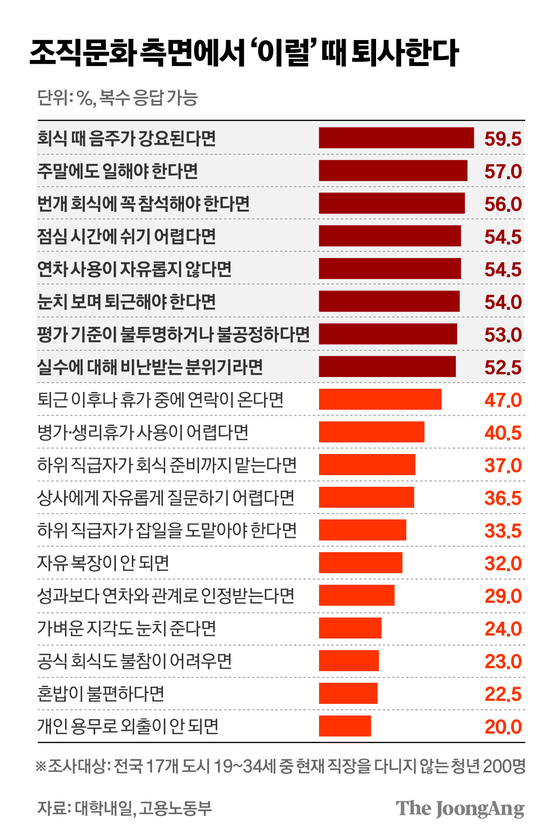
Resting youth graphic table
Some said they survive through ultra-short-term jobs instead of full-time work. “I look at Albamon or Karrot and do daily jobs at logistics centers,” one said.
The report also pointed out that many youths feel it is “already too late” to change careers. Anxiety peaks at age 30, when switching jobs usually requires building on previous career experience.
“Changing jobs usually means using your past career, but I want to strike it all and start over. But there’s no chance to do that," said a respondent.
![Resting youth graphic [YONHAP]](https://koreaseafood.online/data/photo/2025/09/02/19534a8f-c6ff-4076-b1c6-630f27692b71.jpg)
Resting youth graphic [YONHAP]
The conditions young people requested were not excessive: an average desired annual salary of 28.23 million won, a commute time of under 63 minutes, and approximately 3.14 extra workdays per month.
Cultural differences were more striking. When asked about reasons for quitting, many cited forced drinking at company dinners — referred to as hoesik in Korean — as the primary reason, followed by weekend work, mandatory attendance at last-minute dinners or hoesik, no break during lunch, restrictions on vacation days, and pressure to stay late.
Respondents also shared that many jobs were “still beyond common sense,” citing cases of offices without proper heating, unisex restrooms with foul odors and no hot water.
“The definition of a ‘normal workplace’ differs greatly between older generations and millennials or Gen Z,” the report said. “Closing that gap is key to solving the issue of young people leaving work.”
“Ultimately, workplaces need to meet basic standards so that young people stop leaving or giving up on work," said the labor ministry. "In particular, we will improve working conditions at small and medium-sized firms, where most start their first jobs, and provide better information on workplaces and job duties.”
This article was originally written in Korean and translated by a bilingual reporter with the help of generative AI tools. It was then edited by a native English-speaking editor. All AI-assisted translations are reviewed and refined by our newsroom.
BY KIM YEON-JOO [[email protected]]


with the Korea JoongAng Daily
To write comments, please log in to one of the accounts.
Standards Board Policy (0/250자)