

Well runs dry for Yeosu small businesses as petrochemical fortunes fade
Published: 01 Sep. 2025, 19:45
Updated: 01 Sep. 2025, 20:30
Audio report: written by reporters, read by AI
![A “For Lease” sign hangs in the window of a commercial space in the Museon in Yeosu, South Jeolla, on Aug. 21. [HWANG HEE-GYU]](https://koreaseafood.online/data/photo/2025/09/01/a5ab7652-edf8-4dd1-9232-f95367323d07.jpg)
A “For Lease” sign hangs in the window of a commercial space in the Museon in Yeosu, South Jeolla, on Aug. 21. [HWANG HEE-GYU]
YEOSU — On Thursday night, the commercial district of Museon in Yeosu, South Jeolla, long known as a commuter town for workers at the Yeosu National Industrial Complex and a center of nightlife, was eerily silent. Of the roughly 100 storefronts that once lined the main road, just six or seven had their lights on.
Many of the shuttered restaurants and bars had stickers reading “For Lease” or “For Sale” posted on their doors.
In the heart of the district, the once-bustling cluster of noraebang (singing rooms) told a similar story. Despite flashy neon signs illuminating the fronts of more than 20 noraebang and soju bars, there were few — if any — customers.
“Compared to two years ago, when the Yeosu complex was booming, my revenue has dropped to less than a quarter,” said a noraebang owner surnamed Kim. “I open every day in the hope that someone might walk in, but I'm virtually out of business.”
The fallout from a prolonged downturn in the petrochemical industry is now spilling over into the surrounding economy, with once-thriving areas like Museon on the brink of collapse. The area, which flourished for decades by serving plant construction workers and subcontractors from the complex, is now being called a "ghost town."
![The central commercial district of Museon in Yeosu, South Jeolla, appears deserted on Aug. 21. [HWANG HEE-GYU]](https://koreaseafood.online/data/photo/2025/09/01/20456a78-b0ef-48a4-8da4-607f12b77f4f.jpg)
The central commercial district of Museon in Yeosu, South Jeolla, appears deserted on Aug. 21. [HWANG HEE-GYU]
Museon is home to roughly 770 businesses, including restaurants, bars and noraebang. Dozens of one-room apartments and 20 motels nearby had been used as temporary lodging by workers. Apartment complexes on the outskirts, home to more than 3,300 households, are also largely occupied by industrial complex employees — but the entire local economy is now in a deep slump.
“When the plants shut down, both people and money left. All that remains are dark storefronts and empty ‘monthly rental rooms,’” said a realtor operating in the district, surnamed Kim.
“Many business owners who bought motels and one-room studio apartments during the boom just two or three years ago with heavy loans are now buried in debts of 300 to 400 million won [$215,200 to $287,000].”
The sharpest blow to the Museon area has been the steady shutdown of factories in the industrial complex. LG Chem and Lotte Chemical halted operations at some of their facilities last year.
The industrial slowdown has impacted other areas of Yeosu as well, including the Hak-dong and Heungguk commercial districts. According to Yeosu, 730 of the city’s 8,368 restaurants closed in 2023, followed by 687 closures in 2024 and 428 more in the first eight months of this year alone.
“Restaurant and bar owners are telling us this is worse than the Covid-19 period,” said an official from the Yeosu city office. “And these numbers don’t include those who shut down without formally reporting it — the actual figure is likely much higher.”
The crisis has hit subcontractors and plant workers at the petrochemical industrial complex particularly hard. According to the Yeosu Chamber of Commerce and Industry, the total value of plant construction orders in the petrochemical industry — which make up the majority of subcontractor revenue — plummeted from 2.01 trillion won in 2023 to 1.12 trillion won in 2024, a 44.4 percent drop.
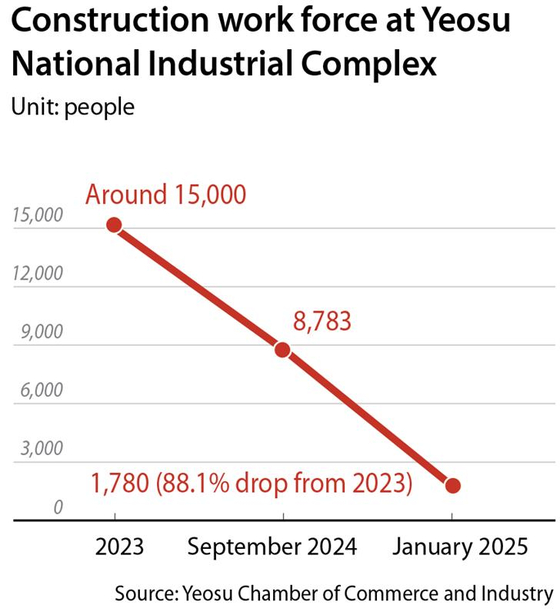
As orders dried up, workers faced mass layoffs. As of January this year, only 1,780 people were employed in Yeosu’s plant construction sector — down 79.7 percent from 8,783 in September 2024. Compared to the 15,000 workers employed at the peak in 2023, the sector has shrunk by a staggering 88.1 percent.
The collapse has devastated the local lodging industry, especially the so-called dalbang — one-room units rented on a month-to-month basis by industrial workers. Dalbang used to have monthslong waitlists. Now, most sit empty.
![A “For Lease” sign hangs in the window of a commercial space in the Museon in Yeosu, South Jeolla, on Aug. 21. [HWANG HEE-GYU]](https://koreaseafood.online/data/photo/2025/09/01/9b930b74-489f-4716-bdde-cdc6c62ad785.jpg)
A “For Lease” sign hangs in the window of a commercial space in the Museon in Yeosu, South Jeolla, on Aug. 21. [HWANG HEE-GYU]
The damage to Yeosu’s local economy is also evident in soaring vacancy rates. According to the Korea Real Estate Board, the official vacancy rate for small commercial properties — defined as under two stories or less than 330 square meters (3,552 square feet) in total area — in downtown Yeosu hit 35.1 percent in the second quarter of 2025. That’s nearly triple the rate from a year earlier, when it stood at 12 percent.
From the first quarter of 2022 through the fourth quarter of 2023, Yeosu’s overall commercial vacancy rate had hovered in the 6 percent range. At its peak in 2022, some areas like Hak-dong and Yeomun even reported near-zero vacancy — but now, closures and temporary shutdowns are widespread.
“The plant construction workers who once energized Yeosu’s economy have lost their jobs, and the local commercial districts are crumbling,” Han Moon-seon, chairman of the Yeosu Chamber of Commerce and Industry, said. “The central government urgently needs to step in — with targeted support for the petrochemical industry, utility subsidies for industrial firms and extraordinary measures to revive the regional economy.”
This article was originally written in Korean and translated by a bilingual reporter with the help of generative AI tools. It was then edited by a native English-speaking editor. All AI-assisted translations are reviewed and refined by our newsroom.
BY CHOI KYEONG-HO, HWANG HEE-GYU [[email protected]]


with the Korea JoongAng Daily
To write comments, please log in to one of the accounts.
Standards Board Policy (0/250자)