

Korea’s A2Z isn’t chasing Tesla. It’s cruising in its own autonomous lane.
-

- SARAH CHEA
- [email protected]
![Han Ji-hyeong, founder and CEO of Autonomous A2Z, poses for a photo with a mockup of his autonomous bus after an interview with the Korea JoongAng Daily at the company’s headquarters in Anyang, Gyeonggi, on Aug. 20. [PARK SANG-MOON]](https://koreaseafood.online/data/photo/2025/09/01/98d40508-a366-4e67-bea9-e9f0a39b5ca8.jpg)
Han Ji-hyeong, founder and CEO of Autonomous A2Z, poses for a photo with a mockup of his autonomous bus after an interview with the Korea JoongAng Daily at the company’s headquarters in Anyang, Gyeonggi, on Aug. 20. [PARK SANG-MOON]
[GAME CHANGER]
Autonomous driving as a future growth engine isn’t breaking news. But caught between the speed of China and the scale of the United States, survival in the race hinges on swiftly identifying and owning scalable niches.
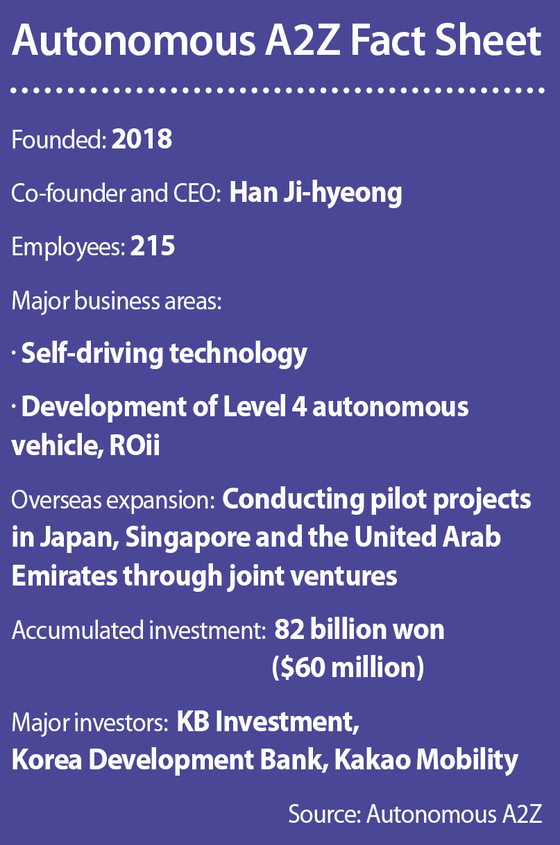
Han Ji-hyeong, founder and CEO of Autonomous A2Z, the largest self-driving startup in Korea by funding — roughly 82 billion won ($60 million) — zeroed in on the shuttle as a game-changing niche, with a formal launch of a Level 4 autonomous vehicle slated for early next year. It has already expanded global business, including in Singapore, Japan and the United Arab Emirates.
"We need to identify which developments hold the highest potential for commercialization and are the most practical; at Level 4 autonomous driving, shuttle services are the fastest and most realistic route," Han said.
"Although A2Z is a startup, we also develop hardware, which means vehicles in this case. Simply creating technology and selling it doesn’t allow us to fully realize our technological potential."
A2Z
Han, who spent over a decade at Hyundai Motor as an engineer, left the company with three colleagues to establish A2Z in 2018. In 2024, the company was ranked 11th in a global evaluation of autonomous driving technologies by market research firm Guidehouse Insights — the only Korean company on the list. Among top-tier names like Waymo and Baidu from China, Israel's Mobileye and Nvidia, A2Z also stood out as the only company in the rankings valued under 1 trillion won ($720 million). Hyundai-backed Motional ranked 15th, while Tesla came in at 20th.
The Korea JoongAng Daily sat down with Han to discuss the company’s development journey and future road map at the company’s headquarters in Anyang, Gyeonggi, on Aug. 20.
The following are edited excerpts from the interview.
![ROii, a Level 4 self-driving shuttle developed by Autonomous A2Z [AUTONOMOUS A2Z]](https://koreaseafood.online/data/photo/2025/09/01/c6609caf-f8c9-4444-92da-1d205490a9ac.jpg)
ROii, a Level 4 self-driving shuttle developed by Autonomous A2Z [AUTONOMOUS A2Z]
Q. A2Z is often touted as Korea’s leading autonomous tech company. What sets your technology apart?
A. The key differentiator is whether your technology is truly ready for commercialization. From the very beginning, we made a clear and bold decision that the most realistic future for autonomous driving isn’t in passenger cars but in shuttle buses that run fixed routes. And we’ve committed fully to that path. Vehicles like shuttles, patrol cars, delivery vans and street sweepers don’t need to move fast, but should prioritize consistency and safety. This market may be small, but it's practical, and it’s a space where we can mass-produce solutions with real completeness within five years.
Looking back at my time on Hyundai’s self-driving team, Hyundai tried everything, from passenger cars to commercial vehicles, without a clear strategy. We ended up missing the right timing, and eventually, the team was disbanded. Hyundai initially announced that it would apply Level 3 technologies on models like the Genesis G90 and Kia EV9, but it's been delayed indefinitely.
Tesla recently unveiled a video of its first fully autonomous delivery of a consumer vehicle. But that's just a promotional video — which cannot be commercialized in reality, at least any time soon, though they own the technologies.
The reality is that commercially available autonomous driving is still stuck at Level 2. Once you hit Level 3, liability shifts to the automaker in the event of an accident. That’s why true Level 3 adoption in passenger cars may not happen anytime soon — if ever.
A2Z also developed its own vehicle, ROii, while most startups focus solely on software. What led you to make that move?
At the end of the day, software can only perform at its best when it’s paired with the right hardware. No matter how advanced your tech is, if the hardware it runs on isn’t optimized for it, the performance will always be limited. It’s like putting Tiger Woods’ brain into my body — it doesn’t mean I’ll suddenly play like him. His strength, muscles, limbs — that entire physical system is what enables his skills to shine. In the same way, autonomous driving requires integration between software and hardware to truly be in sync.
There’s also a strategic reason. If you’re just a software company, your business model ends up depending on selling that tech to carmakers. But big manufacturers like Hyundai will never just install third-party software in their cars. Why? Because if an accident occurs, liability becomes a legal minefield. No automaker wants to take that risk.
That’s why the founding vision of all four co-founders, from Day One, was to build the entire vehicle ourselves. That’s what “Autonomous A2Z" means — handling everything from A to Z in autonomous driving. Full-stack control is the only way to deliver a system that’s truly safe, efficient and scalable.
![Han Ji-hyeong, founder and CEO of Autonomous A2Z, speaks about his future business plan during an interview with the Korea JoongAng Daily at the company’s headquarters in Anyang, Gyeonggi, on Aug. 20. [PARK SANG-MOON]](https://koreaseafood.online/data/photo/2025/09/01/583bd15f-4f05-46f6-ab02-de558b95ce7b.jpg)
Han Ji-hyeong, founder and CEO of Autonomous A2Z, speaks about his future business plan during an interview with the Korea JoongAng Daily at the company’s headquarters in Anyang, Gyeonggi, on Aug. 20. [PARK SANG-MOON]
What is your projected timeline for commercial deployment?
We're aiming to obtain certification for Level 4 self-driving from the Korean government early next year. If successful, it would be the world’s first officially approved Level 4 autonomous vehicle. Currently, only Japan, Germany and Korea have regulatory frameworks for this level of autonomy. Countries like the United States follow a framework that allows anything not explicitly banned, so there’s no formal approval process.
Right now, we’re conducting pilot operations on 55 autonomous vehicles, and we’ve logged Korea’s most cumulative mileage of over 680,000 kilometers (422,532 miles). Until now, we’ve been retrofitting existing buses with our tech, but starting this month, we’ll be deploying ROii, which will be running around the Cheonggyecheon area with a temporary license plate.
Who do you see as ROii's primary clients?
ROii is designed specifically for logistics and transportation operators such as shuttle services, delivery fleets and public transit systems. The demand is already there. Taxi companies often pay up to 100 million won per license, but can’t find enough drivers to operate. In rural areas, bus routes are being discontinued simply due to a lack of drivers. That’s where we see the strongest early demand from regional governments and corporate operators. Some 95 percent of parts used in ROii are locally sourced components. Even the battery; we chose Samsung SDI over cheaper Chinese alternatives.
Currently, each ROii costs between 600 and 700 million won, which is still more affordable than many foreign-made autonomous buses that run close to 1 billion won. Our goal is to mass-produce 100 units next year, 50 for the domestic market and 50 for export.
![ROii, a Level 4 self-driving shuttle developed by Autonomous A2Z [AUTONOMOUS A2Z]](https://koreaseafood.online/data/photo/2025/09/01/4ef53efa-4c1e-4160-921c-07f60e391099.jpg)
ROii, a Level 4 self-driving shuttle developed by Autonomous A2Z [AUTONOMOUS A2Z]
![The interior of ROii, developed by Autonomous A2Z [AUTONOMOUS A2Z]](https://koreaseafood.online/data/photo/2025/09/01/f1f2214e-9b21-46ff-8a56-cea549e5d34b.jpg)
The interior of ROii, developed by Autonomous A2Z [AUTONOMOUS A2Z]
Can you give us more details about your recent partnership with Kia?
We’ll be purchasing Kia’s PV5 models and integrating our autonomous driving system into them for testing. While I can’t disclose the number of units, the goal is clear: to expand the use of our software beyond Roii and into van-type platforms. If successful, this opens up a new path for commercialization with fleet clients like Kakao Mobility or taxi operators. That would be a win for Kia as well, since it would effectively gain a large new customer.
In effect, Kia is stepping into a foundry-style model, producing base vehicles that partners like us can equip with autonomous software. It’s similar to what Hyundai did with Google’s Waymo, using the Ioniq 5 as the hardware platform. And it's not just Kia; we’re already in discussions with several international automakers about similar partnerships. I can’t name them yet, but the interest is very real.
A2Z has been expanding internationally. Could you elaborate on your global strategy? Are there any plans to enter the U.S. or European markets?
We’re focused on regions that are eager to adopt autonomous driving but lack mature, homegrown solutions. In collaboration with Grab, we launched the first autonomous shuttle service operating on public roads in downtown Singapore. This month, we’re finalizing a joint venture with AI firm Space42 based in the United Arab Emirates (UAE) to begin pilot programs in the Middle East. We’ve also signed a memorandum of understanding with Japan’s Kanematsu Corporation to formally enter the Japanese market.
Each of these countries has a clear need — and urgency — for autonomous mobility. For example, the UAE has announced plans to make 20 percent of its public transit fleet autonomous by 2030. Japan is suffering from its rapidly aging population and is already facing a shortage of bus drivers. The need for scalable autonomous solutions is even more urgent there.
Markets like China and the United States are already saturated with domestic players. While those giants are focused inward, we're targeting the rest of the world like Southeast Asia, the Middle East and other under-addressed regions.
![ROii is displayed at the Samsung SDI booth at the InterBattery 2025 expo at Kintex, Gyeonggi, in March. The self-driving bus is powered by Samsung SDI batteries. [SARAH CHEA]](https://koreaseafood.online/data/photo/2025/09/01/8e024c7d-e1bc-4767-aa4b-47b5eb7bb4cf.jpg)
ROii is displayed at the Samsung SDI booth at the InterBattery 2025 expo at Kintex, Gyeonggi, in March. The self-driving bus is powered by Samsung SDI batteries. [SARAH CHEA]
Many say Korea is falling behind the United States and China in the race for autonomous driving. Is there anything you’d like to demand from the government, such as deregulation?
Honestly, I think we need to move past the “deregulation” conversation. The Korean government has already lifted many of the regulatory barriers. The legal framework for Level 4 autonomy exists, but the reality is that there just aren’t enough companies with the technological capability to get certified.
The real obstacle is funding. A2Z is the most well-funded autonomous startup in the country, but we’ve raised 82 billion won over seven years. Companies like Waymo are burning through that much in a week. In China, autonomous driving is practically a state-backed initiative, with massive government support.
If the Korean government really wants to accelerate this sector, more direct investment and support are critical. Look at how quickly EVs took off in Korea; it was due to strong subsidies and policy mandates. Autonomous vehicles need the same kind of national push to achieve real momentum.
Do you have any solid plans to go public?
Yes, we’re targeting an initial public offering filing in April next year, with plans to list on the Korean stock exchange, unlike many firms that turn their eyes to the U.S. stock market. It’s a capital-intensive race. If we aimed for a U.S. listing, the timeline would be much longer, and we don’t have that kind of luxury right now. We need to secure funding quickly and invest it directly into research and development (R&D) to maintain our lead. Out of our 215 employees, 180 are engineers for R&D. That shows you where our priorities are.
BY SARAH CHEA [[email protected]]


with the Korea JoongAng Daily
To write comments, please log in to one of the accounts.
Standards Board Policy (0/250자)