

Lee Jae Myung administration unveils record budget of 728 trillion won for 2026
![Deputy Prime Minister and Finance Minister Koo Yun-cheol, far left, speaks during a meeting on next year's budget at the National Assembly in Yeouido, western Seoul on Aug. 26. [KIM SEONG-RYONG]](https://koreaseafood.online/data/photo/2025/08/29/efaa150c-6df2-4756-9520-20660077babc.jpg)
Deputy Prime Minister and Finance Minister Koo Yun-cheol, far left, speaks during a meeting on next year's budget at the National Assembly in Yeouido, western Seoul on Aug. 26. [KIM SEONG-RYONG]
The Lee Jae Myung administration set next year’s budget at 728 trillion won ($524 billion), a jump of more than 50 trillion won from this year and the largest single-year increase on record.
The move marks a sharp turn toward expansionary fiscal policy. The government says it will use public spending to blunt a sharp economic slowdown while investing heavily in future industries. But the spending surge will push national debt up by more than 140 trillion won in a single year, fueling concern about long-term fiscal stability.
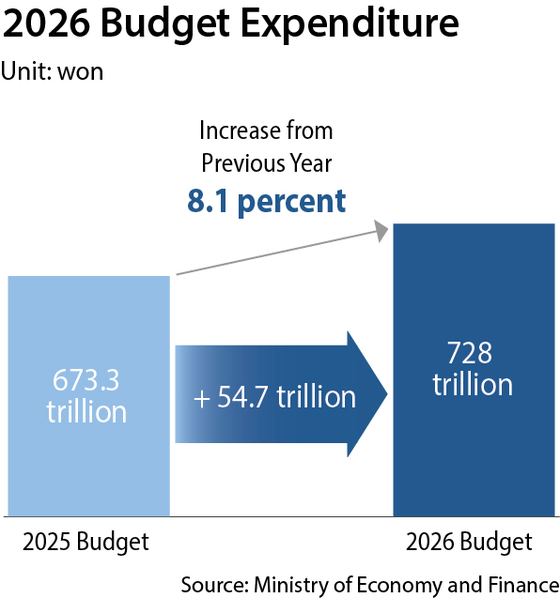
The Cabinet approved the 2026 budget plan in a meeting on Friday. Under the plan, total revenue is projected at 674.2 trillion won, up 22.6 trillion won, or 3.5 percent, from this year’s 651.6 trillion won. Expenditures will rise 54.7 trillion won, or 8.1 percent, from this year’s 673.3 trillion won to 728 trillion won.
It will be the first time that the annual budget surpasses the 700 trillion won mark, only four years after crossing the 600 trillion won threshold in 2022. Next year’s spending increase is also the largest on record, surpassing the 49.7 trillion won rise in 2022.
“Frankly, the country will slowly crumble if nothing is done,” said a senior government official. “At the very least, we must act this year and next. Fiscal spending will act as priming water to create a turning point.”
.
With the working-age population shrinking and productivity growth slowing, the government said it must find a rebound point to avoid a long-term decline in potential growth.
The government will sharply expand investment in AI. Funding for AI-related projects will increase from 3.3 trillion won this year to 10.1 trillion won next year, with an emphasis on “physical AI” that integrates AI with core industries such as automobiles and shipbuilding.
A new “AX-Sprint 300” program will be launched with a budget of 900 billion won to apply AI technology to 300 everyday products in areas such as biotech, housing and logistics. More than 2 trillion won will be allocated to securing high-performance GPUs as infrastructure.
![Deputy Prime Minister and Finance Minister Koo Yun-cheol, second from right, speaks during a press conference on next year's budget at the government complex in Sejong on Aug. 29. [YONHAP]](https://koreaseafood.online/data/photo/2025/08/29/343b118a-57eb-4842-ab93-e3893e69853c.jpg)
Deputy Prime Minister and Finance Minister Koo Yun-cheol, second from right, speaks during a press conference on next year's budget at the government complex in Sejong on Aug. 29. [YONHAP]
Defense spending will rise to 3.2 trillion won, up 1.4 trillion won from this year, to fund next-generation stealth fighter development and other advanced weapons systems. The budget also includes a 6.6 percent pay increase for junior officers with less than five years of service to address disparities with enlisted soldiers, whose wages have risen sharply.
To address the widening gap between Seoul and other regions, block grants to local governments will increase from 3.8 trillion won this year to 10.6 trillion won.
![President Lee Jae Myung speaks during a Cabinet meeting at the presidential office in Yongsan, central Seoul on Aug. 29. [YONHAP]](https://koreaseafood.online/data/photo/2025/08/29/24b87064-caa6-4929-89a1-e1a2b5c93358.jpg)
President Lee Jae Myung speaks during a Cabinet meeting at the presidential office in Yongsan, central Seoul on Aug. 29. [YONHAP]
A pilot system will be introduced to factor in population decline and regional underdevelopment in seven key welfare programs, such as child allowances. A total of 167 noncapital regions will be divided into priority, preferential and general zones for differentiated support. An additional 500 billion won will go toward supporting regional flagship universities tied to local strategic industries.
Lee’s “livelihood budget” measures include raising the eligible age for child allowances from under age seven to under eight, requiring more than 500 billion won in new spending.
A new "Youth Future Savings Plan" will be created to help young people build assets, and job retention incentives will be introduced for those working at small and mid-sized companies outside the capital area. The basic pension will rise by 6,000 won a month, and the number of senior jobs funded by the government will increase from 1.1 million to 1.15 million.
The budget’s 8.1 percent increase puts fiscal policy on par with the expansionary budgets of the Moon Jae-in administration. But unlike in 2017 and 2018, when tax revenues rose by 9.4 and 10.6 percent respectively, Korea has faced tax shortfalls since 2023, with a combined gap of 87 trillion won over two years.
![Deputy Prime Minister and Finance Minister Koo Yun-cheol speaks during a press conference on next year's budget at the government complex in Sejong on Aug. 28. [NEWS1]](https://koreaseafood.online/data/photo/2025/08/29/63a164a7-d893-4dc6-bb0d-f00baf716f94.jpg)
Deputy Prime Minister and Finance Minister Koo Yun-cheol speaks during a press conference on next year's budget at the government complex in Sejong on Aug. 28. [NEWS1]
Even if tax revenues increase as the government projects, it won't be able to cover the scale of expenditures. The government has opted for an “honest deficit” when its revenues are less than its expenditures. The government's estimate for next year's managed fiscal balance is a staggering deficit of 109 trillion won.
The managed fiscal balance, calculated by excluding social security funds like the National Pension Fund from the consolidated fiscal balance, is an accurate indicator of the nation's financial situation for the year.
This year's managed fiscal balance is projected to reach a deficit of approximately 111.6 trillion won, including the supplementary budget. A 100 trillion won annual deficit in the national budget is unprecedented. However, a similar deficit for two consecutive years is unavoidable. Naturally, the national debt will inevitably increase.
As a result, the national debt will soar to 1.4 quadrillion won by the end of next year, up 141.8 trillion won from this year. The debt-to-GDP ratio will climb to 51.6 percent, the first time it enters the 50 percent range.
While that figure remains lower than in many member states of the Organisation for Economic Cooperation and Development, the speed of growth is concerning. Korea’s debt-to-GDP ratio has risen from 9 percent in 2000 to 45.3 percent in late 2024 — a fivefold increase, faster than the United States, according to the Bank for International Settlements.
![President Lee Jae Myung speaks during a Cabinet meeting at the presidential office in Yongsan, central Seoul on Aug. 29. [JOINT PRESS CORPS]](https://koreaseafood.online/data/photo/2025/08/29/baa114bc-06bb-4e65-afb6-0b1c02c2296e.jpg)
President Lee Jae Myung speaks during a Cabinet meeting at the presidential office in Yongsan, central Seoul on Aug. 29. [JOINT PRESS CORPS]
National debt doubled from 359.6 trillion won in 2009 to 723.2 trillion won in 2019, and is set to double again in just seven years. While the principal is a problem, the interest burden is also significant. This year alone, more than 30 trillion won will be spent on servicing interest on government bonds.
The managed fiscal deficit-to-GDP ratio will remain above 4 percent for the second consecutive year, exceeding the government’s own fiscal rule of 3 percent.
Nevertheless, the government’s 2025–29 fiscal management plan offers no clear roadmap to restore fiscal health. The debt-to-GDP ratio is projected to rise to 58 percent by 2029.
“While it is important to spend where necessary, the government must also consider long-term fiscal stability,” said Kim Woo-cheol, a professor of taxation at the University of Seoul. “Public debt will inevitably become a burden for future generations.”
![A nurse cares for newborns at a hospital in Goyang, Gyeonggi on Aug. 27. While the total fertility rate for Korea rose to 0.75 last year, an increase for the first time in nine years, the still alarmingly low birth rate is expected to result in Korea's working-age population shrinking and productivity growth slowing. [NEWS1]](https://koreaseafood.online/data/photo/2025/08/29/4e049fc6-7556-4c00-a151-4e7bb02eaa97.jpg)
A nurse cares for newborns at a hospital in Goyang, Gyeonggi on Aug. 27. While the total fertility rate for Korea rose to 0.75 last year, an increase for the first time in nine years, the still alarmingly low birth rate is expected to result in Korea's working-age population shrinking and productivity growth slowing. [NEWS1]
The biggest increase will go to health, welfare and employment, with 20.4 trillion won more than this year. The median income benchmark will be raised to expand housing and living subsidies, while the obligation for families of medical aid recipients to provide partial living expenses will be scrapped.
General and local administration will rise by 10.4 trillion won, followed by R&D with 5.7 trillion won and defense with 5 trillion won. The only sector to see a decrease is diplomacy and unification, with a 9.1 percent cut, mainly due to reduced funding for official development assistance.
To counter possible fallout from U.S. tariffs, 1.9 trillion won will be allocated for a policy financing package led by the Korea Development Bank and the Export-Import Bank of Korea.
Funding for renewable energy loans and subsidies will nearly double from 500 billion won to 900 billion won. The budget also includes design costs for relocating the National Assembly and the presidential office to Sejong.
This article was originally written in Korean and translated by a bilingual reporter with the help of generative AI tools. It was then edited by a native English-speaking editor. All AI-assisted translations are reviewed and refined by our newsroom.
BY JANG WON-SEOK [[email protected]]


with the Korea JoongAng Daily
To write comments, please log in to one of the accounts.
Standards Board Policy (0/250자)