

Why Korea is suddenly cracking down on foreign real estate purchases
Published: 28 Aug. 2025, 16:57
Updated: 29 Aug. 2025, 12:09
-

- JIN MIN-JI
- [email protected]
![Apartment complexes in downtown Seoul as seen from Namsan Seoul Tower in central Seoul on April 23. [YONHAP]](https://koreaseafood.online/data/photo/2025/08/29/329c980a-3a8d-4e01-b0e5-613cc0e2dc9c.jpg)
Apartment complexes in downtown Seoul as seen from Namsan Seoul Tower in central Seoul on April 23. [YONHAP]
Anxiety over foreign property ownership has intensified in Korea amid tighter real estate regulations, with many Koreans viewing the system as skewed against domestic buyers. Tensions escalated on revelations in May that the Chinese government purchased a large plot of land near the presidential office in central Seoul. The purchase, which was exempt from acquisition tax, raised alarms over national security and the lack of reciprocal rights for Korean investors in China.
In an apparent response to the outcry, the government announced a new regulation last week requiring foreigners to get approval to buy a home in the greater Seoul area, but the rule has not been extended beyond residential properties.
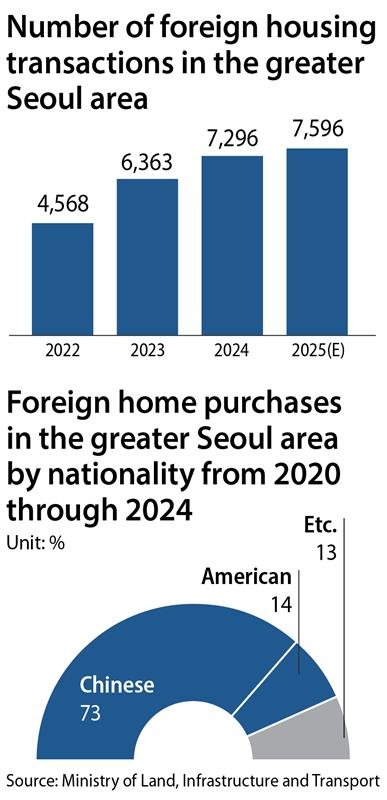
The announcement was made amid a surge in home purchases by foreigners, which have grown by 26 percent annually since 2022.
While local property buyers face stricter real estate loan regulations under the liberal Lee Jae Myung administration, foreign investors can easily bypass them by sourcing funds from overseas financial institutions.
Foreign home ownership accounted for just 0.52 percent of homes in Korea, but the issue quickly became sensitive in a country where property is often viewed as a key path to building wealth for the middle class.
Real-world assets, including real estate, accounted for 75.2 percent of average household's assets in Korea last year, according to government data. That is more than three times the share of financial assets at just 24.8 percent. For those aged 60 and above, the portion rose to a whopping 81.2 percent, indicating that most of their retirement assets are tied up in real estate.
"The measure was politically necessary as it helps the government avoid potential criticism over what locals perceive as foreign property speculation," said Kim Jin-yoo, a professor of Urban Transportation Engineering at Kyonggi University and the president of the Korea Real Estate Analysis Association.
Among various ways to build wealth, real estate — especially housing — has remained one of the few accessible options for ordinary people as the country’s stock market growth has been comparatively weaker than the property market.
"They experience a sense of loss when real estate becomes unattainable, feeling as if they have no alternatives," Kim added.
Easier home purchases for foreign buyers breed resentment
Koreans have faced increasingly strict regulations on home purchases under the Lee administration as the government seeks to steer investment away from real estate and toward the stock market.
On top of a 600 million won ($435,000) mortgage cap, tighter debt-to-service ratio rules — a framework designed to assess a borrower’s ability to service debt based on annual income — have been applied since July. Koreans are also required to reside in an apartment purchased in Seoul’s wealthiest districts of Gangnam, Seocho, Songpa and Yongsan, located in southern and central Seoul.
Against this backdrop, the relative freedom foreign buyers enjoy sparked criticism, with many viewing it as a form of discrimination.
According to data from the Ministry of Land, Infrastructure and Transport, foreigners purchased luxury housing in upscale districts at record high prices — transactions made entirely through deposits. This was made possible by borrowing funds from overseas financial institutions, which are often difficult for local authorities to trace.
Properties purchased through this method included an 18 billion won apartment in Yongsan, a 7.3 billion won apartment in Seocho and an 8.2 billion won detached house in Seongbuk District, central Seoul. One of the buyers was as young as 25 years old.
Criticism of such purchases has raised the issue of adopting the principle of reciprocity in its real estate laws — the idea that if a country restricts Korean citizens from purchasing property within its borders, Korea should impose the same restrictions on that country's citizens.
Other bills proposed by lawmakers include requiring homebuyers to cover at least 50 percent of the home purchase with their own funds and eliminating the capital gains tax reduction for foreigners selling residential real estate in Korea.
"In any country, policies should prioritize citizens," said Lee Eun-hyeong, a research fellow at Korea Research Institute for Construction Policy. "So it doesn’t make sense for foreigners to freely acquire properties, especially when Koreans can’t do the same in their countries."
Of foreign homebuyers, Chinese nationals were the most active group in Korea. From 2020 to 2024, Chinese buyers accounted for 73 percent of all foreign home purchases in the greater Seoul area, followed at a distant second by American buyers at 14 percent.
When a home is purchased in Korea, the sale typically includes the land the home stands on. By land nationwide, foreigners own 0.27 percent of the country. By nationality, 53.5 percent was owned by Americans, followed by Chinese with 7.9 percent.
In contrast, Koreans are barred from purchasing land in China as it is owned by the state. For homes, they generally have to reside in China for more than a year before becoming eligible to buy property.
![Listings for apartments in Jamsil are posted at a real estate agency in Songpa District, southern Seoul on Feb. 13. [NEWS1]](https://koreaseafood.online/data/photo/2025/08/29/e82d190e-e2c1-4f85-bfbb-404984b268e4.jpg)
Listings for apartments in Jamsil are posted at a real estate agency in Songpa District, southern Seoul on Feb. 13. [NEWS1]
Stoking national security fears
Foreign purchases of Korean properties are also raising concerns over national security.
Under current law, land transactions in certain restricted areas, like those near military facilities, are subject to a permit system. But some are calling for similar regulations to be placed over sensitive areas such as diplomatic offices and key national facilities.
Another factor fueling the recent outcry was the Chinese government’s acquisition of a 1-acre plot in Yongsan District — roughly 1.5 kilometers (0.9 miles) from the presidential office and residence.
The Chinese government purchased the land from a private individual in 2018 for 29.9 billion won — a transaction that heightened national security concerns when it came to light in May. The acquisition was exempt from tax, as the site was designated for diplomatic use under Korean law.
The Chinese Embassy in Korea said that the land is for official use without specifying further. There is no visible development on the site and only CCTV cameras have been installed along the perimeter.
“It was difficult to consider the land as a strategically important location from a national security perspective, as there was no presidential residence in the area at the time the Chinese government was registered as the owner,” said Lee Young-joo, a spokesperson for the Land Ministry.
The plot is also 1 kilometer away from the former U.S. military base known as Camp Coiner — now the planned site for the relocation of the U.S. Embassy in Korea.
Concerns were further heightened when U.S. President Donald Trump said he wants the United States to have ownership of the land used as the U.S. military base in Korea.
“You know, we spent a lot of money building a fort and there was a contribution made by South Korea, but I would like to see if we could get rid of the lease and get ownership of the land where we have a massive military base,” Trump said in his first in-person meeting with President Lee at the White House in Washington on Monday.
U.S. military bases are in areas including Pyeongtaek and Osan in Gyeonggi as well as Gunsan in North Jeolla.
“Under the law, if an area is designated as a military facility protection zone, it is automatically classified as a restricted zone requiring approval for foreign land transactions,” said the Land Ministry's Lee.
But there are voices calling for more robust regulatory actions.
“When purchasing sensitive real estate that is important for national security, stricter measures such as parliamentary approval should be required,” said Prof. Kim. “Having regulations that require such approval, especially for large-scale land acquisitions by foreign governments, institutions or militaries, would naturally help prevent misuse or fraud.”
BY JIN MIN-JI [[email protected]]


with the Korea JoongAng Daily
To write comments, please log in to one of the accounts.
Standards Board Policy (0/250자)