

Seoul apartment prices more than 2.6 times national average, highest gap since 2008
Published: 27 Aug. 2025, 16:36
Updated: 27 Aug. 2025, 18:33
Audio report: written by reporters, read by AI
![Apartments in Seoul are seen on Aug. 21. [NEWS1]](https://koreaseafood.online/data/photo/2025/08/27/08a9b5b5-b335-422d-9319-17d7209a8416.jpg)
Apartments in Seoul are seen on Aug. 21. [NEWS1]
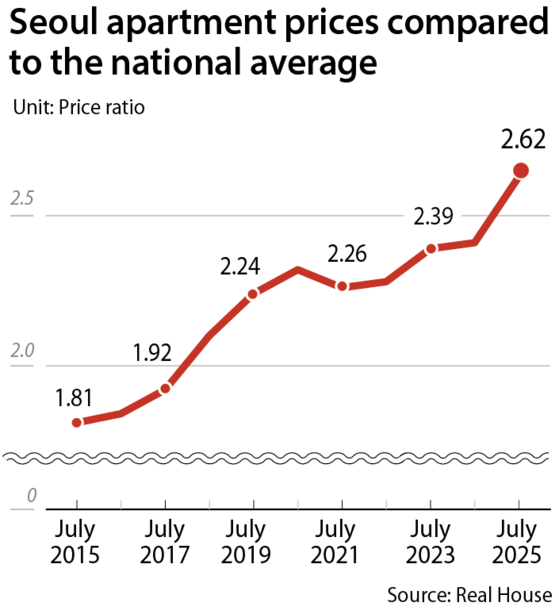
Apartments in Seoul now cost more than 2.6 times the national average, with the price gap hitting its widest point since 2008 as buyers continue to flock to the capital.
Real House, analyzing KB Kookmin Bank time-series data, said the average sales price of an apartment in Seoul in July was 1.4 billion won ($1 million), or 2.62 times the national average of 535.4 million won. Seoul prices were 2.5 times higher than those in Gyeonggi at 561.9 million won and 3.39 times higher than in Incheon at 414.3 million won.
The gap narrowed to 1.8 times in 2015 but widened to 2.3 times by 2020.
Analysts attribute the expansion to demand for a “single high-value home” in Seoul during the Moon Jae-in administration, when heavy taxes on multiple homeownership prompted buyers to opt for high-value properties in the capital. Although the Yoon Suk Yeol administration eased some regulations, the gap has not narrowed.
Seoul’s average apartment price climbed from 508.3 million won in July 2015 to 1.4 billion won this July, an increase of 2.77 times, but the average price nationwide rose from 280.5 million won to 535.4 million won during the same period, or 1.91 times.
“People still strongly believe Seoul apartments will always rise,” said Woo Byung-tak, real estate policy expert at Shinhan Bank. “The government’s temporary easing of capital gains taxes on multiple homeowners did not significantly change the policy direction that favors owning one property.”
The rising costs have shifted the buyer profile. Data from KB Real Estate Data Hub showed the average annual income of households purchasing apartments in Seoul in the second quarter was 91.73 million won, surpassing 90 million won for the first time since records began. Three years ago, most buyers earned between 50 million and 60 million won annually.
“Even in a low-growth economy, higher-income households are seeing rapid wage increases, and that has amplified the tendency to secure Seoul apartments,” said Kim In-man, head of the Real Estate Economic Research Institute.
This article was originally written in Korean and translated by a bilingual reporter with the help of generative AI tools. It was then edited by a native English-speaking editor. All AI-assisted translations are reviewed and refined by our newsroom.
BY JEONG EUN-HYE [[email protected]]


with the Korea JoongAng Daily
To write comments, please log in to one of the accounts.
Standards Board Policy (0/250자)