

Delivering Bach's voice not more loudly, but more truthfully
Published: 22 Aug. 2025, 00:06

Kim Ho-jung
The author is a music editor at the JoongAng Ilbo.
Late last month in Salzburg, Austria. The stage inside the Kollegienkirche, built in the 1700s, was naturally smaller than that of a modern concert hall. The “orchestra,” a modest ensemble of 21 players, could barely be called one, and the “choir” consisted of only 16 singers. These vocalists shifted roles, becoming at times the crowd, at times Jesus or his disciples.
The Freiburger Barockorchester of Germany and Vox Luminis of Belgium joined forces to perform J.S. Bach’s “St John Passion.” The small-scale ensemble produced a sound of striking clarity. Rather than projecting their voices outward to fill the hall, the musicians seemed to draw the audience inward, onto the stage itself. The Salzburg Festival, now in its 105th year, programmed its opening week under the theme of “Fate,” with Bach’s Passion chosen as one of its contemplations on destiny and suffering. The intimate scale proved the perfect vessel.
![A performance of Bach’s "St John Passion" at the Kollegienkirche in Salzburg, Austria, in July. A small ensemble conveyed sounds of striking clarity. [SALZBURG FESTIVAL]](https://koreaseafood.online/data/photo/2025/08/22/42ac2080-3c40-4a9d-960f-0211513ed8fe.jpg)
A performance of Bach’s "St John Passion" at the Kollegienkirche in Salzburg, Austria, in July. A small ensemble conveyed sounds of striking clarity. [SALZBURG FESTIVAL]
Music is often more truthful when pared down. The legendary conductor Philippe Herreweghe, 78, put it this way in an email interview: “My aim is not to deliver Bach’s voice ‘more loudly,’ but more truthfully.” His use of period instruments and his insistence on smaller forces, he explained, are not matters of nostalgia or purism.
When Herreweghe and his colleagues first founded their ensemble in the 1970s, Bach was often staged on a grand scale. “At the time, Bach was performed romantically, with large choirs,” he recalled. His own group, Collegium Vocale Gent, began with 80 singers. “But as research deepened, our goal became a more transparent, more human interpretation.”
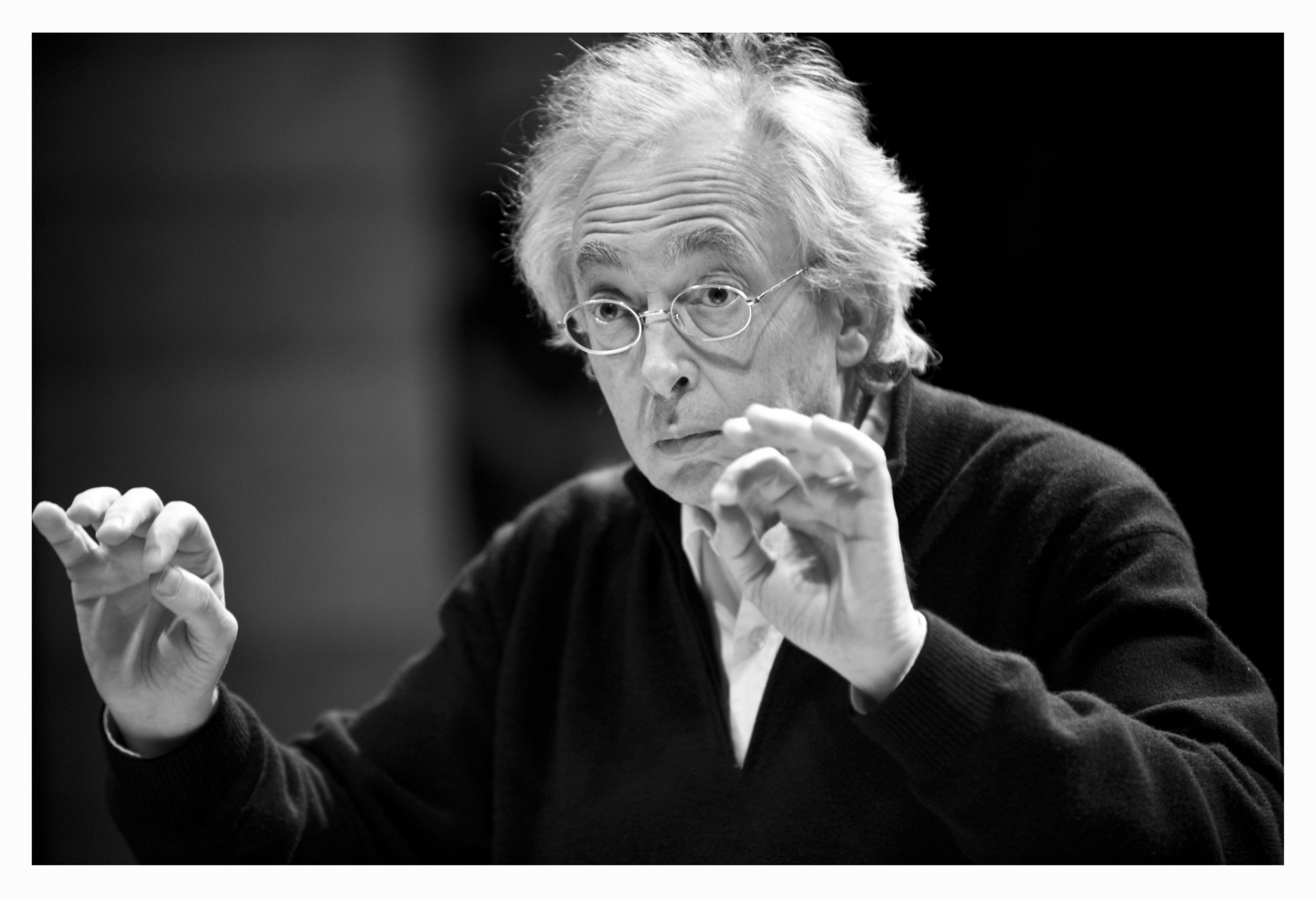
Conductor Philippe Herreweghe will conduct Bach’s final vocal masterpiece, the "Mass in B Minor" next month in Seoul.
The numbers kept shrinking. Next month in Seoul, Herreweghe will conduct Bach’s final vocal masterpiece, the Mass in B Minor, with just 13 choristers and five soloists — 18 singers in total — backed by an orchestra of 24. Including the conductor, the performance will involve only 43 musicians. “Even compared with the 32-voice choirs commonly used, 18 voices will lack nothing in intimacy or cohesion,” he said, stressing again that truth lies not in grandeur but in simplicity.
So how small should it be? A physician by training, Herreweghe approaches the question with precision. “We began with the earliest scores and read every available document,” he said. Research shows that in 18th-century Leipzig, where Bach worked, he had perhaps 25 musicians at his disposal. The Mass in B Minor itself originated partly as a kind of job application, written for the Dresden court. Frustrated by the amateur administrators and meager pay in Leipzig, Bach composed works for Dresden in hopes of securing a new post — music that later found its way into the Mass. As musicologist Lee Ga-young notes, Dresden’s court orchestra then consisted of roughly 25 to 40 musicians, aligning closely with Herreweghe’s reduction from 80 to about 40.
Herreweghe has recorded the Mass in B Minor three times, between 1988 and 2012. Over those decades, chamber-scaled performances have become the historical norm. To some, his interpretations sound too austere, too refined, lacking the drama and richness of Romantic tradition. Yet his conviction remains firm: “In the past, Bach was part of a monumental tradition — majestic and noble, yet somewhat distant. Today we feel closer to his music, because we hear the human voice more clearly.” Having conducted the Mass more than 200 times, he says each performance reveals something new.
In an age where so much strives for the grand and the spectacular, the value of the small and transparent is what gives this music its force. A masterpiece need not be monumental to be great.
This article was originally written in Korean and translated by a bilingual reporter with the help of generative AI tools. It was then edited by a native English-speaking editor. All AI-assisted translations are reviewed and refined by our newsroom.


with the Korea JoongAng Daily
To write comments, please log in to one of the accounts.
Standards Board Policy (0/250자)