

Korea halves growth forecast to 0.9 percent as construction slump drags on
Published: 22 Aug. 2025, 18:56
Updated: 24 Aug. 2025, 16:13
![A worker operates machinery at an apartment construction site in Seoul on Aug. 11. [YONHAP]](https://koreaseafood.online/data/photo/2025/08/24/e0654da4-e3e4-4152-a568-ae8b7c50bad7.jpg)
A worker operates machinery at an apartment construction site in Seoul on Aug. 11. [YONHAP]
The government on Friday halved its economic growth forecast for 2025 to 0.9 percent from 1.8 percent, marking the first time the projection has fallen below 1 percent since the onset of the Covid-19 pandemic in 2020.
The Ministry of Economy and Finance's revision comes as concerns mount over weaker exports in the second half of the year following U.S. tariffs and lingering uncertainty in global trade, despite domestic demand rebounding with the help of government-issued recovery vouchers.
The new forecast remains above projections from the Bank of Korea, the Korea Development Institute, the International Monetary Fund and the Asian Development Bank, which average around 0.8 percent. But it falls short of the 1.0 percent forecast by eight major global investment banks.
The economy grew 0.6 percent in the second quarter this year, recovering from a 0.2 percent contraction in the first quarter. But officials said it would be difficult to sustain growth above 1 percent this year.
“To reach 0.9 percent growth for the year, the economy would need to expand by the mid-1 percent range in the second half, which is not easy,” said Kim Jae-hoon, the director-general for economic policy at the ministry. “We will use every policy tool available to support growth.”
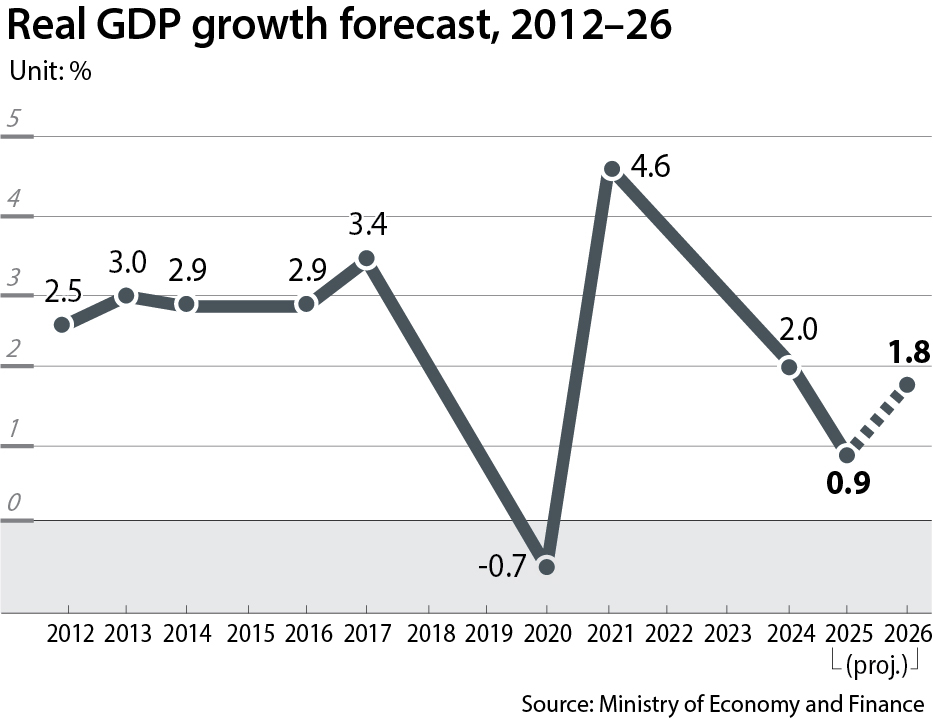
Korea’s growth has stagnated in recent years, falling from 2.7 percent in 2022 to 1.6 percent in 2023 and 2.0 percent in 2024. This year’s projection marks a sharp loss of momentum, with output expected to rise at less than half of last year’s pace.
By comparison, the Organisation for Economic Cooperation and Development expects global growth of 2.9 percent this year, with the same rate projected among Group of 20 economies. The United States and the eurozone are projected to grow 1.6 percent and 1 percent, respectively.
![A shopper looks at fruit displayed at a traditional market in Seoul on Aug. 21. [YONHAP]](https://koreaseafood.online/data/photo/2025/08/24/b0f262a2-e575-4d91-9cae-6397e300c138.jpg)
A shopper looks at fruit displayed at a traditional market in Seoul on Aug. 21. [YONHAP]
Still, the ministry emphasized that domestic consumption has started to recover after a weak first half.
Household spending, which fell 0.1 percent quarter-on-quarter in the first quarter following former President Yoon Suk Yeol's martial law declaration on Dec. 3, 2024, and subsequent impeachment proceedings, rose 0.5 percent in the second quarter.
Retail sales, which had declined for a record 13 consecutive quarters, narrowed their fall to 0.2 percent in the April–June period, raising hopes of a rebound in the third quarter. Officials expect consumption to benefit further from recovery consumption vouchers distributed through a supplementary budget.
Consumer sentiment has also improved. The index rose to 110.8 in July, its highest in nearly four years, rebounding from 88.2 in December 2024.
Although high inflation and household debt remain drags, the ministry expects lower interest rates to support household demand in the coming months.
![Export-bound containers are stacked at Pyeongtaek Port in Gyeonggi on Aug. 17. [NEWS1]](https://koreaseafood.online/data/photo/2025/08/24/a16ed3b5-5abe-4666-93b9-866e18c96680.jpg)
Export-bound containers are stacked at Pyeongtaek Port in Gyeonggi on Aug. 17. [NEWS1]
Exports are projected to edge up 0.2 percent this year — a sharp drop from last year's 8.1 percent growth — helped by the resolution of tariff disputes with the United States. The government expects semiconductor and ship sales to grow in the second half while auto and steel may slow. The impact of new U.S. tariffs on chips was not factored into the forecast.
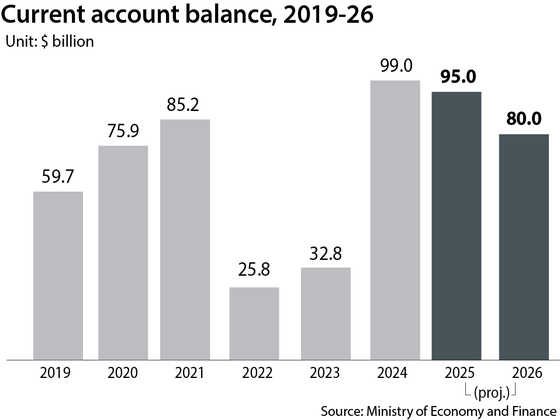
Imports are expected to fall 0.6 percent, largely due to lower oil prices, producing a current account surplus of $95 billion — $15 billion higher than previously estimated.
The ministry acknowledged this reflects a recessionary surplus, with imports falling faster than exports.
The sharp downgrade in growth stems largely from the construction sector. The ministry projects that investment in the sector will contract by 8.2 percent this year, similar to the Korea Development Institute’s forecast of negative 8.1 percent.
The government says the downturn is deeper and more prolonged than earlier expected.
“Orders have been improving gradually since the third quarter of last year,” Kim said. “Because it typically takes four to eight quarters for new orders to translate into actual investment, conditions should improve next year.”
![A construction worker works under a sunshade at a site in Daegu on Aug. 5. [YONHAP]](https://koreaseafood.online/data/photo/2025/08/24/627f65d0-94d2-498b-a15d-bb3f8eee5b49.jpg)
A construction worker works under a sunshade at a site in Daegu on Aug. 5. [YONHAP]
The government projects that two rounds of supplementary budget already passed will add 0.1 percentage point to growth this year and next. But the government said it is not considering a third extra budget at this stage.
The ministry raised its consumer price growth outlook to 2.0 percent from 1.8 percent, citing higher processed food prices despite lower oil prices. Inflation could fluctuate with consumption in the second half, but the government expects it to remain stable overall.
The economy is projected to add 170,000 jobs this year, up from the earlier forecast of 120,000. Employment has already increased by 180,000 through July, led by health and social services jobs, including those created by the government. Manufacturing and construction employment continue to decline.
![A job seeker looks at job listings at a career fair in Gumi, North Gyeongsang, on July 16. [YONHAP]](https://koreaseafood.online/data/photo/2025/08/24/3f1a083a-3382-4c0e-97f2-f224bae4fc18.jpg)
A job seeker looks at job listings at a career fair in Gumi, North Gyeongsang, on July 16. [YONHAP]
The government predicts that the economy will grow 1.8 percent in 2026, about twice this year’s pace, partly due to a low base effect.
“The government has acknowledged reality in forecasting growth below 1 percent this year, but construction is under unprecedented strain, and tariff uncertainty remains,” said Cho Young-moo, a senior economist at NongHyup Economic Research Institute.
“Next year will look better statistically, but policy responses such as whether to pursue another supplementary budget will be critical,” Cho added.
The Finance Ministry said it would increase next year’s budget spending more than it did this year to support recovery.
“We will focus on revitalizing the economy and livelihoods while responding to changes in global trade conditions to manage the economy in a stable manner,” said Yoon In-dae, deputy finance minister.
![Deputy Prime Minister and Minister of Economy and Finance Koo Yun-cheol announces the 15 leading projects for national AI transformation during a joint briefing with related ministries at the government complex in Jongno District, central Seoul, on Aug. 22. [NEWS1]](https://koreaseafood.online/data/photo/2025/08/24/b953209d-abc4-406a-be8d-f1eff6eaf26d.jpg)
Deputy Prime Minister and Minister of Economy and Finance Koo Yun-cheol announces the 15 leading projects for national AI transformation during a joint briefing with related ministries at the government complex in Jongno District, central Seoul, on Aug. 22. [NEWS1]
One of the key themes of the government’s new economic strategy is raising Korea’s potential GDP growth, the maximum output an economy can achieve by fully mobilizing labor, capital and other resources without fueling inflation.
Korea’s potential growth, which stood in the 3 percent range in 2010, is now estimated to have fallen to the high 1 percent range due to a shrinking work force and weak investment.
Finance Minister Koo Yun-cheol said that “AI transformation is the only breakthrough to reverse the growth slowdown caused by demographic shocks” and pledged to expand investment in artificial intelligence.
While there is broad agreement on the need to boost AI spending, critics note that the government has not laid out concrete funding measures despite the enormous capital required to train the entire population — including older workers — as AI talent and to raise adoption rates among small and mid-sized manufacturers.
Structural challenges such as demographic decline, labor market polarization and productivity gaps continue to weigh on Korea’s growth potential, with few solutions offered beyond AI adoption.
Some economists question whether it is appropriate to frame AI as not only an industrial policy, but also a macroeconomic strategy, especially as debate grows over potential risks and overvaluation in the sector.
“To raise potential growth, labor, capital and total factor productivity all need to increase, yet policies that support highly educated workers in balancing careers and family remain lacking,” said Seok Byoung-hoon, an economics professor at Ewha Womans University.
“More importantly, legislation such as the 'Yellow Envelope Law,' amendments to the Commercial Act and higher corporate taxes will discourage business investment, making it difficult to achieve 3 percent potential growth through AI spending alone,” Seok added.
This article was originally written in Korean and translated by a bilingual reporter with the help of generative AI tools. It was then edited by a native English-speaking editor. All AI-assisted translations are reviewed and refined by our newsroom.
BY JANG WON-SEOK, KIM KYUNG-HEE [[email protected]]


with the Korea JoongAng Daily
To write comments, please log in to one of the accounts.
Standards Board Policy (0/250자)