

Samsung closes gap with Apple by half in Q2 as Galaxy line takes off in U.S.
Published: 18 Aug. 2025, 16:32
Updated: 18 Aug. 2025, 19:35
Audio report: written by reporters, read by AI
![Visitors look at Samsung Electronics’ Galaxy S25 series at a Samsung store in southern Seoul on Aug. 5. [NEWS1]](https://koreaseafood.online/data/photo/2025/08/18/1cd116ad-37a2-4ce9-9002-5b84ab4af45e.jpg)
Visitors look at Samsung Electronics’ Galaxy S25 series at a Samsung store in southern Seoul on Aug. 5. [NEWS1]
Samsung Electronics significantly narrowed its market share gap with Apple in the U.S. smartphone market during the second quarter of this year, fueled by strong sales of its midrange Galaxy A series. The move positions Samsung Electronics as a stronger competitor ahead of Apple’s highly anticipated iPhone 17 launch next month.
Samsung Electronics held a 19.9 percent market share in the global market by shipments in the first half of 2025, up slightly from 19.5 percent a year earlier, according to the company's semiannual report released Sunday. The United States and the Middle East led the company’s regional gains.
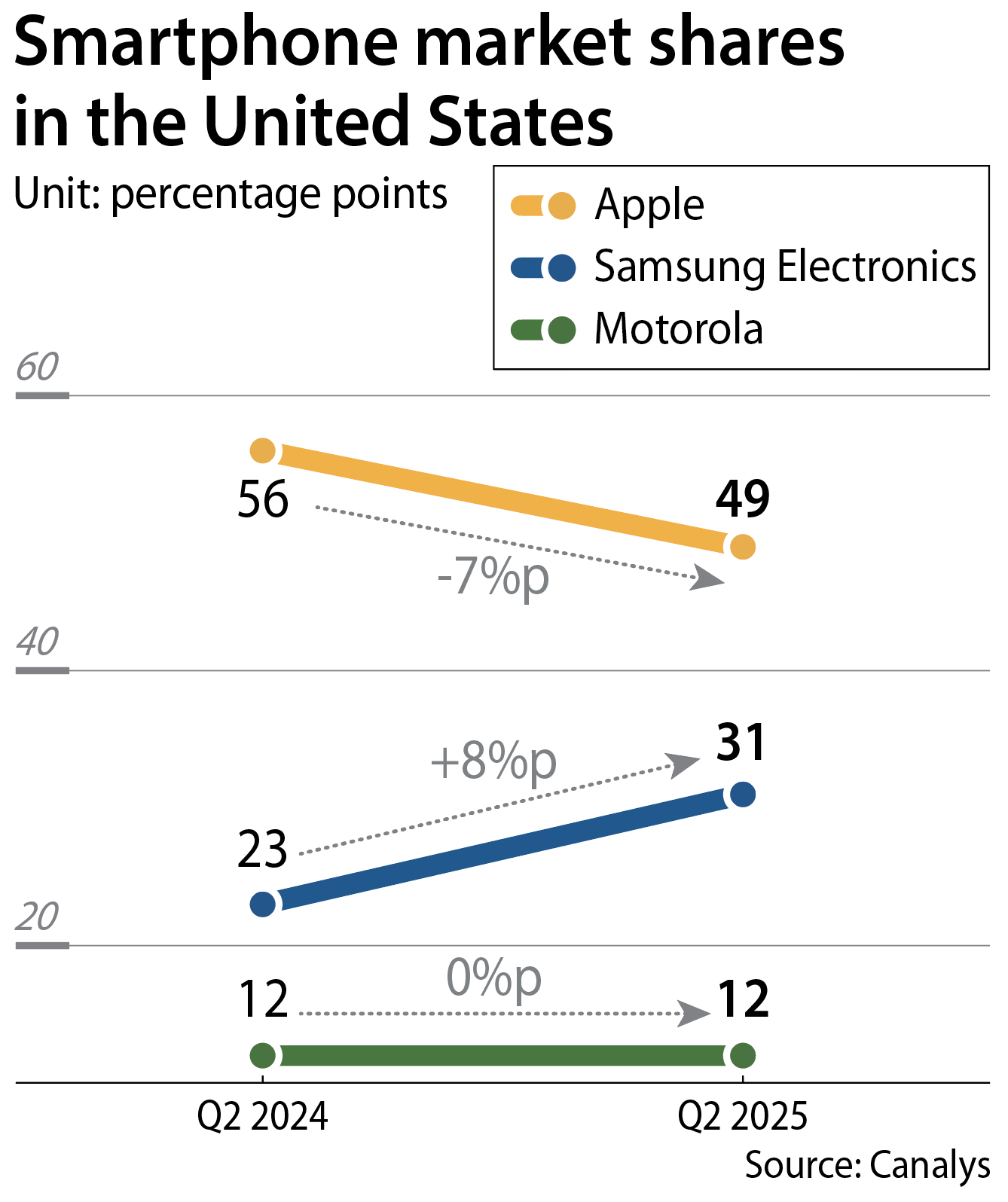
Samsung Electronics captured 31 percent of the U.S. market in the April–June period, up 8 percentage points from a year earlier, while Apple’s share dropped from 56 percent to 49 percent, according to Canalys.
The difference between the two companies has shrunk from 33 percentage points to 18 percentage points in the past year.
Analysts attribute Samsung Electronics’ growth to the popularity of its midrange smartphone lineup equipped with AI. The company launched the Galaxy A16 5G with a starting price of 290,000 won ($209) in January, followed by the A36 5G at 590,000 won in March and the A56 5G at 690,000 won in July.
“A-series models have been launched around the same time in past years, but this year’s addition of AI intelligence features to midrange models appears to have had a positive effect,” a Samsung spokesperson said. “Sales of the S25 series also remain strong.”
![A model promotes preorders for Samsung’s new Galaxy devices on July 16. [YONHAP]](https://koreaseafood.online/data/photo/2025/08/18/bed6e7b8-617a-45b6-9023-d75ec431ead7.jpg)
A model promotes preorders for Samsung’s new Galaxy devices on July 16. [YONHAP]
Analysts interpret the growing preference for Samsung phones as a result of Apple's falling behind in the AI race. In the Middle East, Samsung’s market share rose to 34 percent in the second quarter, widening the Korean tech giant's lead over Xiaomi, which fell to 17 percent. Apple dropped from third to fifth place as its share slipped to 8 percent, trailing Honor at 10 percent.
Looking ahead, competition is set to intensify for the rest of the year. Apple plans to unveil four models in the iPhone 17 series in early September: the base iPhone 17 with a 6.1-inch display, the iPhone 17 Pro with a 6.3-inch display, the iPhone 17 Pro Max with a 6.9-inch display and a new ultrathin iPhone 17 Air with a 6.6-inch display. The iPhone 17 Air is expected to be just 5.5 millimeters (0.2 inches) thick, slimmer than Samsung’s S26 Edge, which measured 5.8 millimeters when it was released in May.
To counter Apple’s launch, Samsung Electronics plans to release the S25 FE, a new midrange to high-end model priced below 1 million won, in early September.
Samsung Electronics is also gearing up to launch the world’s first trifold phone by the end of the year, its first smartphone to fold in two places. The company aims to stay ahead of Apple, which is expected to release its first foldable iPhone next year.
“Samsung’s Galaxy and Z phone lineup stretches from $650 up to $2,400. That is a massive span of devices,” Canalys analyst Runar Bjorhovde said. “You can target people at every single price point, and you can meet them at every spot."
This article was originally written in Korean and translated by a bilingual reporter with the help of generative AI tools. It was then edited by a native English-speaking editor. All AI-assisted translations are reviewed and refined by our newsroom.
BY YI WOO-LIM [[email protected]]


with the Korea JoongAng Daily
To write comments, please log in to one of the accounts.
Standards Board Policy (0/250자)