

China surpasses U.S. in investment pledges to Korea in bid to bypass U.S. tariffs
Published: 15 Aug. 2025, 18:43
Updated: 18 Aug. 2025, 14:42
-

- SARAH CHEA
- [email protected]
Audio report: written by reporters, read by AI
![Chinese flags flutter near shipping containers at the Yangshan Port outside Shanghai, China, on Feb. 7. [REUTERS/YONHAP]](https://koreaseafood.online/data/photo/2025/08/18/329ef566-08f9-4f7f-980b-570f06ebb7f2.jpg)
Chinese flags flutter near shipping containers at the Yangshan Port outside Shanghai, China, on Feb. 7. [REUTERS/YONHAP]
China’s direct investment pledges to Korea surged to a record $6.79 billion last year, as Beijing appeared to be maneuvering around U.S. trade restrictions, according to a recent report by the Korea Institute for International Economic Policy (KIEP).
The report underscores Korea’s growing prominence as a strategic investment destination, serving not only as a manufacturing base but also as a key logistics hub.
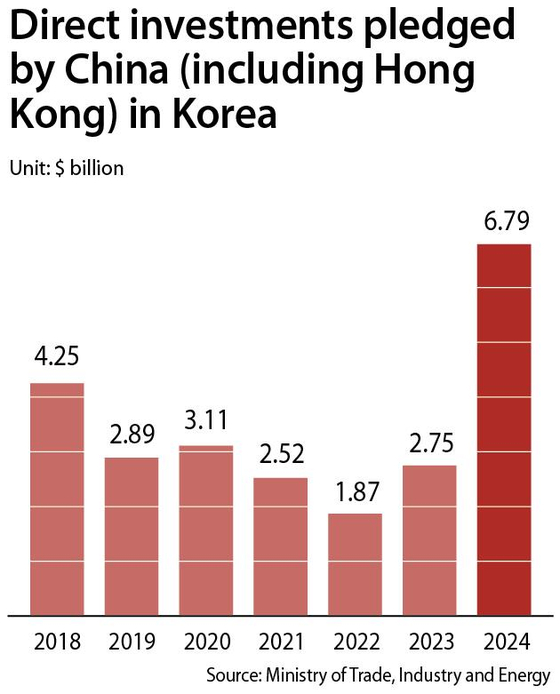
China's reported foreign direct investment reached $6.79 billion last year, a figure that includes investments from Hong Kong, marking a dramatic 147.4 percent increase from the previous year. It pushed the United States, which had held the top spot for seven consecutive years, into third place.
China accounted for 19.6 percent of Korea’s total foreign direct investment last year, surpassing Japan’s 17.7 percent and the United States’ 15.2 percent.
“China has been expanding its presence in Korea as a way to circumvent U.S. restrictions following Washington’s designation of China as a ‘Foreign Entity of Concern [FEOC],’” the report pinpointed.
“The surge in Chinese investment into Korea also reflects objectives such as securing access to technology, establishing production bases and ensuring market entry,” it added, noting that there also “appears to be a strategic imperative to strengthen economic linkages with Korea.”
However, actual investment inflows lagged far behind, totaling just $1.23 billion, though still a 94.4 percent increase from 2023.
The gap between pledged and executed investment reached an all-time high, suggesting that a growing number of Chinese firms are delaying or withdrawing their planned investments in Korea.
GEM, China’s largest precursor materials company, in March 2023 pledged to invest 1.2 trillion won ($863 million) jointly with Korean companies SK On and EcoPro to build a battery materials factory in Saemangeum, North Jeolla. However, the company withdrew its plans just in December that year, blaming regulatory uncertainties related to the U.S. Inflation Reduction Act and its designation of China as an FEOC, which it said undermined the project’s business viability.
Zhejiang Huayou Cobalt, the world’s largest cobalt supplier, has also indefinitely postponed a planned 1.2 trillion won investment with Posco Future M in building a nickel refining plant in Saemangeum, citing risks driven by the Donald Trump administration.
“Industries with high geopolitical sensitivity — such as batteries and specialized machinery — are particularly vulnerable to external variables, including shifts in regulatory frameworks and uncertainty stemming from U.S. efforts to contain China,” the report examined.
“It raises the possibility that the surge in 2024 may have been a temporary spike aimed at circumventing supply chain constraints, rather than a sign of a structural upward trend.”
![BYD's Atto 3, Korea's first passenger EV from the Chinese EV giant, is on stage at its launch event in Incheon on Jan. 16. [YONHAP]](https://koreaseafood.online/data/photo/2025/08/18/67a5614b-c46c-42ba-847a-b48eed426aa6.jpg)
BYD's Atto 3, Korea's first passenger EV from the Chinese EV giant, is on stage at its launch event in Incheon on Jan. 16. [YONHAP]
Roughly 77.7 percent of actual investment was injected in the manufacturing sector, with a particular focus on batteries. Xiamen Tungsten, a Chinese battery materials firm, announced an additional $15 million investment in Saemangeum, on top of its earlier $13 million factory project last year. Ningbo Jiangfeng Electronic Materials also committed $53 million in Feb. 2024 to building a new plant in Asan, South Chungcheong.
BYD, the world’s biggest EV maker, launched Atto 3 in Korea in January, and Zeekr, a premium EV brand under Geely, is planning its entry next year. Major Chinese e-commerce and logistics firms like Alibaba and Temu are also ramping up their presence in Korea.
While the KIEP report assessed China’s growing investment as broadly positive in terms of revitalizing regional economies and stabilizing supply chains, it also cautioned that the trend carries risks about declining profitability of Korean firms, as well as concerns over potential technology leakage.
“Chinese companies’ aggressive low-price strategies pose a threat to the profitability and market position of existing Korean firms producing similar goods,” the report noted, adding that “thorough monitoring is essential.”
The report also read, “In addition, tighter enforcement is needed to crack down on illegal transshipment practices designed to mask the origin of Chinese goods.”
In July 2022, the United States launched an investigation into a Chinese aluminum producer suspected of circumventing tariffs by setting up a manufacturing facility in Korea. As a result, new duties were imposed on those products in November 2023. More recently, cases of Chinese goods being rerouted through Korea and falsely labeled as Korean-made for the U.S. market have been uncovered, according to the report.
BY SARAH CHEA [[email protected]]


with the Korea JoongAng Daily
To write comments, please log in to one of the accounts.
Standards Board Policy (0/250자)