

Vietnam emerges as key rare earth source as Korea reduces reliance on China
Published: 12 Aug. 2025, 20:11
-
- PARK EUN-JEE
- [email protected]
-

- SARAH CHEA
- [email protected]
![Workers transport soil containing rare earth elements for export at a port in Lianyungang, Jiangsu province, China October 31, 2010. [REUTERS]](https://koreaseafood.online/data/photo/2025/08/12/4258de62-58ff-403b-b9ec-f612f8cd94fc.jpg)
Workers transport soil containing rare earth elements for export at a port in Lianyungang, Jiangsu province, China October 31, 2010. [REUTERS]
Rare earths — key minerals essential for semiconductors, arms and EV batteries production — have moved to the forefront of U.S.-China tensions as China, which accounts for the majority of the world’s rare earth supply, increasingly leverages its dominance as a geopolitical tool.
Against the backdrop of uncertainties, Seoul is also moving away from China after experiencing shortages of multiple rare earth elements originating from the neighboring country over the past few months.
The Korean government and major corporations have instead expanded sourcing from Vietnam, Australia and European suppliers, with the goal of further diversifying imports of strategically important minerals.
A joint statement from the latest Korea-Vietnam summit this week involves an increase in Vietnam’s supply of rare earth materials to Korea.
![Korean President Lee Jae Myung, right, and To Lam, general secretary of Vietnam's Communist Party, shake hands ahead of their bilateral summit at the Yongsan presidential office in central Seoul on Aug. 11. [JOINT PRESS CORPS]](https://koreaseafood.online/data/photo/2025/08/12/1c322f44-eeac-4cac-adfe-895129856ea4.jpg)
Korean President Lee Jae Myung, right, and To Lam, general secretary of Vietnam's Communist Party, shake hands ahead of their bilateral summit at the Yongsan presidential office in central Seoul on Aug. 11. [JOINT PRESS CORPS]
“The two countries agreed to combine Vietnam’s abundant rare earth resources with Korea’s technological prowess to further strengthen cooperation in the field of critical minerals,” said President Lee Jae Myung on Aug. 11. “Starting this year, we will explore ways to cooperate in the supply, processing and utilization of critical minerals primarily through the Korea–Vietnam Critical Minerals Supply Chain Center being established this year.”
Automotive supply chain in spotlight
When China imposed export restrictions on seven rare earth elements and magnets used in the defense, energy and automotive sectors in April, Korean automakers were put on high alert due to concerns for the supply of Dysprosium, a rare earth element and a critical enabler for high-performance magnets. China currently holds 99.8 percent of the world's supply of Dysprosium. The cost of the element jumped three times following the April curb, according to the Korea International Trade Association.
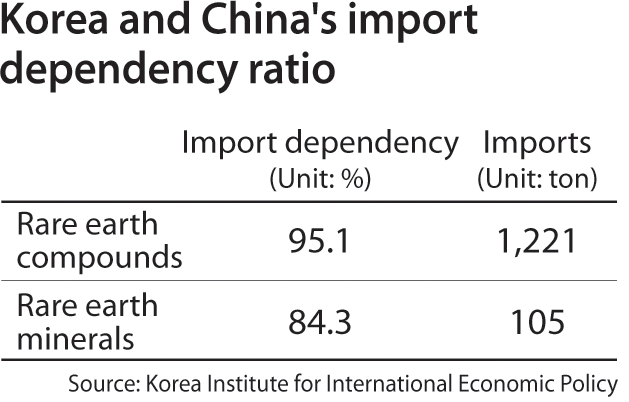
Korea's import reliance on China was 95.1 percent for rare-earth metals and 84.3 percent for rare-earth metal compounds in 2023, according to the Korea Institute for International Economic Policy.
In the wake of Monday’s meeting between Lee and Vietnamese counterpart General Secretary To Ram, Korean companies are seeking to increase imports from the Southeast Asian country.
LS Cable & System is developing infrastructure for mining and refining rare earth elements in Vietnam with the goal of supplying the processed materials to Korea’s major automakers.
“We have a plan in mind, but we need a mining operator for it. While we possess the technology to refine rare earths, we do not have the resources themselves, so we need a mining developer to extract them,” a spokesperson for the cable manufacturer said.
The spokesperson went on to note that government support has helped the development project proceed smoothly, although it is still in the early stages.
“The government is providing some connections. Since permanent magnets are used in electric vehicles, the supply will likely go to automakers, but the exact approach has yet to be decided. The priority is to secure rare earths.”
Executives of Posco and its affiliates also met with the Vietnamese delegation on Tuesday, although the company declined to specify further.
Swift moves
Supply chain risks are nothing new, with precedents set during the Covid-19 pandemic and Japan’s export curbs. Having experienced a range of disruptions, major chipmakers have already expanded the number of countries from which they import rare earths.
“We have already diversified our rare earth sources, so the risks surrounding China’s dominance in rare earths remain minimal,” a spokesperson from Samsung Electronics said. “We have refrained from depending on a single country for a certain material, improving our bargaining power in both procurement and pricing.”
SK hynix echoed this stance, acknowledging that the agreement from Monday’s meeting could help it and its suppliers in further diversification.
“Globally, the share we actually need is limited, and our usage volume isn’t large. We import a small amount of rare earths, and our consumption is also minimal — and diversification is already in place,” a spokesperson at SK hynix said.
“We import some materials ourselves, and rare earth raw materials for equipment and components makers are procured in small quantities. Our suppliers have diversified as well. Support at the national level and from multiple countries for companies using rare earths in their supply chains would be beneficial, though.”
BY PARK EUN-JEE, SARAH CHEA [[email protected]]


with the Korea JoongAng Daily
To write comments, please log in to one of the accounts.
Standards Board Policy (0/250자)