

U.S. commerce secretary touts no chip tariffs for companies building facilities in the country
![U.S. Commerce Secretary Howard Lutnick looks on as President Donald Trump and Apple CEO Tim Cook announce an additional $100 billion Apple investment in the United States in the Oval Office of the White House in Washington on Aug. 6. [EP/YONHAP]](https://koreaseafood.online/data/photo/2025/08/08/3d5f144c-a1b4-4645-a597-671131992ace.jpg)
U.S. Commerce Secretary Howard Lutnick looks on as President Donald Trump and Apple CEO Tim Cook announce an additional $100 billion Apple investment in the United States in the Oval Office of the White House in Washington on Aug. 6. [EP/YONHAP]
WASHINGTON — U.S. Commerce Secretary Howard Lutnick said Thursday that semiconductor companies that commit to and follow through with building manufacturing facilities in the United States during President Donald Trump’s term will be exempt from the newly proposed 100 percent tariff on semiconductors.
“So [what] the president said is if you commit to build in America during his term, and if you file it with the Commerce Department and if your auditor oversees you building it all the way through, then he will allow you to import your chips, while you are building, without a tariff,” Lutnick said during an interview with Fox Business. “But you have to be confirmed and overseen building in America.”
“What that’s going to bring is $1 trillion of semiconductor build in America by Trump,” Lutnick added.
Trump announced a plan on Tuesday to impose 100 percent tariffs on certain semiconductor imports, while stating that companies with existing or pledged production in the United States could be exempt.
However, he did not clarify whether the exemption would apply only to U.S.-produced chips or also to those produced in other countries by the same firms. Lutnick’s comments clarified that the exemption hinges on confirmed domestic plant construction and compliance with monitoring.
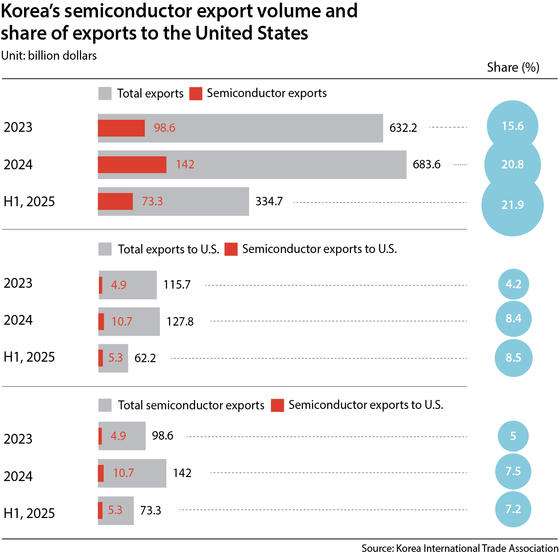
Semiconductors are Korea’s second-largest export to the United States after automobiles. Korea exported $10.6 billion worth of semiconductors to the U.S. last year, according to the Korea International Trade Association (KITA). A 100 percent tariff would deal a heavy blow to Korean chipmakers.
Samsung Electronics and SK hynix are expected to be exempt, given that both companies are operating or constructing semiconductor facilities in the United States during Trump’s term.
Samsung runs a foundry in Austin, Texas, and is building a second plant in Taylor, Texas, set to open in 2026. SK hynix is investing $3.87 billion to construct a high-bandwidth memory (HBM) packaging facility in West Lafayette, Indiana, with mass production planned for 2028.
![Apple CEO Tim Cook reacts while U.S. President Donald Trump speaks, as they present Apple's announcement of a $100 billion investment in U.S. manufacturing, while U.S. Treasury Secretary Scott Bessent and Commerce Secretary Howard Lutnick stand, in the Oval Office at the White House in Washington on Aug. 6. [REUTERS/YONHAP]](https://koreaseafood.online/data/photo/2025/08/08/06d154da-df14-4702-a395-ccf830cb4f6b.jpg)
Apple CEO Tim Cook reacts while U.S. President Donald Trump speaks, as they present Apple's announcement of a $100 billion investment in U.S. manufacturing, while U.S. Treasury Secretary Scott Bessent and Commerce Secretary Howard Lutnick stand, in the Oval Office at the White House in Washington on Aug. 6. [REUTERS/YONHAP]
Lutnick said the policy of tariff pressure to attract foreign semiconductor manufacturing to the United States could result in $1 trillion in investment, calling it “historical.”
“TSMC announced a $200 billion [investment] in Arizona, and Micron announced [to invest] another $200 billion in Idaho and New York,” said Lutnick. “These are huge, and it’s going to be cross-America.”
Lutnick also projected that the reciprocal tariffs taking effect at midnight Thursday could generate over $50 billion in monthly revenue.
“And now you will get the semiconductors, you will get the pharmaceuticals, you’re going to get all sort of tariff money coming in,” said Lutnick.
![U.S. Secretary of Commerce Howard Lutnick testifies before a House Appropriations Committee hearing on U.S. President Donald Trump's budget request for the Department of Commerce, on Capitol Hill in Washington on June 5. [REUTERS/YONHAP]](https://koreaseafood.online/data/photo/2025/08/08/84435d6f-e969-49c4-8e87-757fa59140db.jpg)
U.S. Secretary of Commerce Howard Lutnick testifies before a House Appropriations Committee hearing on U.S. President Donald Trump's budget request for the Department of Commerce, on Capitol Hill in Washington on June 5. [REUTERS/YONHAP]
Lutnick also predicted a likely extension of the U.S.-China mutual high-tariff freeze, set to expire on Aug. 11.
“The president said yesterday that everything is on the table, and we are going to leave that to the trade team and the president to make those decisions,” said Lutnick. “But it feels like they are going to come to a decision and extend that for another 90 days.”
The United States and China reached a tentative agreement to extend the freeze during trade talks held in Stockholm between July 28 to 29.
While China has confirmed the agreement, Washington is reportedly awaiting Trump’s final approval. As of Wednesday, the president had not signed off.
Translated from the JoongAng Ilbo using generative AI and edited by Korea JoongAng Daily staff.
BY KIM HYOUNG-GU [[email protected]]


with the Korea JoongAng Daily
To write comments, please log in to one of the accounts.
Standards Board Policy (0/250자)