

Pyongyang deepens ties with Moscow through direct flights, snubs Seoul's efforts
-

- MICHAEL LEE
- [email protected]
![Passengers check in for Nordwind Airlines’ first Pyongyang-bound flight at Sheremetyevo International Airport in Moscow on July 27. [AP/YONHAP]](https://koreaseafood.online/data/photo/2025/08/04/0b1cfa46-d227-4d0c-b851-d756fc7518f7.jpg)
Passengers check in for Nordwind Airlines’ first Pyongyang-bound flight at Sheremetyevo International Airport in Moscow on July 27. [AP/YONHAP]
[NEWS ANALYSIS]
A Russian airline last week flew the first direct commercial flights between Moscow and Pyongyang in decades, signaling a new phase in Russia-North Korea relations.
Nordwind Airlines, a privately owned Russian carrier once associated with ferrying Russian tourists to Mediterranean beach towns, operated the inaugural flight between the two capitals on July 27, with the return trip occurring two days later.
The first flight — NWS6107 — landed at Pyongyang International Airport on July 28 after more than eight hours in the air, having departed Moscow’s Sheremetyevo Airport at around 7:30 p.m. the previous day.
The opening of the direct route came as South Korean President Lee Jae Myung is pushing to reduce inter-Korean tensions and resume exchanges with the North, to little avail.
Though state airlines and limited services have previously connected the two capitals, this new regular route by Nordwind represents a symbolic normalization of bilateral mobility at a time when both Russia and North Korea face continuing efforts from the West to isolate them economically and diplomatically.
A carefully timed announcement
The decision to reopen direct flights comes against the backdrop of Russia’s ongoing war against Ukraine and Pyongyang’s increasing willingness to re-engage with select foreign partners after years of pandemic-induced isolation.
Although Russian state media reported that the Boeing 777 that departed Moscow was mostly filled with North Koreans returning home, Russian Natural Resources Minister Alexander Kozlov was among a number of Russian citizens aboard.
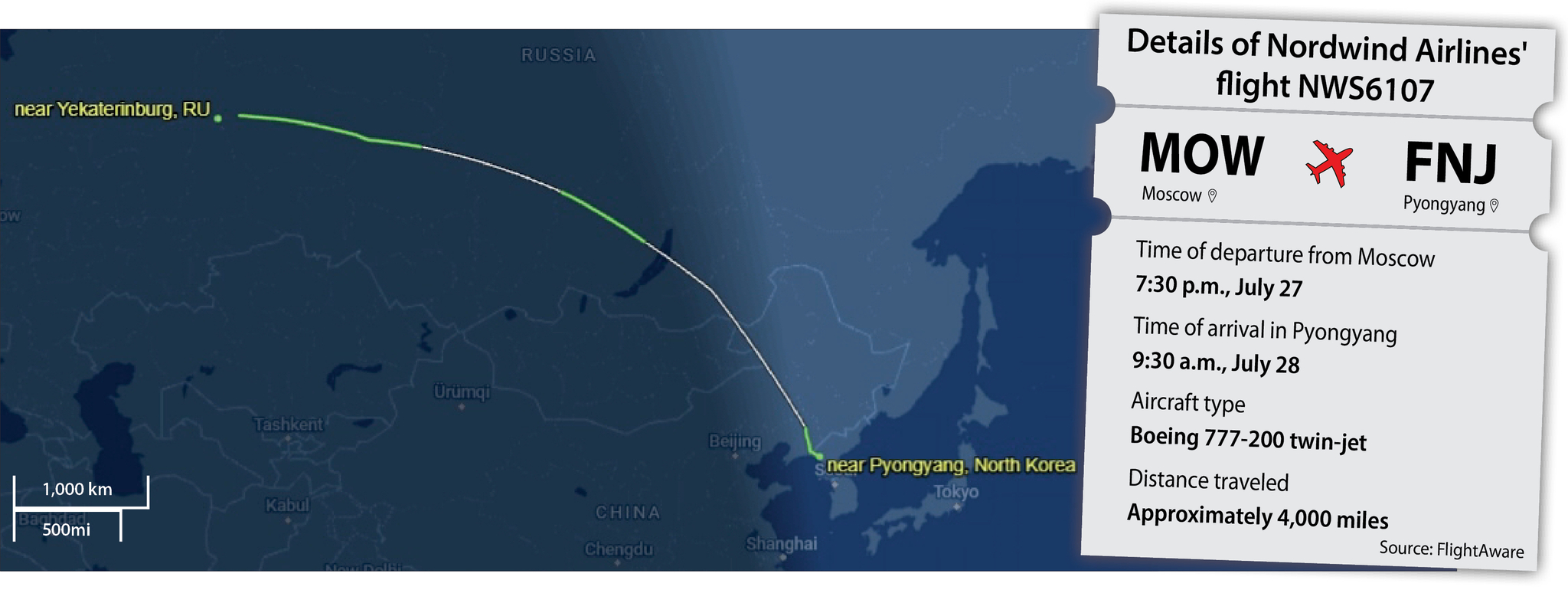
He held talks upon arrival the following day with Yun Jong-ho, the North’s external economic relations minister, further highlighting the dual purpose of the route as both a commercial experiment and a diplomatic gesture.
In media reports, Russian officials emphasized the significance of the route’s opening in the context of the “strategic partnership” between Pyongyang and Moscow — though not without exaggeration.
“For the first time in more than 70 years of diplomatic relations, we are launching direct flights between the capitals of our countries,” said Vladimir Poteshkin, Russia’s deputy transport minister, on Telegram.
However, earlier reports indicate that carriers, such as Russia’s Aeroflot and North Korea’s Air Koryo, maintained service between Moscow and Pyongyang into the early 2000s, making the Nordwind flights a resumption rather than a true first.
Direct flights between Pyongyang and the eastern Russian city of Vladivostok have also been in operation since 2023.
![North Korean External Economic Relations Minister Yun Jong-ho, left, and Russian Natural Resources Minister Alexander Kozlov look at a phone together following a ceremony at Pyongyang International Airport on July 28 marking the arrival of the first direct flight from Moscow to the North Korean capital in decades. [AP/YONHAP]](https://koreaseafood.online/data/photo/2025/08/04/f4b1015c-ae5e-4db7-873e-ce82484543a7.jpg)
North Korean External Economic Relations Minister Yun Jong-ho, left, and Russian Natural Resources Minister Alexander Kozlov look at a phone together following a ceremony at Pyongyang International Airport on July 28 marking the arrival of the first direct flight from Moscow to the North Korean capital in decades. [AP/YONHAP]
Still, the opening of the air route between Pyongyang and Moscow marks a drastic improvement in transit time over the two cities’ rail connection, by which one-way journeys take approximately a week.
Questions abound
Although a Nordwind staff member, speaking to AFP on condition of anonymity, touted his company’s flights to Pyongyang as “a historic event that strengthens the ties between our nations,” the flights’ commercial viability and actual popularity remain uncertain.
Tickets for the first flight were reportedly priced at 45,000 rubles (approximately $570) — a steep fare by Russian domestic standards.
The ministry also claimed seats on the flight were sold out, though AFP reported that at least nine seats were available on Nordwind’s website on the morning the flight departed from Moscow for Pyongyang.
However, Pyongyang is no longer listed as a destination on the website, suggesting that tickets to the North Korean capital are no longer publicly available for individual purchase.
![North Korean women wait with bouquets of flowers on the tarmac at Pyongyang International Airport on July 28 during a ceremony welcoming the first direct flight from Moscow to the North Korean capital in decades. [AP/YONHAP]](https://koreaseafood.online/data/photo/2025/08/04/679dc0ed-6c68-423e-a993-0c15307d1d3f.jpg)
North Korean women wait with bouquets of flowers on the tarmac at Pyongyang International Airport on July 28 during a ceremony welcoming the first direct flight from Moscow to the North Korean capital in decades. [AP/YONHAP]
While Russia’s civil aviation authority has granted Nordwind permission to operate flights between the two capital cities twice a week, the Russian Ministry of Transportation said that flights would initially operate only once a month in order to “help build stable demand.”
The same Boeing 777 that arrived in Pyongyang on July 28 departed the following morning, returning to Moscow at 10:50 a.m. on Tuesday, according to tracking website Flight Aware.
If this speedy turnaround is maintained for future round-trip schedules, it is likely that most tourists departing from Moscow will spend at least eight days in the North — the typical duration of an organized group tour, which is usually the only way for outsiders to visit the tightly controlled regime.
Increased exchanges
The flight’s timing coincides with North Korea’s efforts to revive its stagnant tourism industry.
Kozlov suggested that Moscow and Pyongyang are considering additional links, including a direct flight from Russia to Wonsan, Kangwon Province, where the North recently opened a sprawling beachfront tourist complex to lure international visitors.
Kozlov also suggested a maritime ferry route, which would further institutionalize travel between the two countries while reinforcing their efforts to circumvent Western economic pressure.
The Wonsan Kalma resort, capable of hosting up to 20,000 guests, is a centerpiece of North Korean leader Kim Jong-un’s plan to raise foreign currency through tourism.
While the country largely remains closed to traditional tourism, Pyongyang has made limited exceptions for Russian tour groups and international sporting events, including an international marathon that took place in April.
![A North Korean passenger holds her passport while checking in for Nordwind Airlines’ first Pyongyang-bound flight at Sheremetyevo International Airport in Moscow on July 27. [AP/YONHAP]](https://koreaseafood.online/data/photo/2025/08/04/a90a0c88-6d31-48bf-afb8-2a1914cd83bb.jpg)
A North Korean passenger holds her passport while checking in for Nordwind Airlines’ first Pyongyang-bound flight at Sheremetyevo International Airport in Moscow on July 27. [AP/YONHAP]
The opening of the direct route between Pyongyang and Moscow also comes as Russian tourists find themselves with diminished options for leisure travel to previously preferred destinations in Europe due to the European Union’s landing ban on Russian aircraft.
In contrast, the prospect for renewed exchanges between South and North Korea remains dim.
Satellite images show that the North has mostly dismantled prominent symbols of inter-Korean cooperation, such as South Korean-built hotels in the Mount Kumgang tourism zone.
Kim Yo-jong, the powerful sister of the North Korean leader, has also flatly ruled out talks with South Korea, saying the regime has “no interest” in “whatever proposal is made in Seoul” in a commentary released last week by the North’s state news agency.
A deepening axis
In recent years, Moscow and Pyongyang have deepened their cooperation in defiance of international efforts to isolate both countries.
Russia is believed to have increasingly turned to the North for weapons and soldiers to support its war against Ukraine, while North Korea benefits from access to fuel, technology and diplomatic cover.
In March of last year, Russia vetoed a United Nations Security Council resolution renewing the mandate of the panel of experts who monitor UN member states’ enforcement of sanctions on North Korea. Three months later, Russian President Vladimir Putin signed a security and defense treaty with Kim during a state visit to Pyongyang, sending an explicit signal of Moscow’s support for the North Korean leader.
In turn, the North has ramped up military assistance to Russia. Western diplomats told the Kyiv Independent in a report published July 28 that North Korea recently sent 20,000 to 30,000 troops to Russia.
Though UN sanctions ban the export of refined petroleum to North Korea, experts believe Pyongyang has continued to procure fuel through ship-to-ship oil transfers and Russian supplies — suggesting that refueling large aircraft like Nordwind’s Boeing 777 is still feasible.
By courting countries excluded from Western blocs, the Kremlin appears to be reinforcing old Cold War ties with partners that are willing to support its efforts to remake the international order.
BY MICHAEL LEE [[email protected]]


with the Korea JoongAng Daily
To write comments, please log in to one of the accounts.
Standards Board Policy (0/250자)