

Business owners face pressure as customers demand cash refunds for state-issued consumer coupons
Published: 29 Jul. 2025, 09:58
Updated: 29 Jul. 2025, 17:00
![Pedestrians walk by a street in Gyeongsan, North Gyeongsang, on July 27, with an advertisement showing a notice that customers can use consumer coupons at a nearby restaurant. [YONHAP]](https://koreaseafood.online/data/photo/2025/07/29/a85e6f95-a303-4aa9-8eb6-3097a6499f84.jpg)
Pedestrians walk by a street in Gyeongsan, North Gyeongsang, on July 27, with an advertisement showing a notice that customers can use consumer coupons at a nearby restaurant. [YONHAP]
Business owners are biting the bullet as a growing number of customers are reportedly demanding cash refunds after using state-issued consumer coupons. Small business owners are on high alert, and authorities warn of potential legal violations.
Under the current policy, refunds for these coupons — issued to encourage domestic spending — are supposed to be returned in the form of coupons. However, some consumers have asked for refunds via bank transfer, often citing issues with the food or service, leaving merchants in a bind.
In some cases, critics say this may be a new tactic to illegally convert coupons into cash. Such refunds, if processed in cash, may expose both the consumer and the business to penalties.
According to franchise industry sources on Monday, cases of customers demanding bank refunds after paying with coupons are becoming increasingly common.
"We're getting phone calls asking whether a cash refund is possible after they pay with the consumer coupons," said one chicken franchise owner in their 50s in Eunpyeong District, northern Seoul.
![A consumer uses their consumer coupon through a mobile app on July 27 at a retail complex in eastern Seoul's Dongdaemun District. [NEWS1]](https://koreaseafood.online/data/photo/2025/07/29/97d30346-7c40-49a8-b5f5-d25619979ab8.jpg)
A consumer uses their consumer coupon through a mobile app on July 27 at a retail complex in eastern Seoul's Dongdaemun District. [NEWS1]
One online post described a customer who called in advance to confirm coupon eligibility and placed a delivery order exceeding 40,000 won ($29). After receiving the food, the customer claimed that their child had vomited after eating it and requested a refund via bank transfer, which the vendor reluctantly processed.
Another merchant reported a case in which a customer who had paid with a consumer coupon claimed to have found a hair in the food and threatened to report the restaurant to the Ministry of Food and Drug Safety unless refunded — in cash. The vendor issued a bank refund despite not being shown any evidence.
In another case shared online, a customer who had received a beauty procedure using a coupon later complained about the service, citing the distance as a reason for not returning, and again demanded — and received — a bank refund.
According to the Ministry of the Interior and Safety, converting these coupons into cash or using them outside of their intended scope violates the Subsidy Management Act and can result in the full or partial repayment of support funds. Offenders may also face fines and be excluded from future government support programs.
“Even if it’s not a direct peer-to-peer transaction, receiving a refund in cash goes against the intent of the consumer coupon program and could constitute a violation,” said an Interior Ministry official.
![A consumer coupon notice is posted at the retail complex in eastern Seoul's Dongdaemun District on July 27. [NEWS1]](https://koreaseafood.online/data/photo/2025/07/29/10b3147b-7906-4a7a-97a0-636f055a9bee.jpg)
A consumer coupon notice is posted at the retail complex in eastern Seoul's Dongdaemun District on July 27. [NEWS1]
If a consumer lies about health problems or the presence of foreign substances in food to obtain a refund, they may also face fraud charges under the criminal code.
Resale platforms have also become flooded with listings offering consumer coupons for sale — a trend that led the ministry to request that these platforms block certain keywords and remove related posts. Now that direct sales are harder, some suspect cash refunds are being used as a workaround.
Crucially, vendors who provide such refunds are also at legal risk. Under the Specialized Credit Finance Business Act, it is illegal to fabricate credit card transactions without an actual exchange of goods or services. Violators face up to three years in prison or a fine of up to 20 million won.
“Depending on the case, providing a cash refund for coupon payments could be punishable under this law,” said an official from the Financial Services Commission.
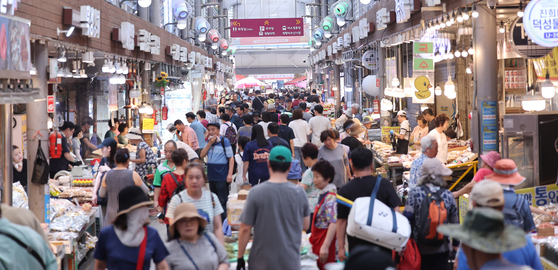
(서울=뉴스1) 박지혜 기자 = 민생회복 소비쿠폰 지급 이후 첫 주말인 27일 서울 동대문구 청량리종합시장이 시민들로 북적이고 있다. 2025.7.27 / 뉴스1
But the reality isn't so simple for business owners.
“I’m more afraid of bad reviews than fines," said 48-year-old Lee, who owns a restaurant in Busan. "Realistically, it’s hard to say no when a customer insists on a refund.”
Industry representatives are calling for stronger public awareness.
“Since the coupons were distributed, we’ve seen a rise in cash refund requests,” said a spokesperson for the Korea Franchise Association. “The government and local authorities need to actively inform the public that such refunds are illegal.”
“To prevent abuse, the government should investigate how these coupons are being converted into cash and create comprehensive countermeasures," said Jung Yeon-sung, a professor at Dankook University’s Graduate School of Business.
Translated from the JoongAng Ilbo using generative AI and edited by Korea JoongAng Daily staff.
BY LIM SUN-YOUNG [[email protected]]


with the Korea JoongAng Daily
To write comments, please log in to one of the accounts.
Standards Board Policy (0/250자)