

Philip Morris International stock unfazed by market volatility
Published: 15 Jul. 2025, 16:07
Updated: 16 Jul. 2025, 09:44
Audio report: written by reporters, read by AI
![Philip Morris International's nicotine pouch ZYN [JOONGANG SUNDAY]](https://koreaseafood.online/data/photo/2025/07/16/7eba28ff-df1e-4ad9-8edc-2455f4211985.jpg)
Philip Morris International's nicotine pouch ZYN [JOONGANG SUNDAY]
Philip Morris International, a global tobacco firm, became one of the hottest stocks among U.S. investors in the first half of this year, defying market volatility triggered by U.S. President Donald Trump's tariff rhetoric.
Philip Morris International shares steadily climbed, repeatedly hitting record highs, despite fluctuations in the broader market.
Shares briefly traded at $186.69 on June 16 before closing at $180.99 on July 10. The stock rose 49 percent from the start of 2025 and nearly 80 percent compared to July 2024.
Global stock markets — including in Korea and the United States — have been dominated by so-called “big tech” names in semiconductors, electric vehicles and AI in recent years.
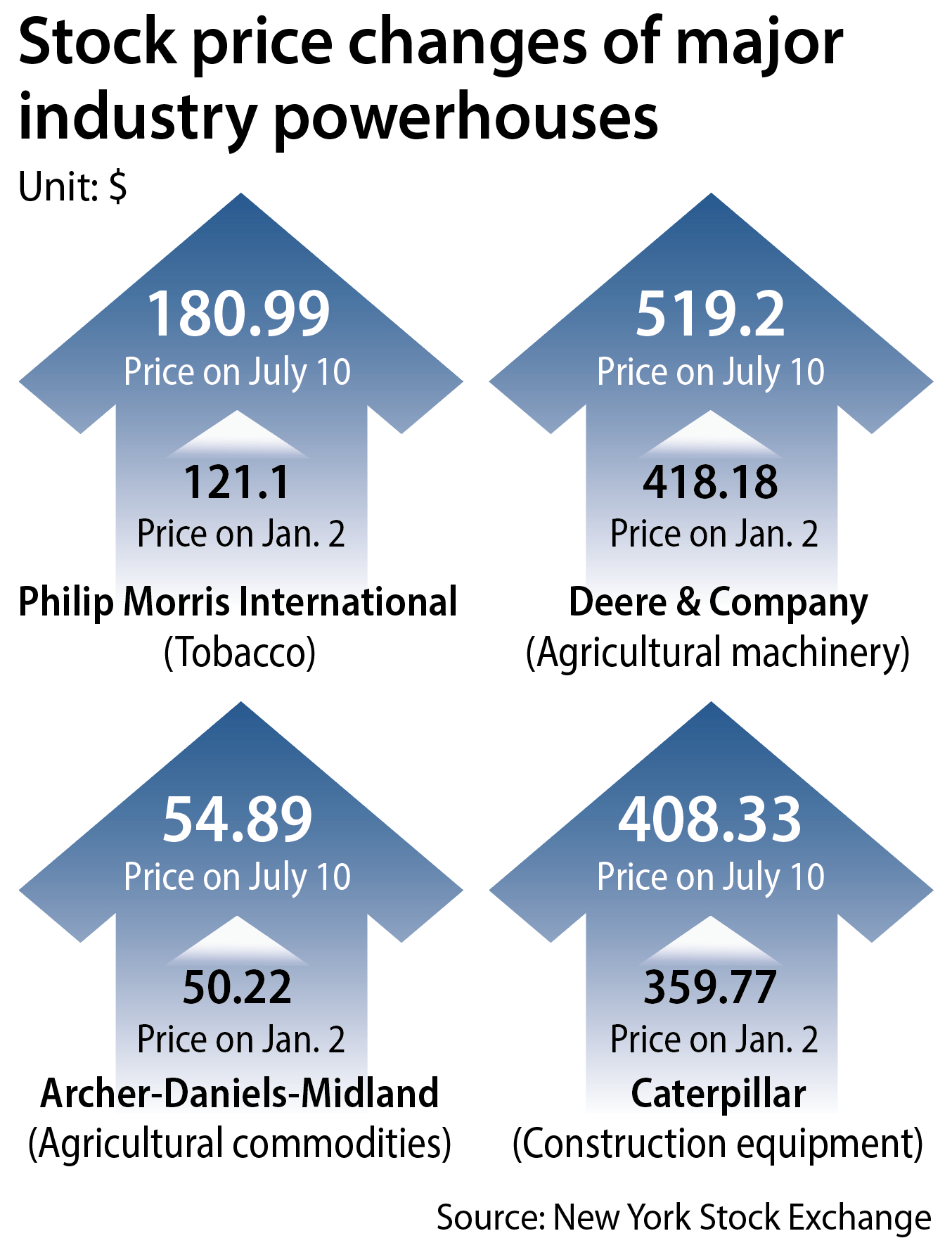
That trend persisted this year, but stocks in more traditional industries such as tobacco, agricultural machinery and heavy equipment are outpacing the market average, catching the eyes of domestic and global investors.
“Investors are gravitating toward companies like Philip Morris International, which show clear sales growth,” said Park Sang-jun, a researcher at Kiwoom Securities, in a report published earlier this year.
The traditional tobacco and agricultural machinery sectors are generally considered to have reached maturity.
![Deere & Company robotic harvester equipped with AI and autonomous driving technology [JOONGANG SUNDAY]](https://koreaseafood.online/data/photo/2025/07/16/3428b6f7-5fc6-4bf3-a9d6-657711f17025.jpg)
Deere & Company robotic harvester equipped with AI and autonomous driving technology [JOONGANG SUNDAY]
Global tobacco consumption, for instance, has been in decline since 2016.
Annual cigarette sales in Korea dropped 3.2 percent from 6.4 billion packs in 2018 to around 6.2 billion in 2023.
But companies like Philip Morris International have continued to post growth by redefining their industries through innovation.
A decade ago, Philip Morris International launched IQOS — a heat-not-burn tobacco product — opening the market for what it calls “non-combustible” tobacco.
IQOS and other non-combustible products from Philip Morris International today are available in 95 countries and used by 38.6 million people.
Following IQOS, Philip Morris International introduced the VEEV e-cigarette and the ZYN nicotine pouch, part of its broader goal of creating “a smoke-free future.”
![Officials showcase the IQOS ILUMA i series, a heat-not-burn device by Philip Morris Korea, at a launch event held at the Lotte Hotel Seoul in central Seoul on Feb. 5. [YONHAP]](https://koreaseafood.online/data/photo/2025/07/16/259dbfc2-f8e4-4eca-832f-404906c88fd8.jpg)
Officials showcase the IQOS ILUMA i series, a heat-not-burn device by Philip Morris Korea, at a launch event held at the Lotte Hotel Seoul in central Seoul on Feb. 5. [YONHAP]
IQOS received Modified Risk Tobacco Product authorization from the U.S. Food and Drug Administration, while ZYN has secured a Premarket Tobacco Product Application authorization.
“In 2023, IQOS generated $11 billion in global net revenue, surpassing Marlboro in cumulative sales over the past decade,” said Yoon Hee-kyung, CEO of Philip Morris Korea . “It took Marlboro over 60 years to achieve what IQOS did in just 10.”
Deere & Company, dubbed “Nongsla” by Korean investors — a portmanteau of nongeop, the Korean word for "agriculture," and Tesla — has been leading the sector since unveiling its self-driving tractor in 2022.
“On some farms, tractors now operate autonomously,” wrote Kim Geun-young, a professor of smart urban engineering at Kangnam University, in his book "John Deere," published earlier this year. “By 2030, we could see farms without farmers, mines without miners and golf courses without gardeners.”
These transformations have introduced a “growth premium” — typically associated with big tech names like Nvidia and Tesla — into more conventional sectors.
ZYN has seen rapid sales growth in the United States and Europe.
Market research firm Grand View Research expects the U.S. nicotine pouch market, valued at $5.4 billion this year, to reach $19.7 billion by 2030.
Based on that outlook, many securities firms and media outlets are touting Philip Morris International as a company with "strong long-term potential."
“Given its remarkable growth trajectory, it may be worth buying the stock whenever it dips,” said Sim Eun-joo, a researcher at Hana Securities.
Deere & Company is also evolving into a subscription-based platform company, offering AI-powered cultivation optimization and sensor-driven agricultural solutions.
“Deere’s revenue model is diversifying, moving from traditional machinery to precision agriculture and software-based services,” said Millius Research, which raised its target price for the company to $750 by 2027 — roughly 45 percent above current levels.
“Even manufacturing-focused companies can achieve tech-level growth if they leverage data, software and future value,” said Cho Won-kyung, head of the Global Industry-Academia Cooperation Center at Ulsan National Institute of Science and Technology.
Translated from JoongAng Sunday using generative AI and edited by Korea JoongAng Daily staff.
BY HWANG JEONG-IL [[email protected]]


with the Korea JoongAng Daily
To write comments, please log in to one of the accounts.
Standards Board Policy (0/250자)