

Korean firms leery of $1B investment threshold for U.S. incentives
Published: 24 Feb. 2025, 18:47
Updated: 24 Feb. 2025, 19:49
-
- JIN EUN-SOO
- [email protected]
Audio report: written by reporters, read by AI
![President Donald Trump, left, speaks during a ceremonial swearing-in for Secretary of Commerce Howard Lutnick in the Oval Office of the White House in Washington, Friday, Feb. 21, 2025. [AP/YONHAP]](https://koreaseafood.online/data/photo/2025/02/24/ab8371ef-c5eb-4a49-9f06-7467f8d23378.jpg)
President Donald Trump, left, speaks during a ceremonial swearing-in for Secretary of Commerce Howard Lutnick in the Oval Office of the White House in Washington, Friday, Feb. 21, 2025. [AP/YONHAP]
[NEWS IN FOCUS]
The $1 billion investment threshold presented by U.S. Commerce Secretary Howard Lutnick for firms to qualify for extra incentives does not appear to be sitting well with most big Korean businesses.
Lutnick on Friday set the minimum requirement for Korean investments at over $1 billion to qualify for incentives like fast-tracked approvals of environmental impact assessments for new factories. The announcement came during his meeting with Korea Chamber of Commerce and Industry (KCCI) Chairman Chey Tae-won in Washington.
"A dedicated team will be allocated to companies that invest more than $1 billion to promote administrative fast-tracking, although smaller-sized investments are of course eligible for other incentives," an official with knowledge of the meeting told the Korea JoongAng Daily on Monday.
Lutnick was known to have made the comment when Hanwha Group mentioned its investment of $100 million when acquiring Philly Shipyard.
The $1 billion threshold, however, seems to lack enough detail for the firms to crunch the numbers to decide their next moves.
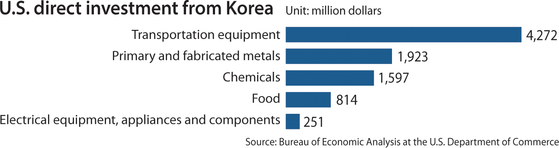
"It is not clear whether that number refers to existing investments or for upcoming ones, but if that includes existing investments, most of the big businesses in Korea have already met the condition," said Lee Hang-gu, a researcher at consulting firm Automotive Intelligence Networks.
"For the automotive industry alone, Korea has invested approximately $4 billion directly in the United States in 2023."
![An aerial view of Hyundai Motor Group's Metaplant in Georgia in construction [HYUNDAI MOTOR]](https://koreaseafood.online/data/photo/2025/02/24/24ad2a99-04ce-44e3-9819-f0f5cabd4156.jpg)
An aerial view of Hyundai Motor Group's Metaplant in Georgia in construction [HYUNDAI MOTOR]
If Lutnick's comments indicate that fresh new funds are required, Hyundai Motor and Kia will have to find a way to get on good terms with its hardline unionized workers, who will oppose any expansion of manufacturing output overseas.
"If fresh funds mean administrative fast-tracking, it would not mean much for Hyundai," said a source from the automotive industry who wished to remain anonymous.
"If a certain percentage of new investments will translate into a tariff deduction for auto imports, that could be tempting."
The Donald Trump administration has heralded a 25 percent tariff on all vehicles imported to the United States, and Hyundai Motor has been making an extensive effort to minimize the impact by closely communicating with the White House.
Speaking to reporters after attending a Trans-Pacific Dialogue forum held in Washington on Friday as the chair of SK Group, KCCI Chairman Chey said that "incentives are a prerequisite" in order for Korean companies to make more manufacturing facilities in the United States.
A KCCI-organized business delegation visited Washington from Feb. 19 to 20 to meet senior officials from the White House and Congress. The Lutnick meeting was held for 40 minutes on Friday, after the official itinerary of the business trip concluded.
BY JIN EUN-SOO [[email protected]]


with the Korea JoongAng Daily
To write comments, please log in to one of the accounts.
Standards Board Policy (0/250자)