

Outstanding household credit surpassed 1.9 quadrillion won in Q3: BOK
Published: 19 Nov. 2024, 17:19
Updated: 19 Nov. 2024, 19:27
-

- SHIN HA-NEE
- [email protected]
Audio report: written by reporters, read by AI
![A service counter at a commercial bank in Seoul on Tuesday [NEWS1]](https://koreaseafood.online/data/photo/2024/11/19/2714e967-5e6a-4329-8c20-0e02483cb29a.jpg)
A service counter at a commercial bank in Seoul on Tuesday [NEWS1]
Korea’s outstanding household credit in the third quarter set a record once again as it soared above the 1.9 quadrillion won ($1.37 trillion) threshold for the first time, central bank data showed Tuesday.
The pace of the increase also accelerated, yet the rapid surge is expected to gradually slow in the fourth quarter with the implementation of government-led loan-tightening measures.
According to preliminary data from the Bank of Korea (BOK), outstanding household credit, which includes both household loans and purchases on credit, came to an all-time high of 1.91 quadrillion won at the end of the third quarter, up 1 percent or 18 trillion won from the preceding three-month period.
The growth was steeper than the previous quarter’s 13.4 trillion won, and marked the largest quarterly jump since the 35 trillion won increase logged in the third quarter of 2021.
Outstanding household loans stood at 1.8 quadrillion won, an increase of 16 trillion won, or 0.9 percent, from the end of June.
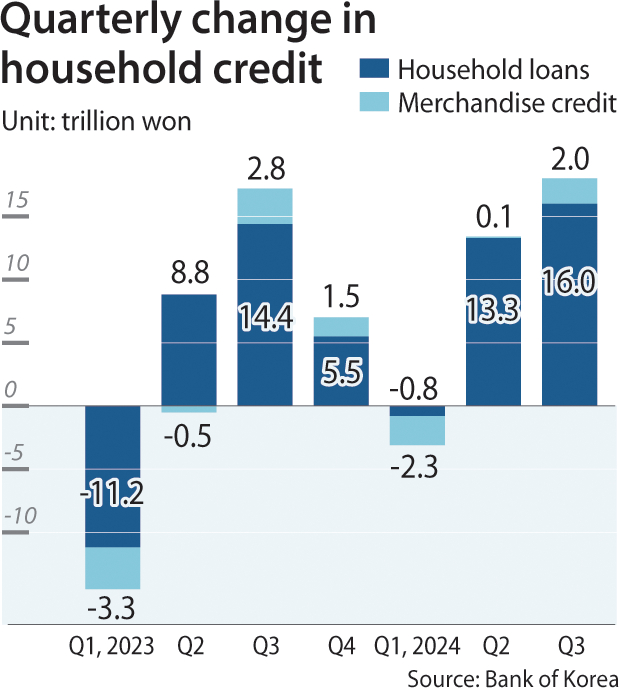
Outstanding mortgage loans, in particular, increased by 19.4 trillion won to 1.11 quadrillion won in the third quarter, while other types of loans including credit loans decreased by 3.4 trillion won to 683.7 trillion won.
Merchandise credit, which refers to the outstanding balance of credit card purchases by households, rose by 2 trillion won from the previous quarter to 118 trillion won.
The significant growth in mortgage loans in the July-September period was driven by a strong surge in housing transactions in Seoul and the surrounding regions, which peaked in July before gradually slowing down.
According to data compiled by Seoul Metropolitan Government, the number of apartment transactions reached a year high of 9,185 in July before declining to 6,479 in August and 3,099 in September.
“The cumulative growth in household credit through the third quarter this year stood at 1.5 percent, which is within the growth rate of the nominal GDP,” noted Kim Min-soo, head of the financial statistics team at the BOK, during a press briefing Thursday, signifying that the increase remains within a reasonable range relative to economic growth.
“This was due to macroeconomic policy efforts including the implementation of the second-phase stress DSR [debt service ratio] rules in September and management efforts by banks,” said Kim.
“The increase in household debt is only natural given the economic growth,” the official said. “As reducing household debt at an overly steep pace may negatively impact the real economy, the government and the BOK aim to gradually stabilize the debt-to-GDP ratio downward.”
![Kim Min-soo, left, head of the financial statistics team at the Bank of Korea (BOK), speaks during a press briefing held at BOK headquarters in central Seoul on Tuesday. [BOK]](https://koreaseafood.online/data/photo/2024/11/19/30529dd0-bdb4-4210-a2b6-d870a297d674.jpg)
Kim Min-soo, left, head of the financial statistics team at the Bank of Korea (BOK), speaks during a press briefing held at BOK headquarters in central Seoul on Tuesday. [BOK]
With the debt growth showing signs of a slowdown, banks that have raised loan interest rates to curb the demand while lowering interest rates for savings are now facing pressure from the authorities to reduce borrowing costs to mitigate the heavy interest rate burden.
“Banks have said that they would strengthen loan management by focusing on non-price factors [such as the purpose of the borrowing] rather than adjusting interest rates,” said Financial Supervisory Service Deputy Gov. Kim Byung-chil following a meeting with bank CEOs on Nov. 14.
“The chief executives explained that the public would begin to feel the actual effects of the interest rate reduction by next month,” Kim said.
BY SHIN HA-NEE [[email protected]]


with the Korea JoongAng Daily
To write comments, please log in to one of the accounts.
Standards Board Policy (0/250자)