

The 'Culinary Class Wars' judge who became a middle-class icon
-

- LEE JIAN
- [email protected]
-

- KIM JU-YEON
- [email protected]
![Paik Jong-won as a judge on Netflix's cooking survival show "Culinary Class Wars" [NETFLIX]](https://koreaseafood.online/data/photo/2024/10/24/a56125d3-5ca0-47b1-8f1c-2de3fabe5a36.jpg)
Paik Jong-won as a judge on Netflix's cooking survival show "Culinary Class Wars" [NETFLIX]
When Netflix’s hit cooking survival show “Culinary Class Wars” set out for production last year, Paik Jong-won, CEO of F&B company Theborn Korea, was the obvious choice for its headlining judge.
“The production essentially took off when Mr. Paik agreed to do the show,” producer Kim Hak-min said during the program’s news conference last month. “Without him, we wouldn’t have ‘Culinary Class Wars.’”
Business moguls don't commonly judge reality shows in Korea, let alone those centered around cooking. But Paik, 58, is his own character.
His day job has him heading a multi-billion won food empire built on dollar-fifty coffee and other budget items, targeting a growing group of cash-strapped consumers in Korea. He has encountered potentially serious business hiccups on that 20-year journey to culinary stardom, but his media savvy has helped him not only overcome them, but also spin them to his advantage, creating a more complex image for himself than that of the typical business owner. Today, he is known as a food expert, celebrity and trusted patron of Korea’s middle class. His company is set to go public next month.
![Paik Jong-won, CEO of Theborn Korea [NETFLIX]](https://koreaseafood.online/data/photo/2024/10/24/0166c079-e063-4ada-8486-c9bd802c9ccc.jpg)
Paik Jong-won, CEO of Theborn Korea [NETFLIX]
It is hard to escape Paik's image in Korea. His face is plastered on the storefronts of his 25 food and beverage franchises. He is featured on at least one TV station at any given time and appears in weekly YouTube videos on a channel run by Theborn Korea’s entertainment subsidiary, TMK. Many, due to the confidence and expertise with which he discusses food on camera, assume him to be a professional chef.
But despite the omnipresence of his likeness in Korea's culinary high society, Paik has never actually been trained as a cook. He has a degree in social welfare, which he manages to apply to nearly everything he does.
It is Korea's middle class, not generally the most sympathetic to food empire CEOs, that has latched onto Paik as loyal followers over the past decade or so. He is praised as unique, lionized as irreplaceable in such circles; his widespread favorability has reportedly even made him the subject of potential presidential nominee discussions.
While Paik claims not to have political ambitions, there is no doubt that his popularity is uniquely entrenched in the hearts of Korea's work force. But with a hit reality show behind him and a stock market debut looming ahead, a question grows ever-more pressing: How long can that popularity last?
The man behind the brand
Step inside a franchise restaurant run by Theborn Korea and two things are evident: The menu is simple, and the prices are cheap.
A bowl of jjajangmyeon (Chinese-style black bean noodles) at Chinese restaurant chain Hong Kong Banjeom, for instance, costs 6,500 won ($4.71), around 800 won cheaper than the average price of a bowl in Seoul, which was 7,308 won as of September, according to the Korea Consumer Agency.
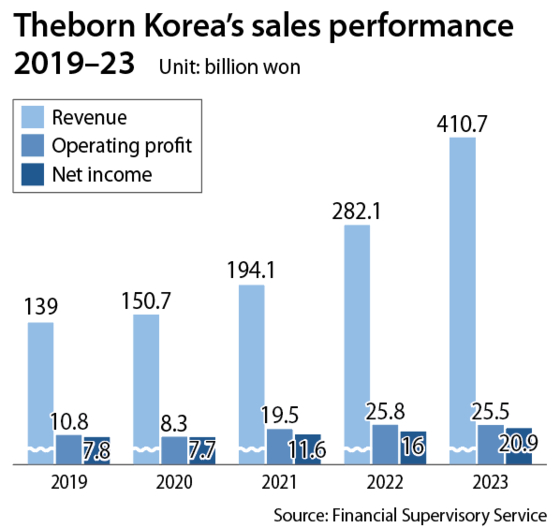
Theborn Korea, launched in 1994 just months after Paik began his restaurant career with the acquisition of Wonjo Ssambapjip, currently operates 149 brands. A total of 149 overseas shops run in 14 countries including in Japan, China and the United States. The menus span global cuisines, from coffee to pasta, jjajangmyeon to tonkatsu (pork cutlets), but one focus runs through them all: affordability.
The same applies to Theborn Korea chain Paik’s Coffee, one of the earliest budget franchises to enter the Korean beverage market in 2006, with costs on par with those of competitors like Mega Coffee and Compose Coffee.
![Paik's Coffee franchise in Seodaemun District, western Seoul [JOONGANG ILBO]](https://koreaseafood.online/data/photo/2024/10/24/7abba8a8-dc11-466c-95d3-5657dd7a2d52.jpg)
Paik's Coffee franchise in Seodaemun District, western Seoul [JOONGANG ILBO]
As the price of eating out rises significantly — as much as 2.8 percent on year this year, outpacing the growth rate of consumer prices by 2.7 percent, according to Statistics Korea — and restaurants that were once midrange grow further out of reach, the relative affordability of Paik’s franchises continues to stand out.
More people feel squeezed as the cost of living soars while income remains stagnant. The average monthly income per household rose 3.9 percent, to 502,000 won, between 2022 and 2023, representing a decline when adjusted for inflation, per Statistics Korea.
“It is expensive to eat out in Korea these days, and it can be difficult to find decent, affordable meals at restaurants,” said Lim So-yoon, a 27-year-old part-time worker in Yeongdeungpo District, western Seoul. “Franchises guarantee a certain level of taste, and I tend to go to Theborn restaurants when I crave Asian food.”
![Upcoming show “Chef Paik & Les Miserables” will feature Paik Jong-won educating men, at their lowest in life, through spartan training to give “those downtrodden a second chance at life,” according to lead producer Han Kyung-hoon. Pictured is a still shot of the teaser for the eight-episode show that will air on ENA from Nov. 30. [ENA]](https://koreaseafood.online/data/photo/2024/10/24/bd638188-68f7-45f4-98f4-67bf71d375ea.jpg)
Upcoming show “Chef Paik & Les Miserables” will feature Paik Jong-won educating men, at their lowest in life, through spartan training to give “those downtrodden a second chance at life,” according to lead producer Han Kyung-hoon. Pictured is a still shot of the teaser for the eight-episode show that will air on ENA from Nov. 30. [ENA]
If Paik’s food feeds the country’s middle class, media appearances empower them.
For instance, the reality entertainment show “Baek Jong-won’s Alley Restaurant,” (2018-21) which aired on SBS, filmed an imperious, yet candid Paik mentoring struggling small business owners and overturning their restaurants.
His YouTube series “Paik Jong Won, Becoming a Market” (2023) showcased Theborn Korea’s work to help regional governments revitalize their tourism and traditional markets. The show saw Yesan Market in South Chungcheong, a bygone marketplace, transformed into a vibrant tourist attraction after Paik consulted its vendors and remodeled five of its eateries. Within one year, the market recorded over 3 million visitors.
![Yesan Market in South Chungcheong booms with people after airing on Paik Jong-won's YouTube series "Paik Jong Won, Becoming Market" in 2023. [YONHAP]](https://koreaseafood.online/data/photo/2024/10/24/3cc674ab-a841-426b-8afa-78bce3b82e21.jpg)
Yesan Market in South Chungcheong booms with people after airing on Paik Jong-won's YouTube series "Paik Jong Won, Becoming Market" in 2023. [YONHAP]
The common thread underlying his media appearances is that they portray him as a charitable figure rather than a profit-seeking business owner, according to pop culture critic Jeong Deok-hyun.
“Everything that he does in front of a screen somehow traces back to servicing the public. Even in his mukbang [eating shows] he makes sure to mention things like the globalization of hansik [Korean food]. These portrayals make the public feel that he isn’t acting for himself, but for the public and contributing positively to society. This significantly contributes to creating his likable and trustworthy image.”
When promoting “Culinary Class Wars,” Paik and the producers continuously pushed the rhetoric that they were doing the show to “help” and “revitalize” Korea’s restaurant industry.
TV producer Han Kyung-hoon also noted Paik’s penchant for social service. He worked with Paik on the upcoming ENA reality show “Chef Paik & Les Miserables” whose proposal Paik initially viewed favorably because the program could “help people socially.”
“He likes to solve problems himself and sees his projects through,” Han said. “He is loyal like that.”
The brand behind the man
It can nevertheless be difficult, from a market perspective, to separate the profit-driven Theborn Korea from its leader, Paik, who owns a 76.69 percent stake in the franchiser. Controversies that impact one have a tendency to tarnish the other.
Most recently, franchisees of Theborn Korea's fried pork chain Yeondon Ball Katsu accused the company of inflating its expected sales and profit to lure store applicants, and of interfering with owners’ pricing decisions, in a complaint filed to the Fair Trade Commission in June.
![Pork cutlet balls sold at Paik Jong-won's franchise Yeondon Ball Katsu [SCREEN CAPTURE/THEBORN KOREA]](https://koreaseafood.online/data/photo/2024/10/24/f1334ceb-229e-45fc-8e43-e345b07c4458.jpg)
Pork cutlet balls sold at Paik Jong-won's franchise Yeondon Ball Katsu [SCREEN CAPTURE/THEBORN KOREA]
Its beginnings were rocky from the start. The franchise, originally an independent store, was revamped and launched as a chain, dually owned by Paik and its original operators, in 2021 through the aforementioned reality show “Baek Jong-won’s Alley Restaurant.” But a KPI News report revealed, soon after, that three of the chain's four initial franchisees were either family members or acquaintances of Paik's, while other applicants had been barred — fueling the fire of critics who accused the CEO of using his media appearances to unfairly benefit his company and personal connections.
Paik, in response, claimed that he had merely selected his contacts as franchisees to help the chain find its footing through reliable guidance in its early stage. He has continuously denied the Yeondon Ball Katsu franchisees’ accusations.
The claims have nevertheless augmented growing public suspicion that Paik's franchises, boosted by his media popularity, could be harming local businesses.
Such discourse was ongoing as early as 2018, when Paik spoke on the issue while testifying as a restaurant expert during a parliamentary hearing. “All I did was grow my franchise so that the store owners could earn well; I don’t get what’s wrong here,” he said, hitting back to Rep. Jung Yoo-seop’s question of whether he would limit the number of franchised stores, which were “stealing all the customers away.”
![Paik Jong-won on his YouTube channel [SCREEN CAPTURE]](https://koreaseafood.online/data/photo/2024/10/24/b8b53f4d-c85f-4294-9477-ac5b78d6bc56.jpg)
Paik Jong-won on his YouTube channel [SCREEN CAPTURE]
More recent rebuttals came from his YouTube channel, which had nearly 6.6 million subscribers as of Tuesday.
Paik denied the Yeondon Ball Katsu protesters' claims in a 15-minute YouTube video posted in July, saying news had portrayed him unfairly and that the franchisees had made incorrect calculations. The video had 4.97 million views as of Tuesday and a slew of comments supportive of Paik; other store owners who were not part of the complaint have also spoken out in his favor.
“Having one’s own meaningful media channel to speak through is an incredibly powerful thing,” said culture critic Jeong.
The success with which Paik leverages that mouthpiece to regain the trust of Korea's working class could decide the fate of his hard-fought fortune in the coming months. Theborn Korea aims to go public before the end of this year and passed preliminary review in August, but the Yeondon Ball Katsu case is still ongoing. Though the company is working to court overseas investors, it will still hope to win and hold the trust of the Korean market — and so, most importantly, will its flagship figure.
For now, Paik is lucky. The protests of Yeondon Ball Katsu's franchisees have been somewhat drowned out by the success of “Culinary Class Wars.”
But the conflict underscores the fact that pleasing the public is a tricky business, even for Paik. The burly foodie reigns supreme, for the moment.
BY LEE JIAN, KIM JU-YEON [[email protected]]


with the Korea JoongAng Daily
To write comments, please log in to one of the accounts.
Standards Board Policy (0/250자)