

Number of births rises in August for 2nd month of growth
Published: 23 Oct. 2024, 17:13
Updated: 23 Oct. 2024, 21:58
-
- SHIN HA-NEE
- [email protected]
Audio report: written by reporters, read by AI
![Pedestrians walk on a crossroad in Jongno District, central Seoul, on Wednesday. [NEWS1]](https://koreaseafood.online/data/photo/2024/10/23/12d46a58-b928-495a-8da5-0672039f80b0.jpg)
Pedestrians walk on a crossroad in Jongno District, central Seoul, on Wednesday. [NEWS1]
Korea saw another major yearly increase in births in August, extending strong growth for a second consecutive month, data showed Wednesday.
The uptrend, driven by a base effect from last year’s dismal birthrate and a post-pandemic increase in marriages, may continue through the end of this year, suggested Statistics Korea.
The number of newborns in August rose 5.9 percent on year to 20,098, the steepest yearly growth rate for the month since the 6.1 percent logged in 2010, according to data by the state statistics agency.
The on-year jump followed a 7.9 percent increase in July, which was the largest increase for a July figure since 2007.
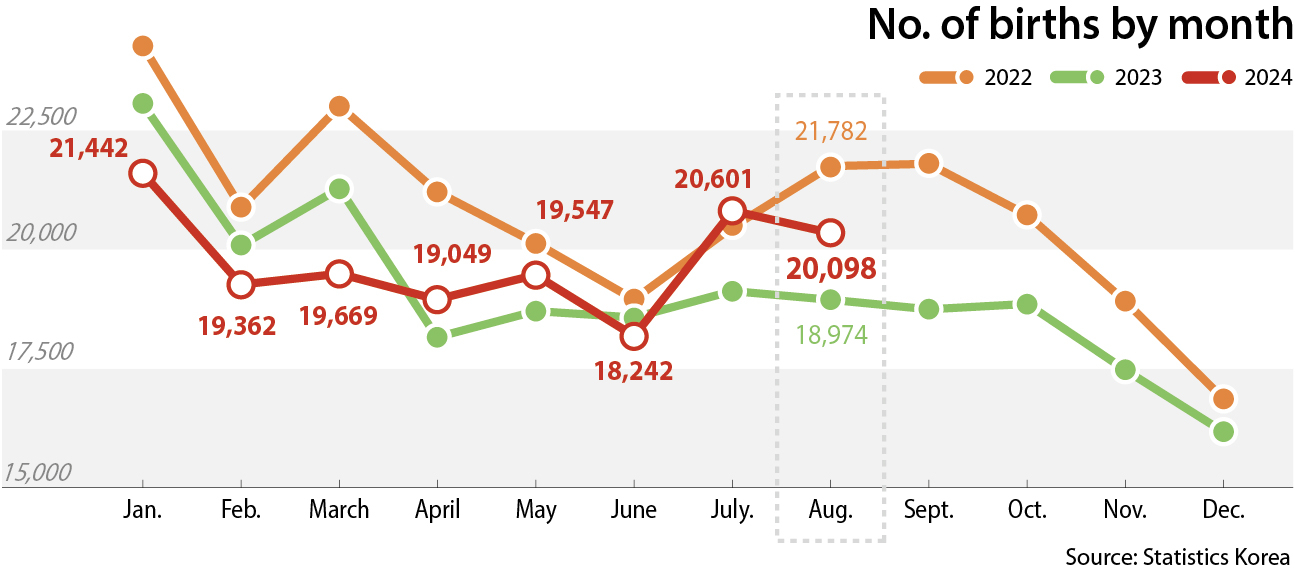
The number of births broke an 18-month downward streak with an uptick in April by 2.8 percent, followed by a 2.7 percent increase in May. The growth was reversed in June with a 1.8 percent decrease before rebounding again in July.
While the cumulative number of births from the January-August period still fell 0.4 percent from the same period last year to 158,011, Statistics Korea expects that the yearly figure may rebound this year if the growth trend persists.
“Considering the duration of the post-pandemic increase in marriages, there is a possibility that births may further rise through the remainder of the year,” said Lim Young-il, head of population trends at the state agency.
The latest rebound is attributed to post-pandemic growth in the number of marriages starting in August 2022 that ran for eight straight months, as it typically takes about two to three years for a first child to be born to a couple after they get married, according to Statistics Korea.
Lim also suggested that the government’s policy efforts to boost the country’s ultralow birthrate have encouraged younger generations to get married, saying, “The significant increase in marriages among those in their early 30s can be attributed to the impact of government policies.”
The number of marriages rose 20 percent from a year prior to 17,527 in August, logging an on-year increase for the fifth consecutive month. The extent of the growth has also remained relatively strong, from 24.6 percent in April and 21.6 percent in May to 5.6 percent in June and 32.9 percent in July.
According to a survey by the Presidential Committee on Aging Society and Population Policy published on Oct. 14, 65.4 percent of unmarried respondents said that they are open to marriage, up 4.4 percentage points from the committee’s previous survey in March.
Earlier this year, Statistics Korea projected this year's fertility rate to be a record low of 0.68, even lower than last year’s 0.72. If the number of births posts an on-year increase this year, it will mark the first rebound since 2016, bringing an end to eight consecutive years of rapid decline.
Meanwhile, the number of deaths increased 5.6 percent on year to 32,244, resulting in a net population decline of 12,146 people in May. Korea's population has been shrinking for 58 consecutive months.
BY SHIN HA-NEE [[email protected]]


with the Korea JoongAng Daily
To write comments, please log in to one of the accounts.
Standards Board Policy (0/250자)