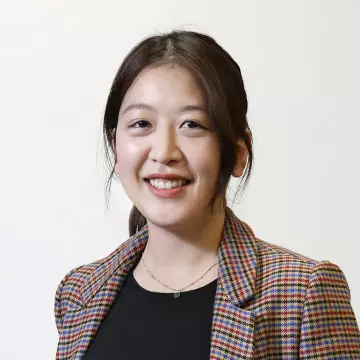
National Museum of Korea Director You Hong-june bows in apology before the National Assembly audit session in Yeouido, western Seoul, on Oct. 19.YONHAP
National Museum of Korea Director You Hong-june bowed twice in apology during a National Assembly audit Monday, acknowledging his failure to properly verify a calligraphy work in his personal collection before displaying it at the museum.
The director said he arbitrarily identified the problematic piece as the work of the independence collaborator Park Won-geun (1912-50) after acquiring it at a 2019 online auction for 50,000 won ($37). The work was later revealed to have been written by a pro-Japanese collaborator, Park Jung-yang, who used to go by the name Park Won-geun.
“I was reluctant to disclose that I had made a significantly huge mistake as an art historian,” the director said, apologizing to the public, faculty members of the museum and the family of the late Park Won-geun, on Monday before being questioned.
“The value of the museum built on the support that has been given [by the visitors] and the effort made by the faculty member of the museum collapsed due to my significant mistake.”
The calligraphy in question, titled "Ilban Sigugeun," was originally presented as the work of an independence activist from North Chungcheong, Park Won-geun, who fought against Japanese colonial rule (1910-1945) as part of the museum’s special exhibition, “The Korean Table: Food, Nature, and Life,” which opened July 1.
The calligraphy work "Ilban Sigugeun"NATIONAL MUSEUM OF KOREA
"Ilban Sigugeun," or “Even a bowl of rice is a gift from the nation,” was coined by the 16th-century Buddhist monk Yeonggyu, who used the phrase to mobilize soldier monks against Japanese invaders during the 1592-98 Imjin War.
You said he had authenticated the calligraphy work "by himself," as a specialist in calligraphy history, after acquiring it at an online auction, effectively admitting that the piece never went through the verification process normally required for a third party's work entering the museum.
"When I first obtained it at the auction, it said it was the work of Park Deok-won, which I corrected to Park Won-geun," You said.
"Since Park Won-geun wasn't a professional calligraphy artist, there wasn't much data [on his calligraphy style]. The words 'Ilban Sigugeun,' originally used by Yeonggyu, also fit perfectly with [what would have been written by] an independence activist. I thought it was a new discovery of Korea's modern history."
The piece received extra attention when a photo of Park Won-geun's son tearing up before the work went viral shortly after the exhibition launched.
It was more than a month later, on Sept. 7, that the museum confirmed the work had been wrongfully attributed and pulled it from the exhibition.
You has since apologized four times, but it was not until lawmakers sent him preliminary questions for the National Assembly’s audit that the work was revealed to be from his personal collection.
"At first, I didn't reveal that it was mine because I worried it might be perceived as boasting. Then [when the attribution was revealed], I didn't say it because I was ashamed and wished it would just pass by," the director said.
Asked whether he had included his own work in the national museum’s exhibition to raise its market value, You said he “did not consider such consequences” because he planned to donate the piece to the Buyeo Cultural Center for its county museum.
An embroidered table cover, currently on display in the same exhibition, "The Korean Table: Food, Nature, and Life," also belongs to director You's collection. He said he plans to donate that piece to the Jeonju National Museum.