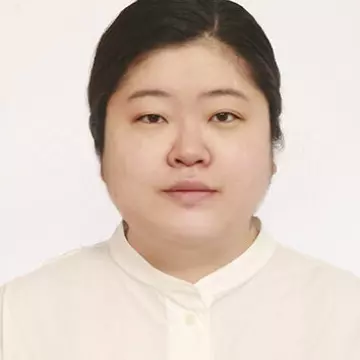
Chinese curator Ruan Yuanlai, center, speaks during a press conference announcing Chinese artists' withdrawal from the Gwangju Biennale, at the Ha Jung-woong Museum of Art in Gwangju on Sept. 3.YONHAP
The Embassy of China in Korea demanded on Thursday that the Gwangju Biennale immediately correct what it called a wrongful naming of Taiwan, warning of damage to relations between Beijing and Seoul, as Chinese artists announced their withdrawal from this year’s edition of the arts event.
“China reserves the right to defend its own interests,” a Chinese embassy spokesperson said in a statement released Thursday. “There is only one China in the world, and Taiwan is an inalienable part of Chinese territory.”
The dispute began with the name of the Taiwanese exhibition. The Gwangju Biennale Foundation changed the National Taiwan Museum of Fine Arts’ space from “Taiwan Pavilion” to “NTMoFA Pavilion,” then restored the original name on Aug. 25 after the Taiwanese side objected. Dai Bing, the Chinese ambassador to Korea, conveyed regret and concern over this to Jeonnam-Gwangju Mayor Min Hyung-bae, and the Chinese team stopped installing its works last Sunday.
The Chinese exhibition team announced its decision to pull out from the biennale on Thursday in Gwangju, a day before the biennale’s opening ceremony scheduled for Friday. The Chinese team had voted unanimously to pull out, according to Ruan Yuanlai, the curator of the Chinese pavilion.
“We attach great importance to the Gwangju Biennale and have been actively preparing to take part in this exhibition, and we have put a great deal of care into the curated show in the Chinese pavilion,” Ruan said during the press conference on Thursday. “But the Gwangju Biennale’s use of an incorrect name concerning the participation of the China and Taiwan regions has brought about a situation in which political factors intervene in the domain of art.”
“The Chinese exhibition team cannot accept this and has unanimously decided to withdraw from the exhibition to express its strong protest,” Ruan added.
Poster for the pavilion project at the 2026 Gwangju Biennale shows Taiwan alongside China.GWANGJU BIENNALE FOUNDATION
Jeonnam-Gwangju and the Gwangju Biennale Foundation reaffirmed their respect for the “one China” position and apologized for procedural shortcomings on Monday.
“The name 'Taiwan Pavilion' is only an expression left to the participating artists within the realm of art. It does not mean that the merged Jeonnam-Gwangju or the Gwangju Biennale recognizes Taiwan as a state,” the two entities said.
The Chinese Embassy said Thursday that it and the Chinese Consulate General in Gwangju had raised the matter repeatedly with the city government and the foundation, pressing the Korean side to keep the event in line with Seoul’s China policy, international law and international practice.
“At the United Nations, the only designation for Taiwan is ‘Taiwan, Province of China’ and the Taiwan region’s participation in multilateral events must be handled according to the one China principle,” the spokesperson’s statement read.
Organizers of the biennale had held “stubbornly to a mistaken course” and openly allowed the Taiwan region to use a name that “does not fit its status,” which is “a serious breach of the principle” that “directly damages the political foundation of relations between China and Korea,” the statement went on.
“No person and no political force will succeed in using the ‘Taiwan card’ to obstruct or damage China-Korea relations.”
The Gwangju Biennale has run its pavilion project alongside the main exhibition since 2018, bringing in art and cultural institutions from Korea and abroad. Sixteen national pavilions and 11 institutions, including China and Taiwan, were due to take part this year. It is the first time since the project began that both China and Taiwan have signed simultaneously.
The fallout of the naming dispute at the Gwangju Biennale has since reached local government. The standing committee of the Guangzhou Municipal People’s Congress recently notified the merged Gwangju and South Jeolla council that it was canceling a visit scheduled for next Monday through Tuesday, the council said Thursday.
Six officials, led by deputy secretary general Li Haizhou, were due to travel to the region next week, with the trip billed as an official visit to strengthen ties between Guangzhou and the merged Gwangju, which have exchanged delegations since the old Gwangju city council and the Guangzhou congress signed a friendship agreement in 2012.
The cancellation of the Guangzhou congress’s visit is read as an expression of Beijing's displeasure over the naming dispute at the Gwangju Biennale and as a sign of escalating diplomatic tensions.
The 16th Gwangju Biennale holds its opening ceremony on Friday under the theme “You Must Change Your Life,” with opening for the general public beginning on Saturday. It runs until Nov. 15.