A woman holds a smartphone as she speaks into the phone.GETTY IMAGES
“I’m learning Korean very hard, so I hope everyone [will] freely talk to me!” an anonymous user wrote in English on a language exchange app, alongside nine photos from her daily life.
Within hours, more than 100 users had liked the post, leaving comments such as "Hello" and "Nice to meet you" in Korean.
A decade ago, language exchange often meant meeting a stranger at a cafe, joining a university club or attending a conversation class. Today, it can begin with a single post on a smartphone.
GoogleAdmanager-KJD
According to market research firm Business Research Insights , the global language exchange app market is projected to grow from $6.3 billion in 2026 to $21.2 billion by 2034. The firm forecasts a compound annual growth rate of 14.4 percent between 2026 and 2034.
As AI tools, online courses and free educational content continue to proliferate, what keeps learners turning to language exchange apps?
A screen capture from HelloTalk, a language exchange app, shows a prompt asking users about their purpose for using the serviceSCREEN CAPTURE
Deeper understanding, natural conversation
Felicia Ajibade, a self-taught Korean teacher and translator from Nigeria, considers language exchange apps one of the most valuable tools in her Korean-learning journey.
"Over the years, these apps have helped me improve my speaking and listening skills, become more comfortable expressing myself naturally and learn everyday expressions that I probably wouldn't have encountered in textbooks," Ajibade told the Korea JoongAng Daily.
"They've also given me insight into Korean culture, humor and communication styles, which I think is an important part of learning any language."
For some learners, the biggest appeal is the lower social pressure.
Amyah Maze, a digital creator, recommended the Seoul-based app Maum for learning Korean during an interview posted on creator K Explorer's Instagram account.
"It's easier to speak to people. You don't see anyone, so it's less nerve-wracking," she said, adding that she could simply chat through text instead of calling whenever she didn’t feel like making a call.
Maum matches users based on personality traits, hobbies and interests, reflecting a broader shift toward conversation-first language learning.
Another platform that helped popularize the approach is HelloTalk, founded in China in 2012.
The company says it has more than 70 million registered users across over 200 countries and territories. Users can find language partners, exchange messages, post public updates and join group voice chats to practice in real time.
Other homegrown options, including K-friends and Hilokal, are also gaining traction. Some learners in Korea also use the community section of the secondhand marketplace app Karrot to find nearby language partners for offline meetups.
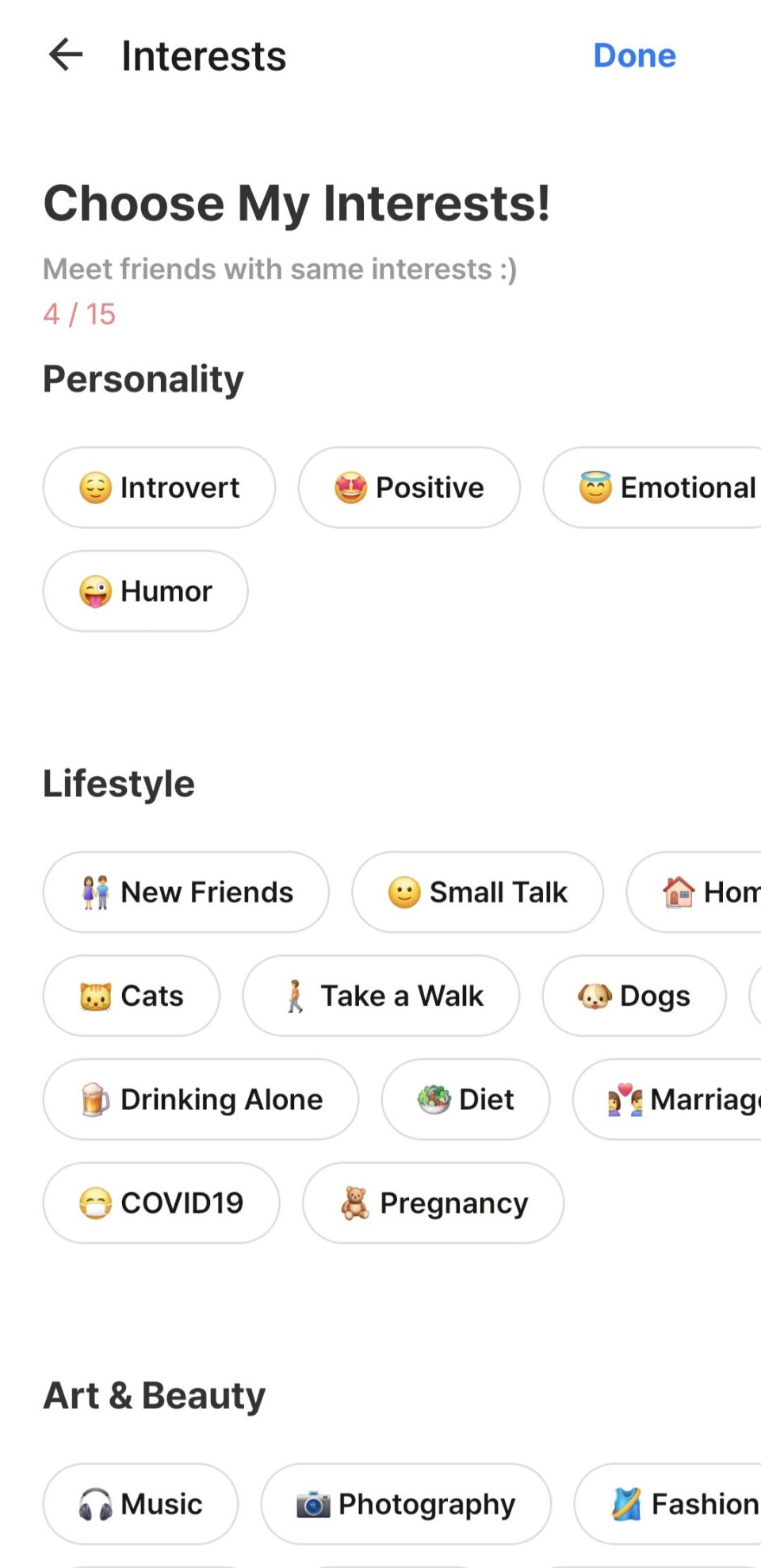
A screen capture from Maum, a language exchange app, asks users to choose their interests when creating an account.SCREEN CAPTURE
A tool, not a replacement
Despite their convenience and relatively low cost, experts say language exchange apps work best alongside structured study.
"When it comes to language learning, it's still best to learn from people [in person]," said Min Byoung-chul, a veteran English educator and endowed professor of business administration at Chung-Ang University, advising to treat apps as a supplement to structured language learning, such as enrolling in language institutions or taking online courses.
He added that learners should especially be mindful of whom they interact with, as users join such apps for different reasons and may not be dedicated to learning.
Kim Ji-eun, a 29-year-old freelancer, used language exchange apps to improve her English while hoping to learn some Cantonese.
She made several online friends and language partners, often exchanging Instagram accounts, but found that many users quickly stopped using the platforms.
"I feel like many people create accounts out of curiosity and then stop using the app soon afterward," Kim said.
Ajibade echoed the sentiment, saying that language exchange apps should complement.
"I teach Korean to beginners and often encourage my students to try these apps once they have a basic understanding of the language," Ajibade said.
"Formal learning gives you the tools, and language exchange gives you the opportunity to use them in meaningful conversations."