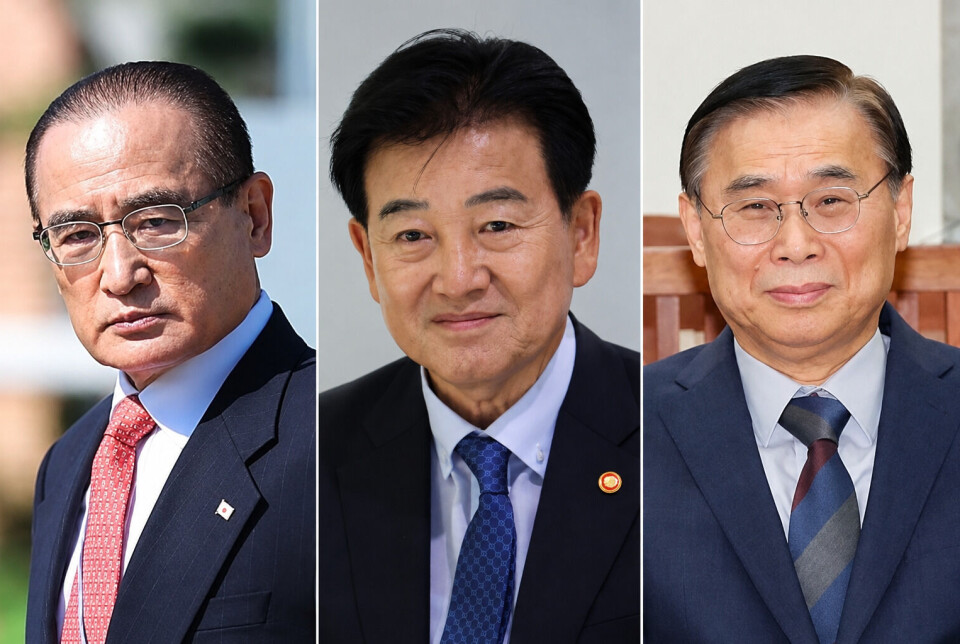
Three men shaped Korea's decision to deploy troops to Iraq. 23 years later, they're doing the same for Hormuz.
The national security adviser, the National Intelligence Service director and unification minister are set to advise President Lee Jae Myung on sending troops to the Strait of Hormuz.
From left: National Security Adviser Wi Sung-lac, Unification Minister Chung Dong-young and National Intelligence Service Director Lee Jong-seokJOONGANG ILBO
South Korea’s latest debate about sending troops to the Strait of Hormuz brings about déjà vu, as the three men who took opposing sides over troops’ deployment to Iraq 23 years ago are once again influencing the final decision.
National Security Adviser Wi Sung-lac, National Intelligence Service (NIS) Director Lee Jong-seok and Unification Minister Chung Dong-young will soon be back at the discussion table.
Twenty-three years ago, the three men were divided regarding how much South Korea owed its ally, and they are now set to advise President Lee Jae Myung on a similar matter in the coming days.
“Sending troops [overseas] is a really difficult matter [to discuss],” President Lee said during a town hall meeting with civic societies at the Blue House in central Seoul on Friday. “There has been no progress [on the decision].”
His remarks came hours after liberal lawmakers largely aligned with the administration fiercely opposed the prospect of deploying troops to the Strait of Hormuz.
They also belie the flurry of behind-the-scenes activity.
The government is expected to begin weighing the prospect and potential scale of the deployment at a working-level National Security Council (NSC) meeting on Thursday. The NSC consists of the president, prime minister, foreign minister, unification minister, defense minister and director of the National Intelligence Service.
U.S. President Donald Trump raises his fist as he boards Air Force One at Morristown Airport in New Jersey on Sept. 7.AP/YONHAP
Officials will brief Lee shortly after he returns from France, then reconvene next Tuesday to consider whether to pursue parliamentary approval for a deployment.
The NSC Standing Committee may begin substantive deliberations on Sept. 17, but that meeting could revive an old fault line.
In September 2003, the United States asked South Korea to send additional combat troops capable of conducting independent operations. The Ministry of Foreign Affairs and the NSC were sharply divided on their response.
Wi, who was then head of the Foreign Ministry’s North American Affairs Bureau, was in a key position to shape Seoul’s response to Washington’s request.
Then-President Roo Moo-hyun, center, visits northern Iraq, where Korean forces were deployed, on Dec. 8, 2004.JOONGANG ILBO
He saw outright opposition to deployment as unrealistic and argued that sending troops in some form was inevitable. He grounded his position in what he called the “national interest.”
But Moon Jae-in, now a former president and then a presidential aide, said that the war was difficult to justify on moral grounds.
“Opposition to sending troops had become almost a dogma within the ruling bloc, but Wi took a more pragmatic view by factoring in [Seoul’s] relations with Washington,” a source familiar with the discussions at the time said.
Wi and then-Foreign Minister Yoon Young-kwan ultimately won over then-President Roh Moo-hyun. By mid-October, the president had agreed in principle to send additional troops.
This time as well, Wi is said to be pushing for a deployment to the Strait of Hormuz as Seoul looks to avoid further straining its relationship with Washington.
But 23 years ago, the question evolved from whether to deploy troops to how far South Korea should go in its support. The alliance-minded camp in the Foreign Ministry and Ministry of National Defense considered sending a sizable combat force, with the Defense Ministry even proposing 10,000 troops.
Korean troops arrive at a Korean airport after completing their deployment to Iraq in December 2008.JOONGANG ILBO
On the opposite end stood Lee Jong-seok, the NSC deputy secretary at the time. The more autonomy-minded camp around him favored a limited, largely noncombat deployment.
“Whatever South Korea stood to gain would be wiped out by sending 10,000 combat troops,” Lee Jong-seok’s side argued.
Despite President Roh’s order for officials to keep quiet on the issue, Lee Jong-seok told the press directly that “a deployment of around 2,000 to 3,000 troops would be reasonable” in October 2003.
Other officials quickly pushed back on his public remarks, and the reaction exposed a rift that had largely remained behind closed doors until then.
In the end, Roh opted for a middle ground: a Zaytun Division of fewer than 3,000 troops, focused primarily on reconstruction. Some combat personnel joined the mission, but the final plan landed closer to the autonomy-minded position.
“Roh made the most pragmatic choice available,” NIS Director Lee Jong-seok told the JoongAng Ilbo last year.
The Strait of Hormuz off Bandar Abbas, Iran, on Sept. 6AP/YONHAP
Unification Minister Chung, the then-chairman of the ruling and liberal Uri Party, had a different stance.
In February 2004, the Uri Party was locked in a bitter fight over sending additional troops.
“Being the ruling party means taking responsibility, not just carrying the title,” Chung said at the time. He ultimately broke the impasse and, with the party’s backing, put a consent motion for the deployment forward.
He had supported the first deployment, saying that Seoul needed to “expand common ground with Washington” to tackle North Korea’s nuclear program. For him, the deployment was a strategic choice to buy Seoul greater diplomatic latitude in dealing with Pyongyang through cooperation with Washington.
Chung also appears to see the Hormuz question as closely tied to prospects for inter-Korean and North Korea-U.S. dialogue.
“There are signs that talks between Pyongyang and Washington could resume, and it would be unfortunate for the deployment issue to disrupt that opening,” a source close to Chung said. “Ultimately, the decision will come down to what best serves the Korean Peninsula.”
This article was originally written in Korean and translated by a bilingual reporter with the help of generative AI tools. It was then edited by a native English-speaking editor. All AI-assisted translations are reviewed and refined by our newsroom.