Actors, YouTubers and filmmakers face mounting criticism and potential legal action over the film’s portrayal of the 1974 assassination of first lady Yuk Young-soo.
Actors and production team members pose for photograph at the “The Assassin(s)” screening event held on Sept. 21.NEWS1
The backlash over alleged historical distortions in “The Assassin(s)” is growing.
Actors who appeared in the film, attended screenings or recommended it have landed on online boycott lists, while prominent YouTubers have deleted reviews or publicly explained themselves.
“The Assassin(s),” which opened last Wednesday, revisits the assassination of first lady Yuk Young-soo, the wife of then-President Park Chung Hee, which took place on Aug. 15, 1974. It follows detectives and journalists who harbor doubts about the government’s findings and pursue the forces they believe were behind the shooting.
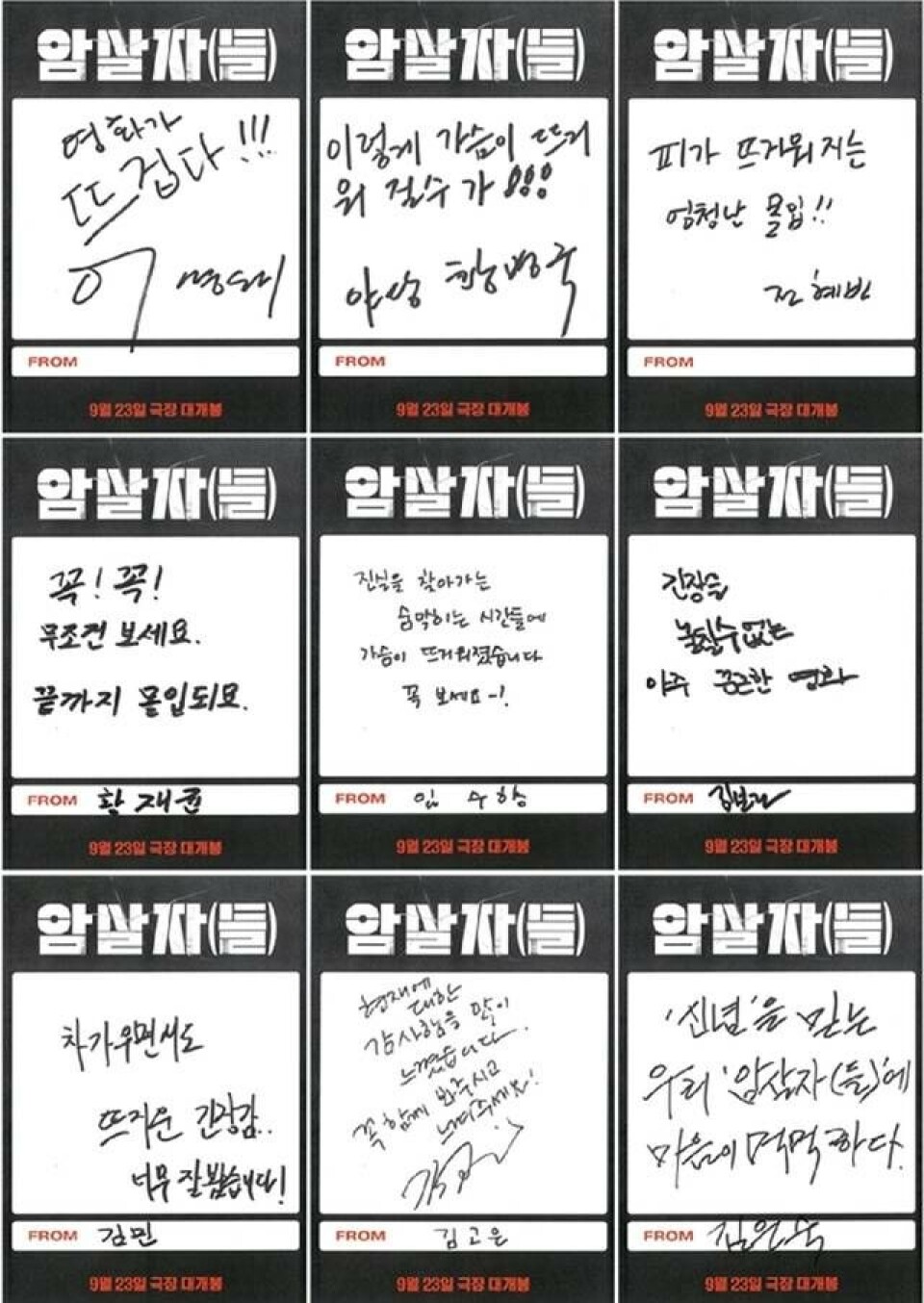
Handwritten endorsements for film "The Assassin(s)" from actors and entertainment industry's insidersJOONGANG ILBO
Park Chung Hee is the father of former president Park Geun-hye, who was ousted in 2017 after the Constitutional Court upheld her impeachment for bribery charges. Park Chung Hee ruled Korea from 1963 through 1979.
The flashpoint is the film’s suggestion of a conspiracy at the highest levels of government. As the protagonists dig deeper, they come to suspect that the Korean Central Intelligence Agency — predecessor of today’s National Intelligence Service — was behind the shooting. It also seemingly floats the possibility that former President Park may have engineered the incident to reverse mounting political troubles, including strains in Korea-Japan relations.
Critics have assailed the premise as a historical distortion.
As the controversy over the film snowballs, the backlash has spread from the film’s cast to actors who were merely invited to screenings or have recommended the movie.
Some people accused the actors of historical ignorance and political bias and circulated lists of their names. The use of the word “truth” in some endorsements has fueled further attacks on the actors’ social media accounts.
The fallout has also reached YouTube. A film channel with 4.17 million subscribers, G Movie, posted a video introducing “The Assassin(s)” but quietly deleted it after criticism mounted in the comments.
Another YouTuber, identified by the handle @1983dk, with about 240,000 subscribers, also deleted his review of the film after it drew sharp criticism. “I didn’t realize this could be a film that some people would find uncomfortable,” the YouTuber said later. “I was politically uninformed.” The apology video was later restricted to members only.
Some groups are also considering seeking a court injunction to halt screenings of “The Assassin(s).”
Actors of the film "The Assassin(s)" celebrate a million admissions in an undated photo.JOONGANG ILBO
“As I understand it, the President Park Chung Hee Memorial Foundation and the Yook Young Foundation are considering filing for an injunction to stop the film from being shown,” said Kim Doo-young, a former Blue House secretary who served Yuk from 1971 to 1974, in a phone interview with the JoongAng Ilbo on Monday. Yuk established the foundation in 1969.
The uneasy line between history and fiction
This is not the first time a film’s portrayal of history has prompted a legal challenge.
In 2005, Park Ji-man, Park Chung Hee’s son, sought to halt screenings of “The President’s Last Bang” (2005). The film covered Park’s assassination on Oct. 26, 1979. Park Ji-man claimed that the film defamed his father and surviving family members.
The court rejected an outright ban as excessive but ruled that several documentary scenes should be removed. It found that parts of the film gave “a distorted impression of the deceased.”
If an injunction is sought against “The Assassin(s),” legal experts say the court would likely assess whether the film’s portrayal is truthful, whether it causes irreparable harm to those affected and whether it serves the public interest.
The filmmakers are also facing a criminal complaint.
Former People Power Party Seoul city councilor Lee Jong-bae said Tuesday that he filed a complaint with the Seoul Metropolitan Police Agency against director Hur Jin-ho and the production team. The complaint accused them of defamation. Criminal law experts say such a charge does not require an explicit false statement and can also apply to claims conveyed indirectly or by implication.
“If the film as a whole leads viewers to accept a particular message as fact, based not only on its dialogue but also on the characters’ actions and the ending, there may be grounds to consider it a false statement of fact,” said Joo Sung-wan, an attorney at law firm Garoje.
A still image from “The Assassin(s)"HIVE MEDIA CORP
When historical fiction crosses legal lines
Some legal experts have also raised the possibility of defamation of the deceased.
“A portrayal implying that former President Park was behind the shooting of his wife infringes on the personal rights of the deceased,” said Kwak Jun-ho, an attorney at Law Firm Chung. “His family has sufficient grounds to examine whether it could constitute defamation of the deceased.”
Courts, however, have also given filmmakers broad latitude in portraying historical events when there is no deliberate distortion.
In 2013, bereaved families of fallen soldiers sought an injunction against “Project Cheonan Ship” (2013), arguing that the film contained false claims. The ROKS Cheonan was a naval corvette that sank in the Yellow Sea near South Korean-controlled Baengnyeong Island on March 26, 2010, following an explosion that caused the ship to break in half. Fifty-eight crew members were rescued, and 46 perished.
The court rejected the request, noting that the film sought to foster open discussion while questions surrounding the incident remained unresolved.
Former President Park Geun-hye visits the birthplace of her mother Yuk Young-soo in Gumi, North Gyeongsang, on Aug. 15, 2023.NEWS1
The producers of “The Assassin(s)” similarly rejected accusations of distortion on Monday. They said the film “takes a historical event as its motif and reconstructs it through cinematic imagination.”
The controversy has also divided the film industry over where cinematic license ends and responsibility begins.
“The film contains so many realistic details that audiences could easily mistake them for historical fact,” said a director who requested anonymity. “The filmmakers may ask audiences to view it simply as a movie, but that does not absolve them of responsibility.”
Film critic Huh Nam-woong took a different view.
“Documentaries and fictional films should be approached differently,” said Huh. “‘The Assassin(s)’ draws on historical material but adds cinematic imagination. If there are genuine problems with the film, the market and audiences will judge them, and the issue will naturally correct itself.”
This article was originally written in Korean and translated by a bilingual reporter with the help of generative AI tools. It was then edited by a native English-speaking editor. All AI-assisted translations are reviewed and refined by our newsroom.