A Mojave STOL performs a flight demonstration at the Seungjin Fire Training Field in Pocheon, Gyeonggi, on Sept. 16.YONHAP
A string of failures before international delegations has exposed weaknesses in Korea’s drone industry. Experts say the country needs a broader overhaul of its drone ecosystem.
An AI-powered high-speed jet developed by Korea Aerospace Industries (KAI) barely made it off the ground before crashing during a demonstration in Pocheon, Gyeonggi, on Wednesday. A second aircraft managed to get airborne during the "2026 Defense Drone Technology Exhibition" (translated) at the Seungjin Fire Training Field, only to lose its signal and disappear shortly afterward.
A direct-impact drone from another defense company also crashed shortly after takeoff, while a drone-borne air-to-ground guided missile failed to reach its target. Among some 2,200 visitors were military officials from the United Arab Emirates (UAE) and Saudi Arabia.
Six of the 17 systems demonstrated failed to perform as intended, including four drones and one counterdrone system.
Industry sourcessuspect radio-frequency interference caused by the large crowd may have been responsible.
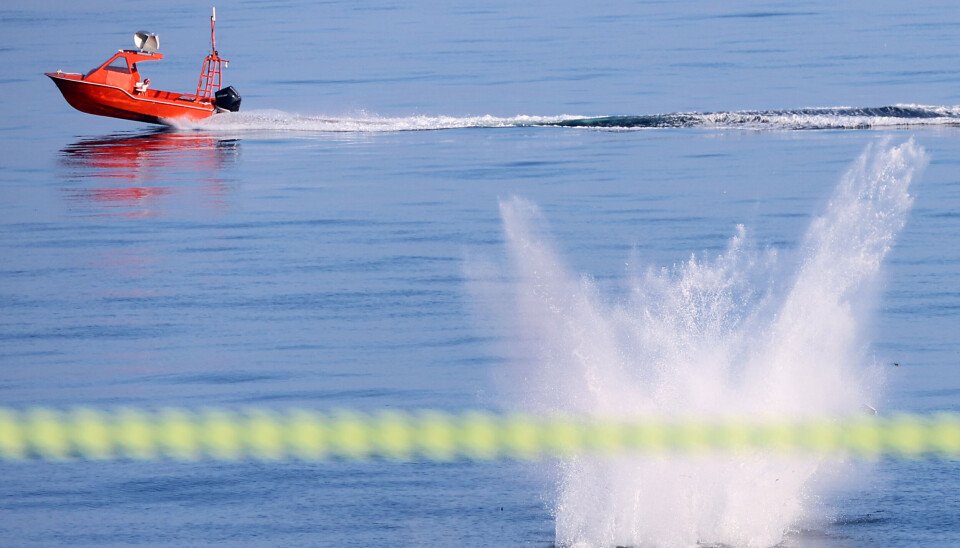
The failures followed another setback last month involving a Korean loitering munition under development in a project led by the Agency for Defense Development. The munition was launched twice toward a high-speed unmanned surface target during a combat experiment on Aug. 25 in international waters south of Busan. Both attempts ended with the drone crashing into the sea within four seconds.
The repeated failures have raised calls for Korea to bolster its overall drone capabilities.
"It is difficult to find places to conduct test flights, which limits our ability to identify problems," said Yun Sang-yong, a military science professor at Seokyeong University. "Korea has complex airspace, and its military environment makes it difficult to secure enough opportunities for flights during the development stage. We need to create adequate conditions for testing unmanned aircraft."
A loitering munition crashes into the sea after being launched during a Navy combat experiment on Aug. 25.JOINT PRESS CORPS
Some experts say Korea’s approach to research and development also needs an overhaul, as funding is spread thinly across numerous projects.
"Given the weakness of Korea's domestic supply chain, procurement that focuses solely on driving down unit costs makes it difficult to ensure security and reliability," said David Shin, a senior research fellow at the Korea Institute for Defense Analyses. “Companies should be selected through competition for each drone category, and investment should be concentrated on those firms.”
Experts say Korea needs a strategy to build a sustainable drone industry ecosystem through rebuilding supply chains and establishing long-term procurement structures.
"Korea should also pursue technological cooperation and joint development with countries such as the United States while simultaneously seeking to acquire drone systems whose performance has already been proven on the battlefield," Shin said.
This article was originally written in Korean and translated by a bilingual reporter with the help of generative AI tools. It was then edited by a native English-speaking editor. All AI-assisted translations are reviewed and refined by our newsroom.