President Lee calls election results a 'warning from the people'
In a press conference marking one year in office, the Korean leader expressed displeasure with ballot shortages but dismissed allegations of election fraud.
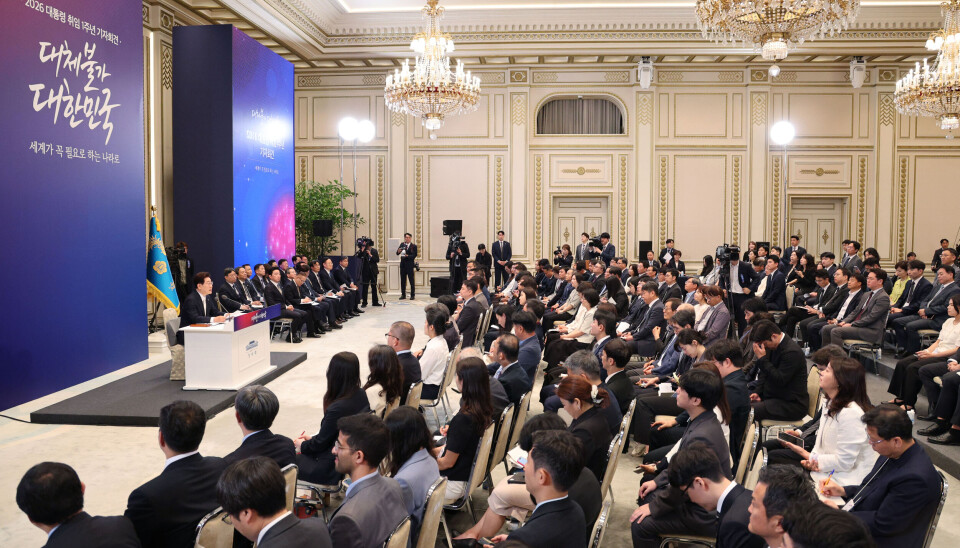
President Lee Jae Myung, center, takes questions from reporters at a press conference marking the first anniversary in office at the Blue House in central Seoul on June 8.JOINT PRESS CORPS
President Lee Jae Myung said in a press conference on Monday that he views the results of the June 3 local elections as a "warning from the people” to him and to his administration and vowed to go into his second year in office with humility.
When asked about his assessment of the election results amid the ballot shortage fiasco at a press conference held on the first anniversary of his inauguration at the Blue House in central Seoul, Lee replied that as the head of the state, “All problems that occur in the Republic of Korea are my responsibility.”
While the ruling Democratic Party (DP) won a significant victory in Korea's local elections last Wednesday, winning 12 of the nation’s 16 metropolitan mayoral and gubernatorial posts, the conservative People Power Party (PPP) won several key races, including the Seoul mayoral election. Likewise, the election process was marred by ballot shortages in some polling stations in Seoul.
Lee strongly criticized the ballot shortage situation, saying it "instantly ruined an exemplary democratic nation."
“At the very least, it is not a success," Lee said regarding the fiasco. “There were many incomprehensible scenes. I consider this to be a warning from the people."
Lee also said the matter of ballot shortage is a completely different issue from "election fraud."
“Using clear falsehoods for political purposes as a means to consolidate power through ceaseless incitement and brainwashing is on a completely different level from raising the question: 'How can we not be able to vote in the Republic of Korea?'" he said.
However, Lee prompted chuckles from reporters when he admitted frankly, “I wasn't feeling very well for the past two or three days,” adding he concluded the election result was due to his “own shortcomings."
Lee laid out his policy vision for the remainder of his five-year term at the press conference and outlined plans to secure "absolute competitiveness" in advanced technologies to grow the country into an industrial powerhouse.
President Lee Jae Myung, left, speaks at a press conference marking the first anniversary in office at the Blue House in central Seoul on June 8.JOINT PRESS CORPSs
Entering his second year in office, Lee presented four major national policy goals: becoming a super-gap industrial powerhouse, a global diplomatic and security powerhouse, a properly functioning society where norms are upheld and a government devoted to saving the lives of its people.
“The unprecedented crisis of democracy became a chance to demonstrate the remarkable strength of the great people of the Republic of Korea,” Lee said in his opening remarks. “The geopolitical crisis brought about by upheavals in the international order became a chance to prove the Republic of Korea’s outstanding industrial and technological competitiveness.”
Lee said this year marks the beginning of a “vision of an ‘irreplaceable Republic of Korea’ — a country no nation can stand in for” building on its “experience, capabilities, values and inherent appeal, as well as our collective effort to overcome the national crisis” to “usher in a new era for the K-initiative.”
He pledged to become the first nation to fully integrate AI across industries and everyday life, the preferred partner for countries pursuing self-reliant defense and a leading energy transition nation.
Regarding the issue of so-called excess corporate profits at semiconductor giants, which has garnered attention due to a labor-management dispute at Samsung Electronics, Lee acknowledged it was an “agenda that could have a very serious impact on national industrial policy,” urging officials to “approach it prudently."
Lee said “excess” corporate gains involve contributions from multiple stakeholders, adding, "Since this significantly impacts the global international trade order, I think discussions at an international level are necessary.”
He pointed out that foreign companies and local businesses could stop investing in Korea or even flee should the government try to impose additional taxes.
Lee was also asked about the record-breaking performance of the benchmark Korea Composite Stock Price Index (Kopsi) in recent months, though he said they are still “undervalued.”
“When I spoke of the stock index reaching 5,000, I was confident and expected it would take about two or three years, but it has turned out this way in just six months,” Lee said. “I think it is due to trust,” and through a “process of normalizing an abnormal state.”
Housing woes
Lee weighed in on the impact of his administration’s real estate policies on the local election results, which some political analysts point out might have cost the liberal DP the Seoul mayoralty.
The president made clear his intentions to curb housing prices, even if it requires raising property holding taxes to crack down on real estate speculation.
"When a conservative government is in power, prices don't go up even if they perform rituals to raise them, but after a few years, they skyrocket when a progressive government takes office," Lee said.
On the recent controversy around a special parliamentary committee filing complaints against individuals linked to allegations of fabricated indictments, including cases involving Lee, the president voiced support for the special counsel probe.
"We need to act according to the law and common sense,” Lee said. “If something is wrong, we must correct it, and if something has been concealed, we must reveal it."
"I think the positive effects outweighed the negative ones,” Lee told reporters, arguing that if his government hadn’t curbed prices, they would have skyrocketed.
President Lee Jae Myung, left, takes questions from reporters at a press conference marking the first anniversary in office at the Blue House in central Seoul on June 8.JOINT PRESS CORPS
Youth voices, mixed responses
The press conference lasted 167 minutes, running longer than allotted, under the slogan “Irreplaceable Republic of Korea.” Monday marked Lee’s 370th day in office. Lee took 21 questions from Korean reporters and foreign correspondents in topics including economy, politics, diplomacy and security and social affairs.
Two university students with backgrounds in student journalism also asked the president questions via videoconference about youth and regional policies.
Lee wore a white tie with thin blue stripes, as he did during the National Appointment Ceremony on Aug. 15 last year, which a Blue House official said “signifies his pledge not to lose sight of his original intentions.”
PPP leader Jang Dong-hyeok slammed Lee’s remarks defending his government’s real estate policies.
“Thinking about what lies ahead makes my vision blur,” Jang said. “I once again realized that there is a separate ‘Lee Jae Myung universe.’ Today’s press conference showed not the slightest remorse toward citizens suffering in a real estate hell.”
Jang said Lee "mentioned raising holding taxes, claiming to have successfully curbed Seoul’s housing prices, but this is the sound of people’s hearts breaking.”
The PPP also pushed back on Lee’s remarks regarding the withdrawal of indictments by the independent counsel.
“The greatest threat to the judicial order of the Republic of Korea right now is none other than Lee Jae Myung himself,” Jang said at the National Assembly later Monday. “Now that the election is over, it is a de facto declaration of dictatorship to do whatever he wants.”
"President Lee fully grasped and presented the short-term and long-term priorities and urgency regarding the problems Korea must solve,” Jung wrote on Facebook.
“The party, government and Blue House will join forces,” Jung added, adding that the DP will “lead by example to dedicate itself to the success of the Lee administration.”