One in three new Ph.D. graduates are jobless, marking highest level on record
A record 33.3 percent of Korea’s newly-awarded doctoral graduates were unemployed or economically inactive last year, with younger degree holders and women facing the steepest challenges.
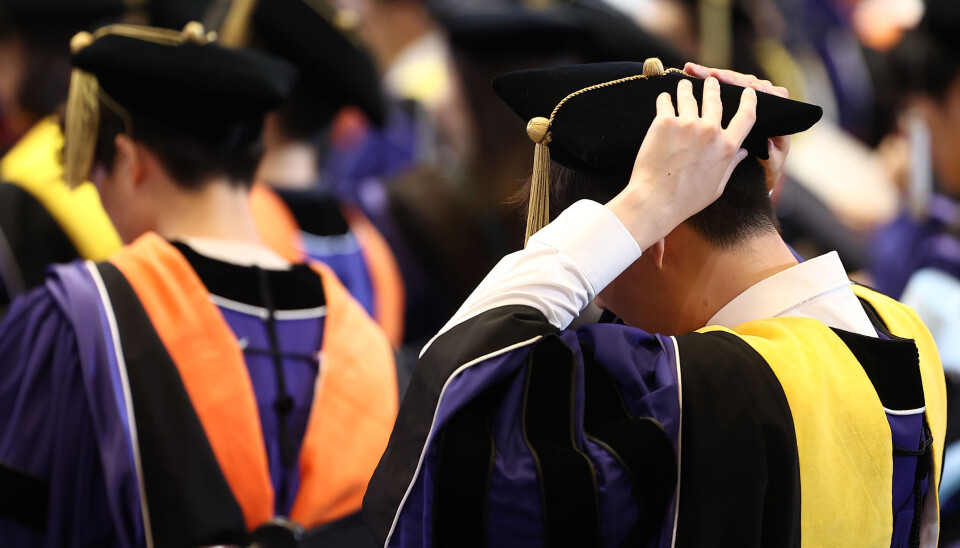
A graduate adjusts their mortarboard during Seoul National University's 79th commencement ceremony for graduates completing their degrees in the second half of the academic year in Gwanak District, southern Seoul, on Aug. 28, 2025.YONHAP
More than 30 percent of newly-awarded Ph.D. graduates in Korea are unemployed for the first time since records began, deepening concerns over a shortage of jobs for highly educated workers.
Young doctorate holders have been hit the hardest, underscoring growing concerns over limited opportunities in academia, research and industry.
Among 10,498 people who earned doctoral degrees last year, 66.7 percent were either employed or had secured jobs, according to the 2025 survey of new doctoral degree recipients released through the Korean Statistical Information Service.
GoogleAdmanager-KJD
Meanwhile, 27.7 percent were unemployed and 5.6 percent were classified as economically inactive. Combined, the share of doctorate holders without jobs reached 33.3 percent, surpassing 30 percent for the first time since the survey began in 2014.
The unemployment rate among new Ph.D. recipients had remained in the mid-20 percent range through 2018 before jumping to 29.3 percent in 2019. Last year, it rose by 3.7 percentage points from a year earlier, marking the largest annual increase on record.
The sharp rise was driven largely by an increase in the number of economically inactive people who were not actively seeking work. While the unemployment rate increased by 1.1 percentage points from the previous year, the share of economically inactive doctorate holders nearly doubled from 3 percent to 5.6 percent.
The trend is widely attributed to a shortage of high-quality jobs for Ph.D. graduates, including tenured university faculty positions, research posts at government-funded institutes and permanent research and development positions at large corporations.
The number of full-time faculty members at higher education institutions fell by 617 to 86,701 last year, while non-tenure-track faculty increased by 4,261 to 153,923, according to the Ministry of Education's annual education statistics.
Employment prospects were even bleaker for younger doctorate holders.
A job posting board at a university employment support center in Seoul is seen on May 13.YONHAP
Out of 569 people under the age of 30 who earned doctoral degrees last year, 51.1 percent were unemployed, exceeding 50 percent for the first time. The share of economically inactive people in the same age group also rose sharply, from 2.6 percent to 7.9 percent.
People between the ages of 30 and 34 accounted for the largest number of new doctorate recipients at 3,836, but 44.2 percent of them were unemployed. The unemployment rate reached 32.8 percent among those aged 35 to 39; 22.1 percent among those aged 40 to 44; 16.6 percent among those aged 45 to 49 and 22.7 percent among those aged 50 and older.
Every age group recorded its highest unemployment rate since the survey began.
Experts say younger doctoral holders with limited work experience face particular difficulties in the job market. They also point to the spread of AI as a factor reducing entry-level hiring opportunities.
Income disparities by academic field remained significant even among those who found jobs.
Among 7,005 employed doctorate holders, 15.9 percent earned annual salaries of at least 100 million won ($65,000), an increase of 1.5 percentage points from a year earlier.
The highest shares of doctorate holders earning at least 100 million won were found in business, administration and law at 29.8 percent, followed by health and welfare at 26.5 percent and information and communications technology at 24.1 percent.
Graduates toss their mortarboards into the air during Ewha Womans University's commencement ceremony for graduates from the spring semester of the 2024 academic year in Seodaemun District, western Seoul, on Feb. 24, 2025.NEWS1
By contrast, only 3.7 percent of those in arts and humanities earned that level of income.
The share of employed doctorate holders earning less than 20 million won annually was highest in arts and humanities at 26.8 percent, followed by education at 19 percent and social sciences, journalism and information studies at 14.9 percent.
The survey also highlighted significant gender disparities. The unemployment rate among women with doctoral degrees stood at 38.4 percent, compared with 29.6 percent for men.
Among employed doctorate holders, 20.6 percent of men earned annual salaries of at least 100 million won, while the figure for women was 8.3 percent. At the other end of the income scale, 6.3 percent of men earned less than 20 million won annually, compared with 17.2 percent of women.
This article was originally written in Korean and translated by a bilingual reporter with the help of generative AI tools. It was then edited by a native English-speaking editor. All AI-assisted translations are reviewed and refined by our newsroom.