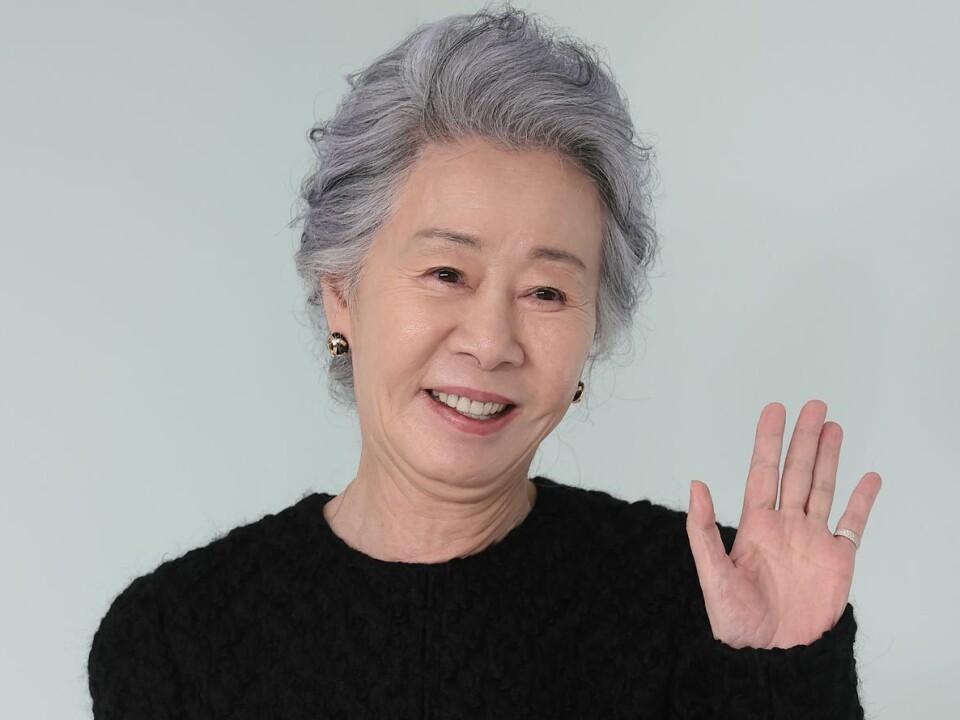
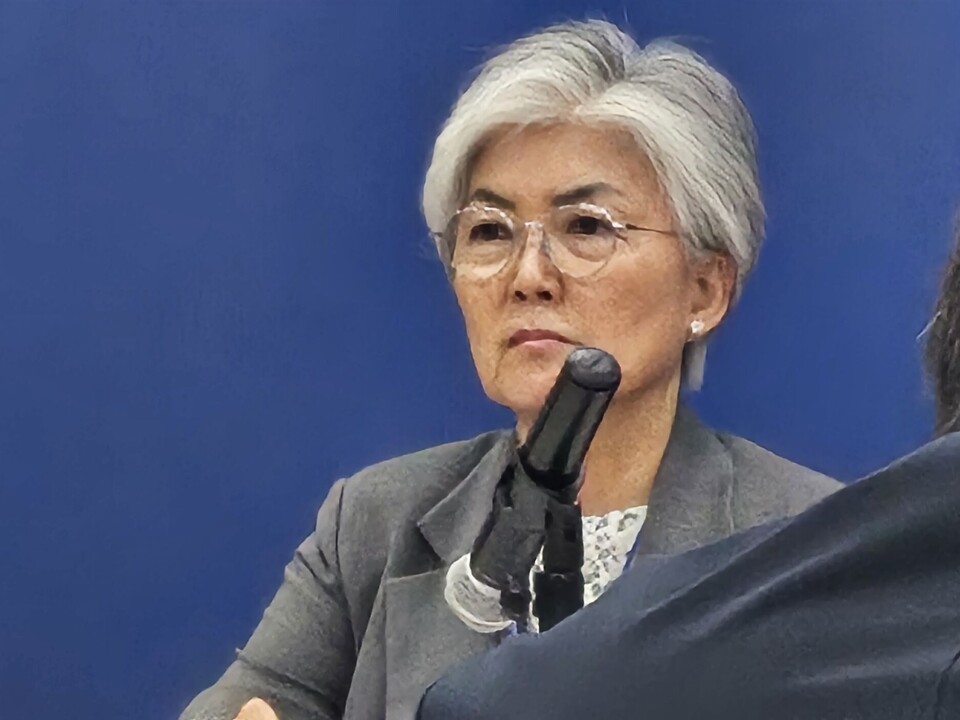
Kang Kyung-wha, Korean ambassador to the United States, speaks during a meeting with Korean correspondents on July 8.KANG TAE-HWA
WASHINGTON — The Korean ambassador to the United States said the two governments have agreed to manage the dispute over Coupang's data leak in a "stable manner so that it does not become a burden on Korea-U.S. relations."
"We will continue consultations with the U.S. side and clearly and consistently explain the Korean government's position," said Kang Kyung-wha, Korean ambassador to the United States, during a meeting with Korean correspondents at the Korean Embassy in Washington on Wednesday.
The comments came after criticism from both the U.S. Congress and White House officials over Korea's handling of Coupang's data leak that broke in November last year. Coupang was imposed a record fine of 624.7 billion won ($147 million) by Korea's Personal Information Protection Commission in June, along with an additional 16.8 million won administrative fine.
The House Judiciary Committee released a report on July 1 claiming that the Korean government was unfairly targeting Coupang, a U.S. company. A White House official said the following day that "Coupang is being singled out by the Lee [Jae Myung] government" and that the "Trump administration will not tolerate unfair trade practices, including those that limit market access for U.S. digital services."
Hong Ik-pyo, senior presidential secretary for political affairs, rejected those claims.
"The report is highly inappropriate because it reflects only Coupang's position," Hong said on Monday. "It is deeply regrettable that a legislature representing the public would issue a report containing one-sided claims about a specific company that do not align with the facts."
Korean government officials were reportedly surprised that the White House echoed concerns similar to those raised by members of Congress, who had been the focus of Coupang's lobbying efforts. Following the White House's remarks, the Korean government reportedly contacted the White House's National Security Council and other U.S. officials, reaffirming their shared understanding that the issue should be managed carefully.
One of the key issues behind the differing opinions is a dispute about the scale of the alleged data leak.
Petitions filed by two U.S. companies that invested in Coupang, obtained by the JoongAng Ilbo on Jan. 22, are laid out on a table. The firms requested a U.S. government investigation, claiming that Korea is unfairly targeting Coupang, a U.S. company, after the company's customer data leak.KANG TAE-HWA
The Korean government maintains that 33.7 million cases of personal information on Coupang were accessed and leaked without authorization. Coupang argues that the number of actual leaked records was only about 3,000.
Korean government officials reportedly say the differing assessments of the scale of the data leak are the main reason U.S. lawmakers and administration officials believe Korea is discriminating against Coupang, as they have based their criticism on the company's claim that only about 3,000 records were leaked.
The Korean government plans to compile factual materials rebutting the claims in the congressional report and submit them to Congress and the Trump administration.
Kang also addressed bilateral cooperation on nuclear-powered submarines and nuclear energy.
"We plan to maintain frequent communication with the United States through various channels to accelerate sector-by-sector consultations," Kang said.
U.S. Under Secretary of State for Political Affairs Allison Hooker, center, arrives at the Ministry of Foreign Affairs building in Jongno District, central Seoul, on June 2.YONHAP
The two countries held their first round of talks in Seoul in early June, beginning discussions on Korea's acquisition of nuclear-powered submarines and uranium enrichment. They are now coordinating the schedule for additional talks and aim to work out a detailed timetable for the submarine project and related issues by the end of the year.
Discussions on shipbuilding cooperation did not make progress during the first round because the U.S. delegation, led by U.S. Under Secretary of State for Political Affairs Allison Hooker, was reportedly not sufficiently prepared to discuss that area. Officials expect future progress to come through a dedicated bilateral working group on shipbuilding cooperation.
Kang also commented on the Trump administration's Section 301 tariff investigations into alleged unfair trade practices.
"We have emphasized that the balance of benefits established under the existing Korea-U.S. tariff agreement should be maintained, and the U.S. side has also expressed its intention to honor that agreement," Kang said.
"We will closely monitor new U.S. tariff measures and continue consultations at all levels to minimize any negative impact."
This article was originally written in Korean and translated by a bilingual reporter with the help of generative AI tools. It was then edited by a native English-speaking editor. All AI-assisted translations are reviewed and refined by our newsroom.