Kim, Xi reaffirm strategic cooperation on North Korea-China treaty anniversary amid regional tensions
In messages marking the 65th anniversary of their friendship treaty, the North Korean and Chinese leaders pledged closer strategic coordination as regional rivalries intensify.
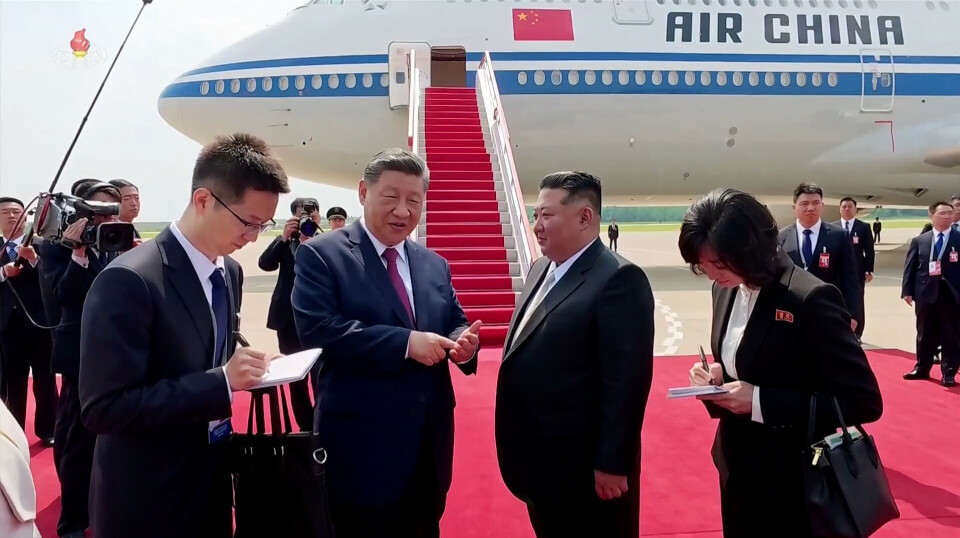
North Korean leader Kim Jong-un, second from right, and Chinese President Xi Jinping, second from left, speak after wrapping up their summit talks in Pyongyang on June 10 in this file photo carried by North Korea's official Korean Central News Agency the following day.
YONHAP
North Korean leader Kim Jong-un and Chinese President Xi Jinping have reiterated their shared commitment to strengthening strategic cooperation between the two countries in their messages marking the 65th anniversary of the signing of a friendship treaty, Pyongyang's state media said Saturday.
The leaders exchanged the messages, pointing to the shifting international security situation, the Korean Central News Agency reported, as a rivalry between China and the United States is intensifying, with Seoul, Washington and Tokyo continuing to reinforce cooperation in confronting shared challenges.
The exchange followed their summit talks in Pyongyang last month, which came at a time when Beijing was seen striving to improve relations with North Korea, which has drawn closer to Russia through deepening military, diplomatic and economic cooperation.
In his missive, Kim highlighted his readiness to develop the bilateral relationship into a "model of the most powerful and strategic relations" between socialist countries by guiding it to a "new height," together with the Chinese president.
"The DPRK-China friendly and cooperative relations ... are now developing at a new strategic level and making a great contribution to firmly protecting the sovereignty, security and development interests of the two countries and defending peace and stability in the region and the rest of the world under the complicated international situation," Kim wrote.
DPRK stands for the North's official name, the Democratic People's Republic of Korea.
He went on to say that it is the "steadfast" stand of the North's ruling Workers' Party and its government to "more dynamically" develop the bilateral relations of friendship and cooperation in various fields "in conformity with the requirements of the times."
Moreover, he stressed that the North Korea-China Treaty of Friendship, Cooperation and Mutual Assistance laid a "solid" legal foundation for the "permanent" development of the two countries' relations of "militant friendship, unity and mutually beneficial cooperation."
The treaty was signed July 11, 1961 by late North Korea founder and then leader Kim Il Sung and then Chinese Premier Zhou Enlai.
In a message to Kim, Xi said he was "ready" to have closer "strategic" communication with the North Korean leader to cope with a rapidly changing world.
"I am ready to have closer strategic communication with you... to bring better well-being to the peoples of the two countries and promoting the regional peace and development by firmly maintaining the orientation of the development of the relations between the two countries," Xi wrote.
Xi also said that China will continue to attach "great importance" to the relationship with the North regardless of the international situation, noting the treaty served as a legal basis for consolidating the bilateral ties "sealed in blood."
A North Korean delegation, led by North Korean Premier Pak Thae-song arrived in Beijing on Friday to attend an event marking the anniversary.
Yonhap