Gyeonggido Office of Education superintendent An Min-suk signs his first official directive since taking office on July 1, endorsing the so-called Phone-Free School implementation plan.GYEONGGIDO OFFICE OF EDUCATION
Gyeonggi has launched an experiment to limit mobile phone use in schools, testing whether stricter rules can improve learning while trying to balance student rights.
The so-called Phone-Free School initiative was approved by Gyeonggido Office of Education superintendent An Min-suk as his first official directive on July 1, according to the education office on Wednesday. The policy was An's signature campaign pledge during his campaign for superintendent.
Under the initiative, students would be required to put away their phones during the school day at elementary, middle and high schools across the province. Schools would instead expand reading, arts, cultural and sports activities to improve learning and encourage face-to-face interaction among students.
GoogleAdmanager-KJD
“The less time students spend on their phones, the more they can focus on learning, and schools can also devote more attention to education,” An said.
A total of77.3 percent believed schools should collect and store students' phones during the school day to protect learning, found a survey of 1,000 respondents conducted by the education office from June 27 to 29. Support was even higher among parents, at 84 percent.
Respondents also preferred provincewide regulations, supported by 67.7 percent, over leaving the decision to individual schools, supported by 24.8 percent.
The most popular approach, chosen by 51.6 percent, was to collect students' phones when they arrive at school and return them at the end of the day.
“Mobile phone use has become such a problem that parents have even coined the phrase 'everyone is fighting with their children's phones,'” one teacher said, referring to a play on the title of the dark TV comedy “We Are All Trying Here,” whose Korean title translates to “Everyone Is Fighting Their Own Worthlessness.”
“Phone-free schools should be implemented to create a better learning environment,” the teacher added.
Schools that have already adopted such policies have reported improvements in academic performance, the teacher noted.
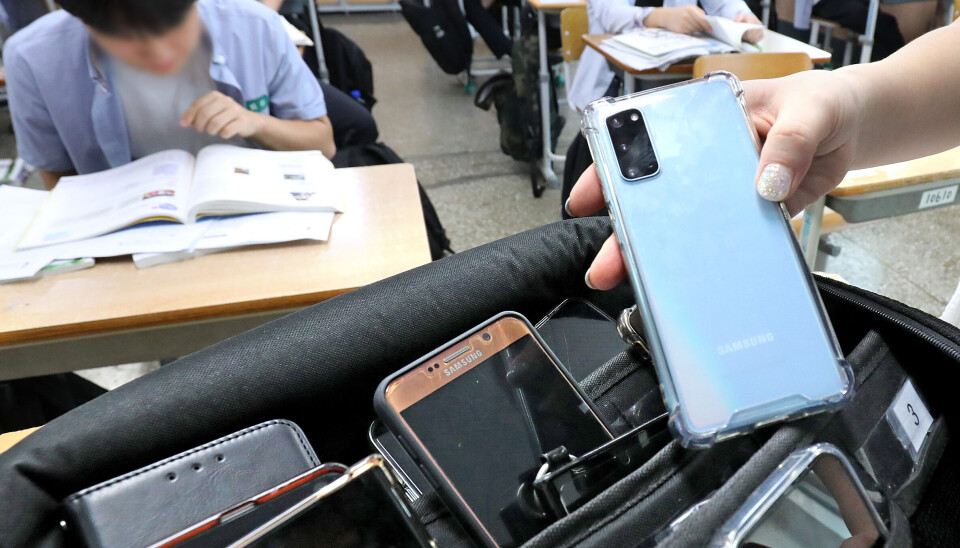
Students' cell phones are collected in a first-year classroom at Dongsan High School in Jung District, Daejeon, on Sept. 1, 2023.NEWS1
Institutional support for the policy has also grown.
Amendments to the Elementary and Secondary Education Act that took effect this year prohibit students from using smart devices, including smartphones, during class. The National Human Rights Commission of Korea also reversed its previous position, and ruled that “collecting students' phones does not constitute a violation of general freedom of action or freedom of communication”in 2025.
Some critics, however, argue that restricting phone use at school does violate students' rights.
“The policy directly conflicts with Article 12, Paragraph 4 of the Gyeonggi Student Human Rights Ordinance, which states that students should not be prohibited from possessing mobile phones,” the youth rights group Asunaro: Action for Youth Rights of Korea said.
Others argued that schools should instead allow limited phone use during noninstructional hours.
“It is appropriate to allow students to use their phones during breaks and lunch periods,” said Cho Young-sun, an executive committee member of the National Youth-Citizen Action for Student Human Rights and Youth Rights.
The education office'ssurvey also identified concerns about the policy. Student resistance and noncompliance ranked as the biggest concern,ranking first with 34.7 percent, followed by difficulties contacting students during emergencies with 23.6 percent.
Teachers' organizations support the initiative but say clear guidelines are needed.
“Schools have different circumstances, so the policy should not be imposed uniformly,” an official from the Gyeonggi Teachers Union said. “The provincial education office should establish and support standard guidelines covering phone storage and collection, liability for lost or damaged devices, emergency communication procedures and exceptions during the school day, and responses to complaints from parents when students refuse to surrender their phones.”
“A total of 35 percent of elementary, middle and high schools in the province already collect students' phones, according to a 2025 Education Ministry survey,” an education office official said. “The office is preparing detailed implementation plans and standard guidelines for the Phone-Free School initiative.”
This article was originally written in Korean and translated by a bilingual reporter with the help of generative AI tools. It was then edited by a native English-speaking editor. All AI-assisted translations are reviewed and refined by our newsroom.