Gyeonggi buses are parked in Suwon, Gyeonggi, on Oct. 23.NEWS1
The Gyeonggi provincial government will deploy about 200 chartered and state-owned buses ahead of a planned strike by 29 bus operators across the province on Friday.
Representatives of unionized bus drivers and management from the 29 Gyeonggi bus companies will hold a final round of negotiations at the Gyeonggi branch of the National Labor Relations Commission in Suwon at 3 p.m. Thursday — the deadline for labor dispute mediation.
The union is pressing management to fulfill a previous agreement the government was party to that promised wage parity between Gyeonggi and Seoul bus drivers by Jan. 1 this year. It plans to stage a general strike, which would halt all bus services starting Friday morning if negotiations fail.
Provincial authorities expect the strike to affect roughly 3,798 buses belonging to the 29 operators, accounting for 35.7 percent of Gyeonggi's fleet of 10,631 local and intercity buses. Services could be disrupted across 15 cities, including Suwon and Yongin in the south and Goyang in the north.
The planned walkout also covers 942 buses serving 63 commuter routes that connect Seoul and the province. KD Transportation Group, Gyeonggi's largest bus operator, will not participate because its affiliated companies are negotiating separately from the union's central leadership. The group's services are concentrated largely in northern Gyeonggi.
If the strike goes ahead, Gyeonggi plans to deploy about 200 chartered and government-owned buses to 160 major transit hubs across the 15 affected cities, including subway stations such as Suwon, Giheung in Yongin and Daehwa in Goyang, as well as bus terminals.
The province will increase the frequency of bus services unaffected by the strike, particularly during morning and evening rush hours, to shorten the intervals between departures. It will also deploy about 2,300 neighborhood buses across 630 routes during peak hours and encourage some 27,000 taxis to operate. Subway and light rail services will operate more frequently across the metropolitan area, and station staff will be assigned to manage congestion and ensure passenger safety.
But the contingency plan comes at a cost, even if the strike never takes place. Fees to arrange chartered buses typically cost between 800,000 won ($600) and 1.2 million won each, depending on the region and operating conditions. Hiring 200 buses would cost between 160 million won and 240 million won.
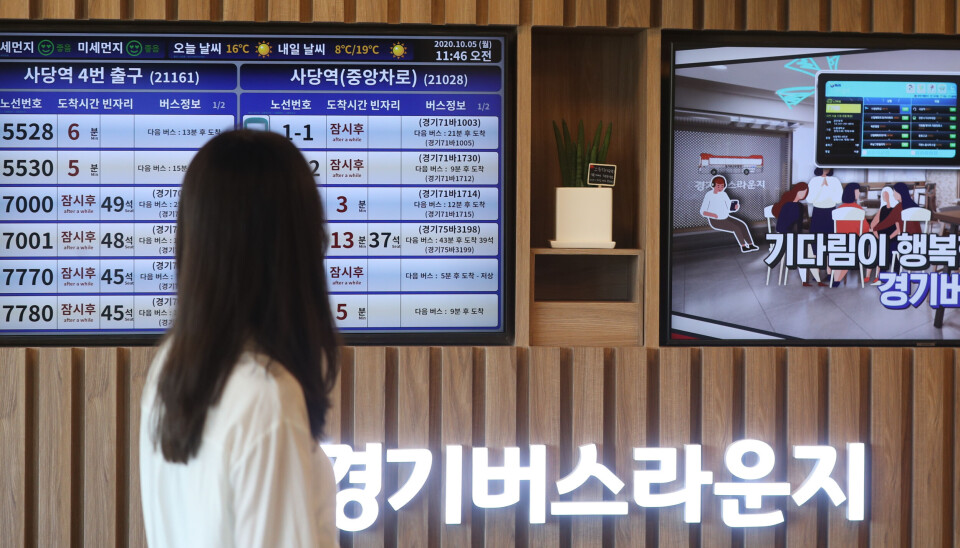
A person waits for an intercity bus at a terminal in southern Seoul on Oct. 5, 2020.YONHAP
Even if the strike is called off, the province must pay cancellation fees of 20 to 50 percent of the contract value, potentially up to 120 million won.
City and county offices are voicing concerns as individual localities bear the cost of securing emergency chartered buses.
“We will consider providing partial subsidies from the public bus management budget to municipalities that have signed joint transportation agreements,” the provincial government said.
Still, the province considers a strike unlikely, as no bus walkout has materialized in Gyeonggi over the past decade.
“We believe the strike is unlikely to materialize, but we cannot afford to go without contingency plans,” Yoon Tae-wan, director of the Bus Policy Division at the provincial government, said when asked about the cancellation fees. “We hope labor and management can reach an amicable agreement and avert the strike.”
This article was originally written in Korean and translated by a bilingual reporter with the help of generative AI tools. It was then edited by a native English-speaking editor. All AI-assisted translations are reviewed and refined by our newsroom.