European partners voice unease over South Korea's rift with Ukraine
European diplomats urge Seoul and Kyiv to resolve their dispute over North Korean POW transfers, with experts warning the spat could harm South Korea's broader relations with Europe, including defense ties.
From left, European Council President Antonio Costa, Ukraine's President Volodymyr Zelensky and European Commission President Ursula von der Leyen arrive for the EU summit in Brussels, on Oct. 16.AP/YONHAP
South Korea said Tuesday it will withdraw about half of its staff from its embassy in Kyiv, escalating a dispute with Ukraine over the transfer of North Korean prisoners of war (POWs) that has already left European diplomats in Seoul uneasy.
"Even after the recall of our ambassador to Ukraine, there has been no forward-looking measure from the Ukrainian side, and with the threat of air strikes across Ukraine persisting and making it difficult to ensure safety, the government has decided to withdraw some of the embassy's staff," Foreign Ministry spokesperson Park Doo-soon said in a regular briefing.
Asked whether Seoul still wants a public apology, Park said, "There is no change in the position we previously requested." A Foreign Ministry official added that "the ball is in Ukraine's court."
Yoon Ji-wan, charge d'affaires at the South Korean Embassy in Ukraine, responds to a question via video during a parliamentary audit taking place at the South Korean Embassy in Warsaw on Oct. 18.YONHAP
The move follows Seoul's recall of its ambassador to Ukraine earlier this month, a step that has left European diplomats in Seoul uneasy, with some unsure why Seoul went to such lengths with a country it has backed since Russia's full-scale invasion in 2022.
Diplomats from several European countries, speaking to the Korea JoongAng Daily on condition of anonymity, said they were concerned to see two close partners at odds, as the dispute could impact broader issues.
In particular, sources indicated that Seoul’s feud with Kyiv cannot be viewed in isolation from Europe’s own stake in Ukraine, which it has strongly backed.
Some described the recall as a strong, even emotional, response.
Others stressed that Europe has an interest in close ties between Seoul and Kyiv, given the need for more support for Ukraine amid the ongoing war with Russia. They noted it was up to Seoul and Kyiv to settle the dispute, though European partners would be ready to help if asked.
Seoul's Foreign Ministry said last week that about "three major European countries" — widely understood in South Korea to mean Britain, France and Germany — had offered to "play a role" in settling South Korea’s dispute with Ukraine, though it declined to name the nations.
The Foreign Ministry official said Tuesday that Seoul has explained to European countries that its steps, including the recall, are a "diplomatic gesture" meant to pave the way for a smooth resolution.
The stakes for South Korea are also closely tied to broader security cooperation and to its growing arms sales to Europe.
Key European nations that have purchased South Korean tanks and rocket launchers since the war began want Seoul to maintain its backing for Kyiv. Meanwhile, U.S. President Donald Trump has been pushing Kyiv toward a settlement with Moscow, stating on Oct. 10 that Ukraine should "get a new leader who can make a deal."
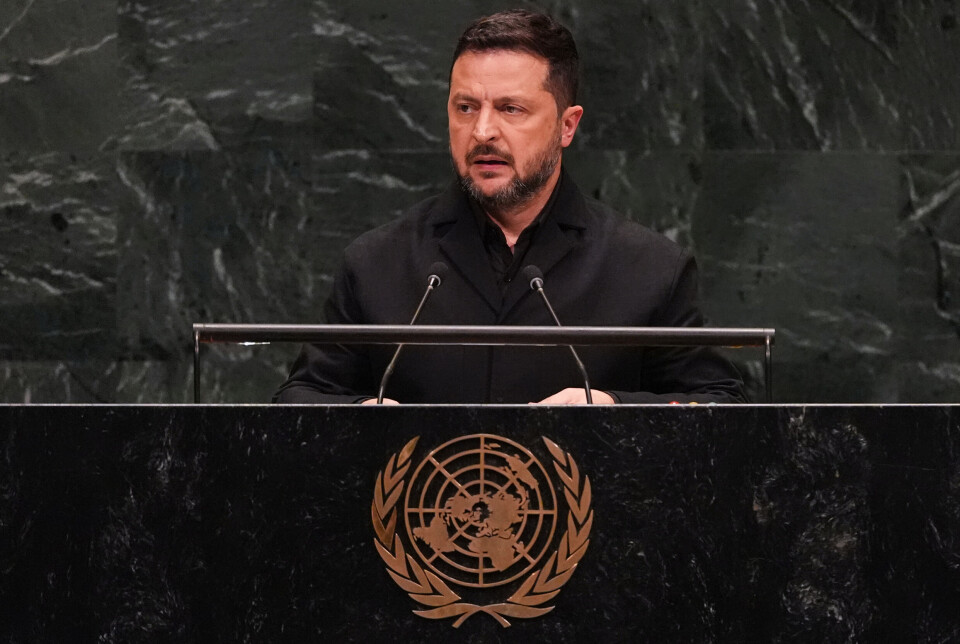
Ukraine's President Volodymyr Zelensky speaks during the 81st session of the United Nations General Assembly at United Nations headquarters, on Sept. 23.AP/YONHAP
Europe's message to Seoul
South Korea recalled its ambassador to Ukraine, Park Ki-chang, on Oct. 8, marking its first recall of a top envoy in protest since 2008 and signaling how far relations between Seoul and Kyiv have soured.
A recall ranks above summoning a foreign envoy as a form of protest, stopping just short of cutting diplomatic ties.
The dispute began when Ukrainian President Volodymyr Zelensky told the United Nations General Assembly on Sept. 23 that Ukraine had sent two captured North Korean soldiers to South Korea. Seoul says the two sides agreed to keep the transfer confidential, while Kyiv says it interpreted the confidentiality arrangement differently.
In an Oct. 2 post on X, President Lee Jae Myung wrote that Kyiv’s denial of the agreement had made “the head of state of the other country a liar.” He also expressed “serious regret to Ukraine, which, on the contrary, talks of an imminent military clash between the two Koreas and seeks to bring about a war on the Korean Peninsula.”
Lee called the matter one of national dignity that “cannot be overlooked” and warned of “further measures” if Ukraine kept refusing to acknowledge the facts and apologize publicly.
In public, European governments have generally avoided taking sides.
A spokesperson for the British Embassy in Seoul said, “Ukraine and South Korea are both among our closest partners,” adding that it was “not in a position to comment on the specifics of those conversations.”
But they have been clear in urging Seoul to keep supporting Ukraine.
"We do this for Ukraine, but also for our own security in Europe. Because Ukraine's security is Europe's security. It is existential," Dutch Ambassador Peter van der Vliet told the Korea JoongAng Daily in a written comment, referring to the Netherlands' military and non-military support for Kyiv.
"And Russia's military alliance with North Korea shows that security on the Korean Peninsula, too, is interlinked with Europe's security," van der Vliet said.
Latvian Ambassador Janis Berzins cited Lee’s own description of South Korea’s foreign policy as “pragmatic diplomacy based on national interest.”
“It is our utmost belief that it is in the pragmatic national interests of [South] Korea to support those that want the fate of nations decided by the nations themselves, and not by military power and bullying,” Berzins said. “Supporting Ukraine is equivalent to sending the clearest message that Korea also wants peaceful coexistence with its neighbors and not conflict resolution with military means.”
Estonia echoed the call. “Estonia joins the European countries that are calling for continued Korean support to Ukraine," Estonian Ambassador Tanel Sepp said.
“Now it’s important for all countries to stand behind Ukraine, encouraging South Korea to help assist Ukraine as much as possible, but also expressing our appreciation for the clear line taken by South Korea,” Norwegian Vice Foreign Minister Andreas Motzfeldt Kravik said in an interview with the Korea JoongAng Daily during a visit to Seoul last week.
South Korea has officially provided humanitarian and financial aid to Ukraine but has not supplied lethal weapons. Seoul's Foreign Ministry has said its support for Ukraine will continue despite the dispute.
Yoon Ji-wan, the minister-counselor now heading Seoul's embassy in Kyiv, told a parliamentary audit Sunday that "there is no further rebuttal from the Ukrainian side," and that there are "many critical voices" in Ukraine "about the confidentiality promise being broken on impulse."
A K239 Chunmoo multiple rocket launcher maneuvers during a large-scale joint field training exercise by the Army’s 17th Infantry Division at a training ground in Seo District, Incheon, on Oct. 15.YONHAP
The cost of the spat
Kwon Ki-chang, a former South Korean ambassador to Ukraine, says the risk goes beyond a bilateral dispute and links to Seoul's standing in Europe.
Europe views South Korea, Australia, Japan and New Zealand — NATO’s four Indo-Pacific partners — as “very strong allies” in supporting Ukraine, he said.
“If European countries start to suspect that South Korea, while quarreling with Ukraine, is giving more consideration to Russia, it could hurt our arms exports,” Kwon said.
The Dutch ambassador tied continued support for Ukraine directly to that trust.
"That is why we hope that [South] Korea will continue to support Ukraine in whichever way it can," van der Vliet said. "That would bring Europe and [South Korea] ever closer as strategic and trusted partners, with boundless opportunities for mutually beneficial cooperation in various fields."
That trust is still being built.
Despite its arms sales to Europe, "South Korea is still far from being considered a fully trusted and deeply rooted European defense partner," Lee Chung-min, a senior fellow at the Carnegie Endowment for International Peace, wrote in a February report.
European policymakers have told their South Korean counterparts that to become a major defense partner, Seoul must "demonstrate greater willingness to align more closely with EU and NATO positions regarding Russia," the report said. South Korean arms sales to Europe reached $11.03 billion in 2025, according to the report.
Kwon added that Seoul's recall of its ambassador leaves fewer channels to Kyiv.
“A minister[-counselor] has to act on behalf of the ambassador, but the level of officials they can meet is limited,” he said. “They cannot meet the foreign minister or vice minister, and it is hard to meet senior officials at the presidential office.”
When Seoul recalled its ambassador to Japan in 2008 over Tokyo's claim to the Dokdo islets, he returned to Tokyo after 21 days, though Japan had neither withdrawn the claim nor apologized.But unlike in 2008, Seoul has this time set explicit conditions for an apology and explanation from Kyiv.
Zelensky said last month that Russia is preparing to deploy another 10,000 North Korean troops. If more are captured and ask to come to South Korea, Seoul will again need Kyiv’s help.
Ukraine's postwar reconstruction is also at stake. Seoul pledged $2.3 billion in 2023 to help Ukraine recover, most of it in long-term loans.
Asked whether the recall and staff withdrawal would affect reconstruction cooperation, a Foreign Ministry official said Tuesday, "It is true that the situation is difficult for now."
Others, however, see less immediate economic danger.
“It is a stretch to say that we are suffering disadvantages or negative effects right away because of the Korea-Ukraine diplomatic dispute,” a defense industry official said on condition of anonymity. “Rather, we seem to be more affected by protectionist moves from Europe, such as the SAFE fund [an EU defense loan program favoring European-made weapons] or making ‘Made in Europe’ mandatory, than by the dynamics between countries.”
"At the end of the day, these partnerships are based on interests and needs," said Ramon Pacheco Pardo, a professor of international relations at King's College London and KF-VUB Korea Chair at the Brussels School of Governance. "European countries need to continue to buy Korean arms as long as Russia remains a threat to Europe."
U.S. President Donald Trump, right, meets with Ukraine's President Volodymyr Zelensky during the United Nations General Assembly on Sept. 22 at the UN headquarters.AP/YONHAP
A way out
As the spat originated between the two countries' leaders, devising an exit strategy may be difficult.
Pacheco Pardo said Seoul’s stance on Russia's war on Ukraine is shaped more by Washington than by Europe.
“Korea should consider the position of the United States on the conflict as well as the different positions across Europe and then decide what works best for itself," he said.
Kwon does not expect Kyiv to apologize publicly, since that would mean admitting that its president was wrong. He said Europe’s offer to help could give both sides a way out.
“As I see it, this is a way for both our government and the Ukrainian government to save a good deal of face,” Kwon said. “Even if our government does not get 100 percent of what it declared, [mediation] can produce wording at a level our government can accept.”
The South Korean government, however, sees less need for outside help.
"Unless our diplomatic channels are blocked, there is little need to involve third parties," a Foreign Ministry official told the Korea JoongAng Daily. "Since consultations between South Korea and Ukraine are continuing bilaterally, the outcome of those will be important."