Episode 9: Four years later, October is still the cruelest month
As fall approaches, the specter of a tragedy and its possible reoccurrence lingers while the need for remorse, accountability, and social healing remains crucial.
A citizen wipes away tears at the site of the Itaewon disaster on Oct. 29, 2025, the third anniversary of the crowd crush.YONHAP
*The series is based on the real-life experience of Kim Nam-young, a JoongAng Ilbo reporter currently living with post-traumatic stress disorder (PTSD). The following articles are written from Kim’s first-person perspective.
To Readers
◆ Note: The story centers on the Itaewon disaster, which occurred on Oct. 29, 2022.
Itaewon is a well-known nightlife district in Yongsan District, central Seoul, and a popular spot for Halloween celebrations because of its diverse international culture. The disaster occurred during the first Halloween weekend after social distancing restrictions imposed during the Covid-19 pandemic had been lifted. Large crowds gathered in the area to celebrate.
As more and more people poured into the neighborhood, the crowd insidiously swelled into a dangerously packed mass. The situation eventually led to a crowd crush in a narrow alley, amid a lack of effective control measures to control the on-foot traffic, leaving some 350 people dead or injured, including 159 fatalities.
I have PTSD.
As a reporter on the social affairs desk, I covered the Itaewon disaster on Oct. 29, 2022. Since November of the following year, I have been receiving treatment regularly. I attend psychiatric counseling sessions and take medication every day.
I am only revealing the illness now, more than two years later, not because I have overcome it. This is not a story about recovery, but a record of living through the illness. To be honest, I still do not know when, or if, I will overcome it.
Instead, I want to talk about the time I have spent living alongside PTSD. Even now, I continue to work as a policy and social affairs reporter while exercising, traveling and getting on with daily life.
If someone is hesitating to see a doctor, I hope this piece can help. I also hope we can become a society where people do not feel forced to hide emotional pain and trauma.
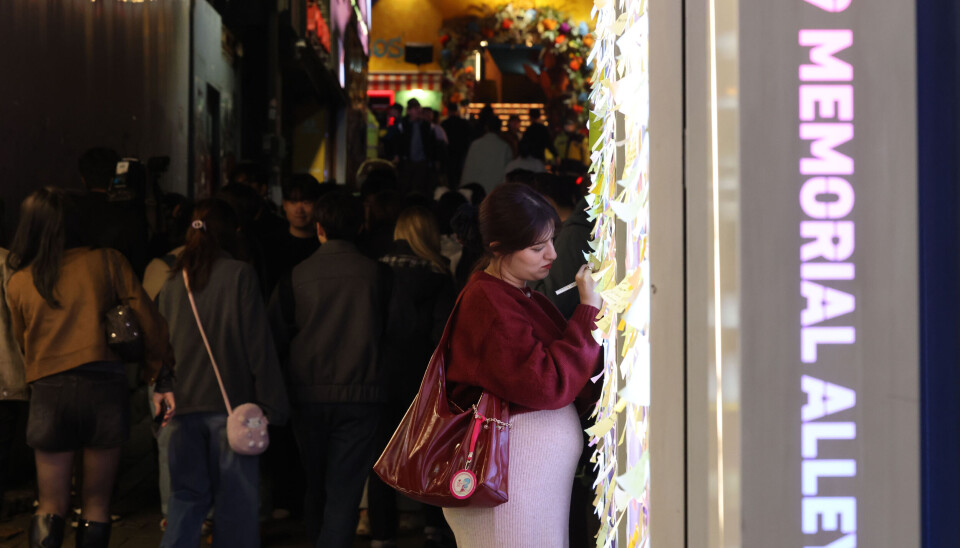
A foreigner pays tribute to the victims of the Itaewon crowd crush along the memorial alley in Yongsan District, central Seoul, on Oct. 31, 2025.YONHAP
What makes horror films truly scary comes from our intrinsic fear of the unknown. The suspense comes from not knowing when, where or what will appear next.
People fear the unseen more than the monster standing in plain sight.
A faint sound echoing through the darkness, a scene that is never fully explained or an inexplicable silence all ignite the imagination. And imagination often creates something even more terrifying. At its core, fear is born of the unknown.
The same principle helps explain why, after a social disaster that leaves a society grappling with collective PTSD, people relentlessly demand the truth.
A disaster whose cause remains unknown is not a monster that has already vanished — it becomes a specter, a possibility that could return at any time.
If the cause of a tragedy and the chain of responsibility behind it are never fully uncovered, people cannot trust again that the system is understandable or predictable. They instead begin to question whether rules actually work, whether safety systems are reliable and whether anyone will act responsibly when danger arises.
At that moment, society itself turns into a horror film.
That is why uncovering the truth is about far more than revisiting the past.
It is an attempt to end a state of uncertainty and bring fear back into the realm of what can be understood and controlled.
Only when the cause of a tragedy is revealed, responsibility is established and safeguards are put in place to prevent it from happening again can people begin to let go of their fear.
The same holds true for healing the post-traumatic stress left behind by a disaster.
A yellow butterfly-shaped paper cutout that participants held during a civic rally commemorating the 12th anniversary of the Sewol ferry disaster in Jung District, central Seoul, on April 11.YONHAP
The meaning behind feeling safe
"Recovering a sense of safety" — that was how my psychiatrist described the goal of treating PTSD.
Recovery begins with being able to believe once again that the world beneath your feet is a safe place.
But that's not something I can do on my own.
I never imagined that so many people would die on a street in the heart of Seoul on Oct. 29, 2022. Even now, it still doesn't feel real.
But it happened, and I watched it unfold in real time.
Regaining the sense of safety I lost that day requires more than individual therapy or visits to a doctor's office. I needed answers to deeper questions.
Is the ground beneath my feet truly safe? Can I trust that it will not collapse beneath me? Can I trust this society?
PTSD is "an experience that changes one's beliefs about oneself, other people and the world," according to Sim Min-young, a PTSD expert and former head of the National Center for Disaster and Trauma.
"Recovery from PTSD means restoring those beliefs," Sim said.
"It means replacing the negative assumptions that 'I can't protect myself,' 'I can't trust other people' and 'the world is not a safe place.' If society is unjust, indifferent or quick to blame victims, people with PTSD have no choice but to remain anxious."
Society must demonstrate, through actions rather than words, that it is committed to improving its systems and acting in good faith toward victims — even if it is far from perfect, according to Sim.
A citizen bows in tribute at the site of the Itaewon crowd crush on Oct. 29, 2025, the third anniversary of the disaster.YONHAP
"Simply telling people that 'the world is safe' will never change the deeply rooted beliefs created by PTSD," Sim said.
Judith Lewis Herman, a psychiatrist and one of the leading authorities on trauma, makes a similar point in her book "Truth and Repair: How Trauma Survivors Envision Justice” (2023).
Survivors of disasters, she writes, are not simply looking for comfort or for the past to be forgotten.
The book states that many survivors desperately long for a genuine apology. They seek acknowledgment from their perpetrators, such as hearing that the perpetrators will take full responsibility and express remorse rather than make excuses. It also notes that survivors want the perpetrator to recognize the suffering they have caused and try to make it right.
A sense of safety cannot be restored through reassuring words alone.
What victims and survivors need as they try to rebuild their lives is not abstract consolation or pressure to "move on." They need acknowledgment that a wrong was committed, recognition that real people suffered and a genuine commitment to ensuring that the same tragedy never happens again.
A bereaved family member breaks down in tears before laying flowers during a memorial ceremony held aboard a vessel near the site of the Sewol ferry disaster off Donggeocha Island in Jindo County, South Jeolla, on April 16, 2024.YONHAP
Why social healing is needed
Sewol ferry disaster
The Sewol ferry sank on April 16, 2014. The overloaded ship capsized in waters off the southwestern coast, leaving 304 people dead, mostly teenagers on a high school trip.
PTSD caused by a social disaster ultimately requires more than individual treatment. It calls for healing at the societal level.
Kim Hyun-soo, director of the Ansan Trauma Center and a professor of psychiatry at Myongji Hospital who has long supported families bereaved by the Sewol ferry disaster, has made the same point repeatedly.
April 19 Revolution
The April 19 Revolution was a mass protest that took place across the country in April 1960 against then-President Syngman Rhee, the first president of Korea. There was large amount of public unrest in March that year after it was alleged that Rhee had rigged the election that month in his favor. The protests exploded when the body of a student named Kim Ju-yeol was found floating near Masan Port in South Gyeongsang on April 11, 1960. He was killed at a rally on March 15. When his body was found later, he had a tear gas canister stuck in one of his eye sockets. A photograph of the body circulated widely in local media, inciting an angry uprising in Masan, South Gyeongsang. The movement picked up nationwide to protest police violence and request free and fair elections. It resulted in Rhee announcing his resignation on April 26.
The Second Battle of Yeonpyeong
The battle was a naval clash between South Korea and North Korea near Yeonpyeong Island in the Yellow Sea on June 29, 2002. Six South Korean Navy sailors were killed. It remains one of the deadliest inter-Korean naval confrontations since the Korean War.
Medication and counseling can help ease some symptoms, he says, but restoring the damage inflicted on an entire community requires collective healing.
That is why society cannot simply brush aside a disaster once it is over.
The reason Korea continues to commemorate events such as the Korean War (1950-53), the April 19 Revolution and the Second Battle of Yeonpyeong — all of which claimed many victims — is "to prevent people from carrying long-term psychological scars," according to Kim.
In that sense, public mourning, collective remembrance, uncovering the truth and putting safeguards in place to prevent another tragedy are not merely political acts. They are part of the process of restoring survivors' sense of safety.
Prof. Kim also explained why establishing responsibility and holding those accountable are particularly important after a social disaster.
"Take the Sewol ferry disaster as an example,” Kim said. “People saw that ship with their own eyes, yet in an age of advanced technology, they still cannot understand how so many lives could not be saved. That is why holding those responsible accountable plays such an important role in healing trauma."
Kim emphasized that social healing and collective mourning play a “vital role” in helping survivors regain their sense of safety.
Recovery from PTSD does not happen only in hospitals or therapists' offices.
Trauma experts argue that healing truly begins when society acknowledges responsibility, uncovers the truth and demonstrates a genuine commitment to rebuilding the trust that was lost.
A visitor bows in silent tribute after laying flowers at the Sewol memorial space inside the Seoul Metropolitan Council building in central Seoul on April 16, 2023.YONHAP
The long road to recovery
On June 7, the National Assembly passed a bill aimed at improving the country's response to social disasters.
The law on life safety enshrines the public's right to safety and clarifies the responsibilities of the national and local governments in protecting it. It also requires objective and independent investigations into the causes of safety-related accidents and the adequacy of the official response.
Institutionalizing thorough investigations and accountability is about more than administrative procedure.
It is part of rebuilding the trust that is shattered in the wake of a social disaster.
At the very least, it tells survivors: "What you experienced was a real tragedy, and society will not forget it."
Though the law carries profound significance, passing it does not, by itself, heal the wounds of a disaster.
An enactment of the new law did not instantly restore my own sense of safety.
My heart still races whenever I find myself in a crowded place. PTSD is not something that simply fades away.
As October 2026 approaches, I still find myself counting each day and wondering how I will get through them all.
This article was originally written in Korean and translated by a bilingual reporter with the help of generative AI tools. It was then edited by a native English-speaking editor. All AI-assisted translations are reviewed and refined by our newsroom.