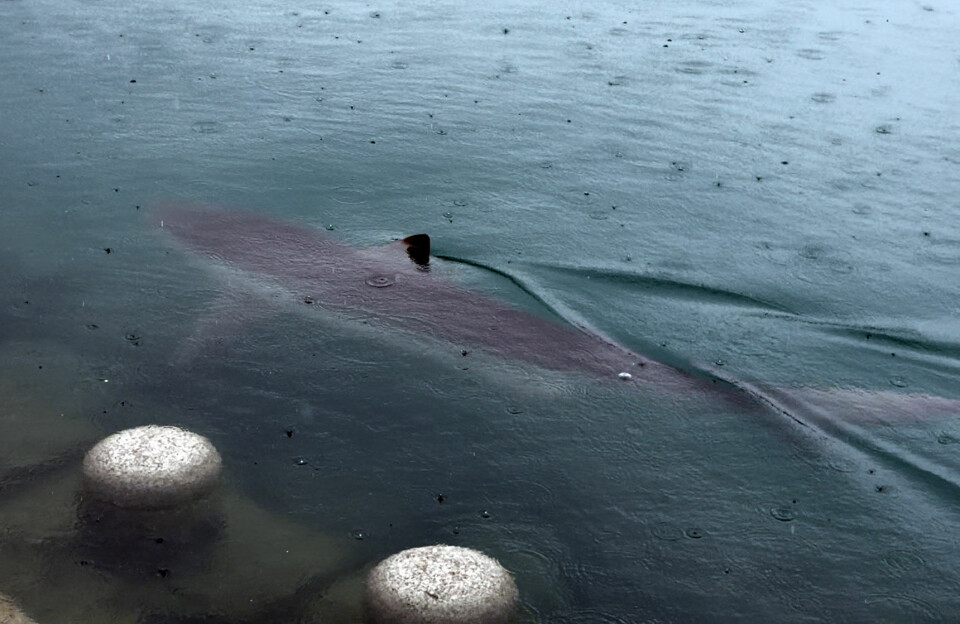
Bukang-i swims with its dorsal fin above the water in the canal at North Port Waterfront Park in Dong District, Busan, on Sept. 26.YONHAP
BUSAN — Two weeks after it swam into a canal in Busan, Bukang-i remains trapped, unable to find its way out of a man-made waterway that confuses the shark's sense of direction.
Bukang-i, believed to be a copper shark, has been circling the canal at North Port Waterfront Park since it was first spotted on Sept. 18. Experts say the canal's complex layout and the species' own habits have prevented the shark from leaving, rather than any particular wish to stay in the port city.
The shark likely followed its prey to the Busan coast before entering the canal, the National Institute of Fisheries Science (NIFS) said Thursday. Warmer waters have pushed warm-current fish such as mackerel and yellowtail farther north, and the sharks that feed on them are ranging farther as well.
The trouble starts once a shark is inside. The North Port canal curves at its far end and is lined with walls and structures, so water moves through it differently than along a natural coastline. Sharks find their bearings by smell and currents, which can make it hard to find the way back to sea in a setting like this.
"It is not that Bukang-i is not leaving. It cannot leave," said Choi Yun, professor emeritus of marine biology at Kunsan National University. "Copper sharks have highly developed sensory organs, but the canal's structures and environment are different from the sea, so it appears unable to find its bearings."
"Copper sharks in aquariums keep circling in one direction," Choi said. "Bukang-i is presumably repeating similar behavior as it bumps into the edges of the canal."
People watch Bukang-i swim in the canal at North Port Waterfront Park in Dong District, Busan, early on Sept. 27, the last day of the Chuseok harvest holiday.YONHAP
The ampullae of Lorenzini, special electrosensory organs that sharks carry around the snout, nose and head, may also play a part.
"Sharks sense things like magnetic fields to find their direction on long journeys," Choi said. "In a canal with many man-made structures and electrical facilities, that magnetic sense could get confused."
The copper shark's habits are also seen as the reason the first rescue attempt failed on Tuesday. The Coast Guard used the foam, noise and current from high-pressure water jets to open a path toward the open sea, but Bukang-i instead stayed in the canal and dove below the surface or turned away to avoid the jets.
"A great white shark rescued in the United States in 2004 moved to the surface when threatened, so rescuers could confirm its position and guide it out," Choi said. "Copper sharks normally live below the surface and hide deeper when disturbed, which appears to be why this method did not work well."
That great white had wandered into a shallow lagoon off Naushon Island, Massachusetts, where it stayed for two weeks before state fisheries workers and local fishermen coaxed it back to sea, in part by using netting to steer it.
Busan Coast Guard and Busan fire authorities spray water from rescue boats and rubber boats to drive Bukang-i out of the canal at North Port Waterfront Park in Dong District, Busan, on Sept. 29. The shark had not left the canal as of 1 p.m.YONHAP
Bukang-i could die if it is left in the canal. The canal holds mullet and Japanese jack mackerel, but the shark has not yet been seen feeding.
"It is healthy and swimming well for now, but the canal is shallow and narrow, so it is presumably unable to feed normally," Kim Hyun-woo, a researcher in the NIFS's coastal and offshore fisheries resources division, said earlier. "Its health could deteriorate if it stays for a long time."
Cooling water poses another risk.
"The water temperature is not a major problem right now, but if it drops below 20 degrees Celsius [68 degrees Fahrenheit], [the shark] could struggle to stay active," Kim said. "The canal is shallower than the sea, so it is affected more quickly by changes in air temperature."
Fire and Coast Guard rescue boats spray water to drive Bukang-i, the shark trapped in the canal at North Port Waterfront Park, toward open water in Dong District, Busan, on Sept. 29. Rescuers deployed boats and water pumps but failed to move the shark out.YONHAP
Busan city plans a second rescue attempt with nets on Friday. The nets are not meant to catch the shark but to block its retreat and slowly push it toward open water.
"The net method has a high chance of success, but there is also a risk that the shark will come into contact with the nets," Choi said. "It should not be herded all at once but moved little by little while its position is checked."
"Rather than trying to finish in a day or two, taking several days to guide it out slowly will raise the chances of success," Choi added.
This article was originally written in Korean and translated by a bilingual reporter with the help of generative AI tools. It was then edited by a native English-speaking editor. All AI-assisted translations are reviewed and refined by our newsroom.