K-pop idol’s use of local dialect ignites Korea’s latest political identity clash
Rescene leader Woni faced accusations of using far-right code after a YouTube clip, igniting a broader debate over dialect, ideology and the pressures on K-pop stars.
Girl group Rescene's Woni, left, says "It's scary," in a Gyeongsang dialect during her visit to member Minami's home in Japan in a YouTube video.SCREEN CAPTURE
Korea's online habit of scouring celebrities for hidden political signals has found a new target: a rising K-pop idol accused of far-right sympathies over a single syllable of local dialect.
Woni, the leader of girl group Rescene, ended a sentence in a recent YouTube video with the suffix "-no," commonly appended to questions in the dialect of Busan and South Gyeongsang. A broadcast producer and a former liberal party leader called it far-right code; her defenders called it ordinary hometown dialect. Across the political spectrum and among most of the public, far more people rejected the accusation than backed it, calling it ideological policing gone too far.
The suspicion turns on that single syllable. In the Gyeongsang dialect of Korea's southeast, sentences often end with "-no," rather than "-ni" or "-da" in standard Korean. But users of the far-right site Ilbe also attach "-no" to sentences to mock the late President Roh Moo-hyun, who came from the region and often spoke in his Gyeongsang dialect in official speeches. His surname, though written "Roh" in English, is also pronounced "no" in Korean.
Rescene's Minami, right, shouting, ″Geoje yahoo,″ next to Woni on a YouTube videoSCREEN CAPTURE
The practice of Ilbe users to append "-no" to the end of every sentence — even when it doesn't make grammatical sense — eventually became an identifier of the far-right community. Some saw Woni as repeating far-right lingo, while others saw her simply as a young woman from Geoje, South Gyeongsang, who spoke in her local dialect.
The clip that started this all went online on June 28. In it, Woni visits the home of the group's Japanese member, Minami. As Minami shows Woni her younger sister's room, they hear noises from the closet, and the channel's producer says, "Something rattled over here. What was that? Museopno," or, "how scary" in the Gyeongsang dialect.
To which Woni replies, "Museopno."
The row took off several days later on Wednesday, when a producer at state broadcaster MBC's South Gyeongsang bureau wrote on X that she was "upset to see a female idol and a producer happily trading 'no's,'" labeling the interaction Ilbe-esque. Online, a few agreed that it constituted hate speech, but most users ridiculed the idea and argued that it was simply how people in South Gyeongsang talk.
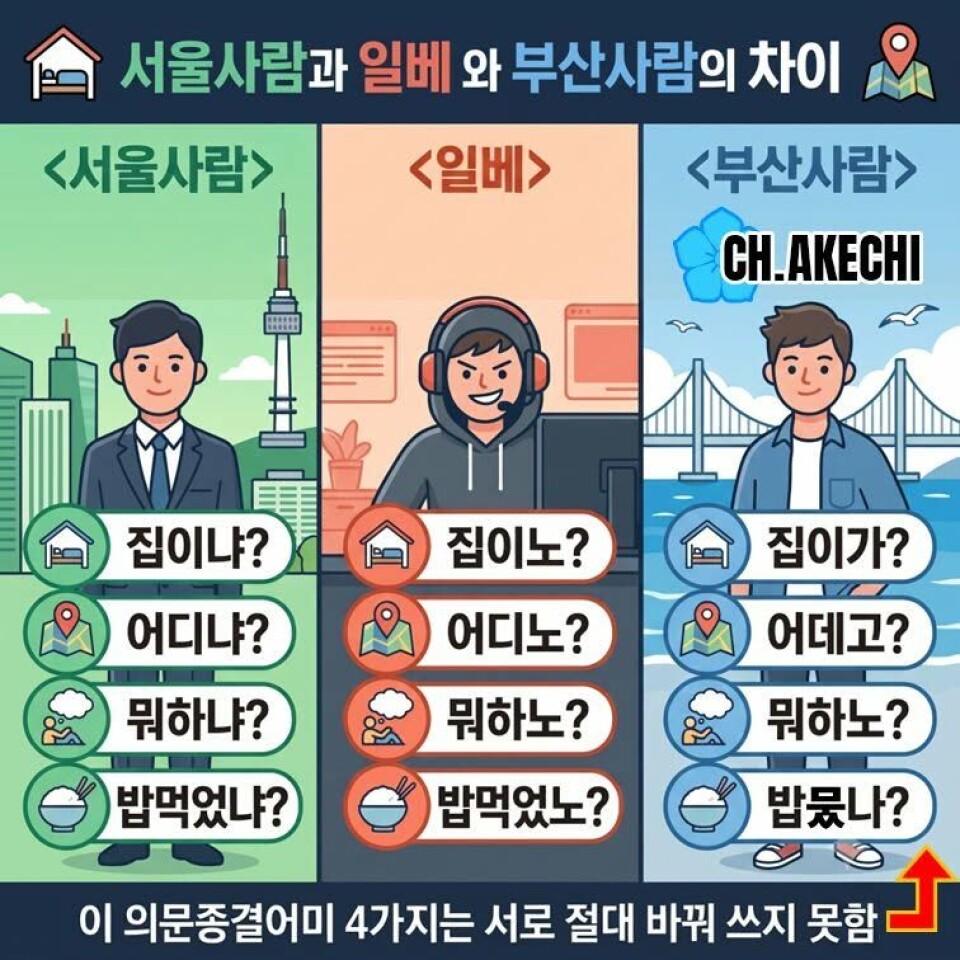
A post uploaded to former Rebuilding Korea Party lawmaker Cho Kuk's Facebook, where he accused Woni of using hate speech from the right-wing online community Ilbe.SCREEN CAPTURE
Politicians took up the argument. Cho Kuk, the former leader of the liberal Rebuilding Korea Party and himself a Busan native, criticized Ilbe's use of "-no" in a Facebook post on Sunday, claiming that this did not constitute authentic dialect. He shared an image that contrasted how a Seoul native, an Ilbe user and a Busan native speak, noting that Ilbe users "mechanically attach 'no' after standard Korean," unlike in the genuine Busan dialect.
In a follow-up post the next day, Cho said that "many people in their teens and 20s attach 'no' to their questions, even though they're not Ilbe members," and that they should know that this a "mistaken practice that mocks and denigrates late President Roh." He said that even young people "must know that attaching 'no' to their questions is an expression of hate and stop doing it."
Cho's assertions met with pushback. Lee Jun-seok, leader of the conservative Reform Party, accused Cho of trying to vet people's beliefs by their linguistic habits.
"Even when linguists explain that in the southeastern dialect, 'no' is an ending used not just for questions but for exclamations and asides, the labeling doesn't stop," he wrote on Facebook Sunday.
Yoon Sang-hyun, a People Power Party lawmaker, called it appalling to brand ordinary regional speech as far-right code.
"Must we sow division by dragging up even the dialect of an idol member barely 20 years old?" Yoon wrote on social media on Sunday, calling it "truly cruel and frightening politics."
Ha Heon-gi, a former Democratic Party deputy spokesperson, wrote that "you can't tell from one word ending whether someone is an Ilbe devotee mocking late President Roh or simply using a phrase that has become common and lost its original meaning."
The scrutiny has landed on a group at the peak of a sudden rise. Rescene had its 2024 track "Love Attack" (2024) climbed to third on the Top 100 chart of the streaming service Melon as of Monday.
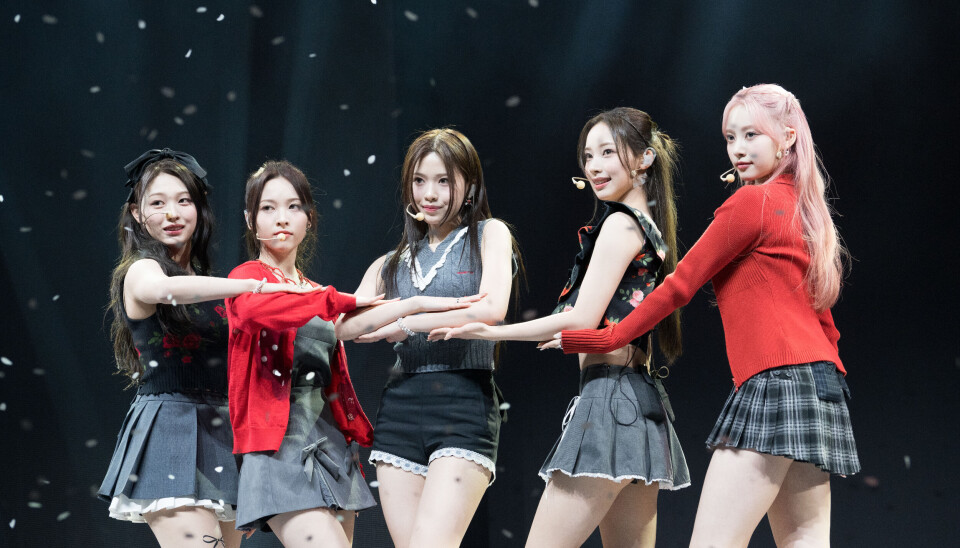
Rookie girl group Rescene performs ″UhUh,″ the lead track from its debut EP ″Re:Scene″ at a press showcase held Tuesday at the Yes24 Live Hall in Gwangjin District, eastern Seoul.CHO YONG-JUN
The group only began receiving public recognition a few months ago, when a video of Woni and Minami touring Woni's hometown of Geoje in flashy Japanese gyaru makeup went viral. Geoje made Rescene its publicity ambassador in May, and last month, the group was chosen for a Ministry of Culture, Sports and Tourism program supporting small agencies abroad, one of 10 acts set to receive up to 300 million won ($196,000) a year.
The political scrutiny is nothing new for K-pop, whose stars are routinely accused of smuggling partisan signals into their clothes and social media.
Last year, aespa's Karina apologized after posting a photo in a red jacket bearing the number 2, the color and ballot number of the conservative PPP, a week before the presidential election, which many online took as an endorsement.
She was hardly alone. As votes near, idols scrub their images of red and blue, the ballot numbers 1 and 2, even the "V" sign that can be read as the number 2.
Rescene itself skipped its signature upside-down peace sign during a recent campaign, and the rapper Beenzino apologized after pairing a red outfit with the caption "Happy World Burgundy Day" during early voting.
The pressure does not lift between elections. Stars who actually voice a political view are scolded for breaking an unwritten rule of neutrality, as the actor Lee Dong-wook was when he publicly backed the drive to impeach then-President Yoon Suk Yeol.
This article was originally written in Korean and translated by a bilingual reporter with the help of generative AI tools. It was then edited by a native English-speaking editor. All AI-assisted translations are reviewed and refined by our newsroom.