Korea's 'Notes app apology': Why celebrities address their most delicate moments by hand
In an age of PR statements and paid posts on social media, Korean celebrities write letters by hand to apologize or make an announcement to convey their effort, sincerity and humility.
SHIN HA-NEESHINHA-NEELIFESTYLE & ENTERTAINMENT REPORTER
PublishedModified
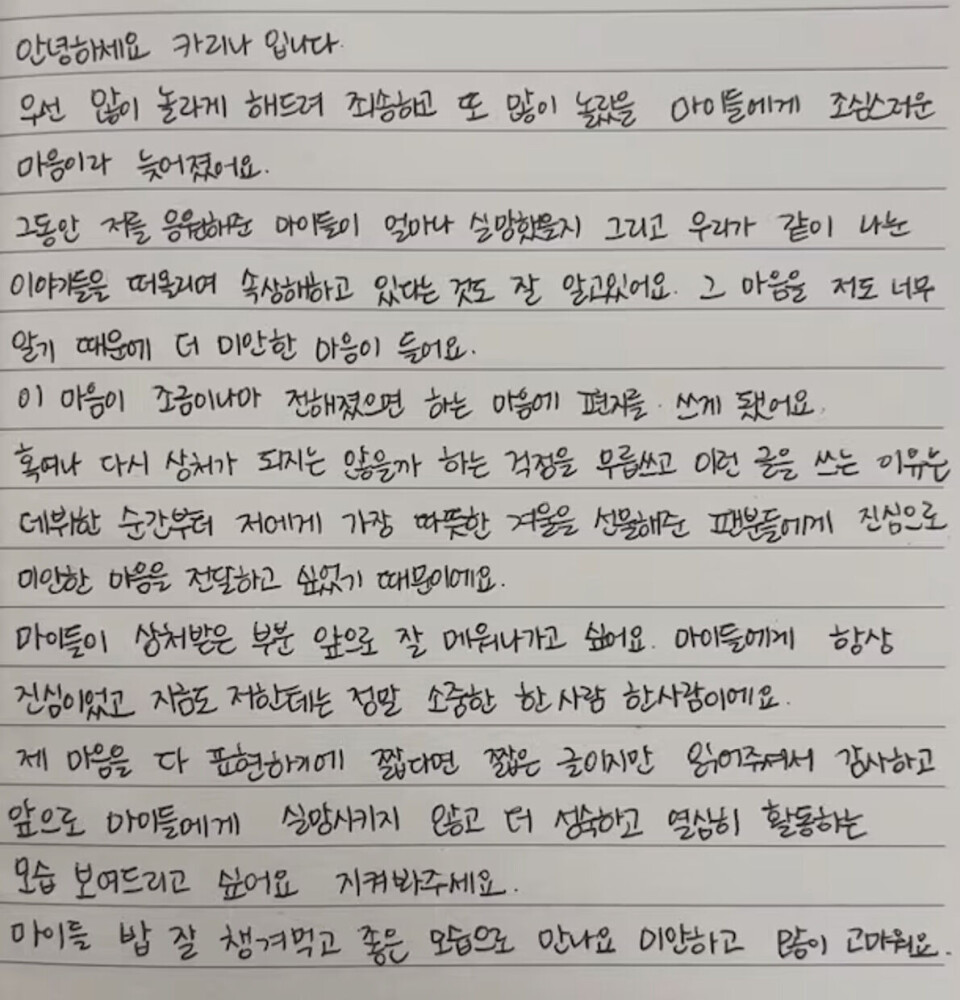
Girl group aespa's Karina superimposed on her handwritten statement released on March 5, 2024NEWS1, SCREEN CAPTURE
How does a K-pop idol respond to a scandal, a major life announcement or, in some cases, something that becomes both?
First, they talk to their PR team. Then they pick up a pen.
“I know how disappointed and sad [our fans], who have supported me until now, must have felt [about the news],” Karina of the girl group aespa wrote in neat handwriting after her then-relationship with actor Lee Jae-wook became public in March 2024.
aespa’s Karina poses for photos during a press conference for the release of the group’s second full-length album “Lemonade” at Sofitel Ambassador Seoul Hotel in southern Seoul on May 28.DANIELA GONZALEZ PEREZ
Girl group aespa's Karina's handwritten letter addressing the news about her relationship in 2024
“I decided to write this letter in the hope that my feelings of apology would reach you, even a little,” she continued.
When something threatens the bond between a star and their fans — from accusations of misconduct to conscription, dating rumors and even marriage announcements — celebrities often respond in one of the most analog forms available in the digital age: a handwritten letter.
The practice may seem decades old by now, as if Korean celebrities have always reached for pen and paper in moments of contrition or confession, but the ritual is much younger than it appears.
Its emergence is closely tied to the same emotional and technological forces that helped transform K-pop into a global phenomenon: the digital revolution, which allowed artists to reach fans across borders, and the unusually intimate bond between Korean stars and their audiences. That connection has inspired extraordinary passion and loyalty while also feeding into the parasocial expectations that make a celebrity’s private choices feel deeply personal to fans.
When do celebrities pick up pens?
Not every controversy warrants a handwritten apology, of course. A minor misunderstanding can be handled with an agency statement or social media post. Sometimes, a situation requires no public response at all.
But when a situation is considered serious — or personal — enough, writing by hand replaces typing.
Boy band Alpha Drive One’s Geonwoo poses for photos during a showcase for the release of the group’s first EP, “Euphoria,” at Blue Square in central Seoul on Jan. 12.DANIELA GONZALEZ PEREZ
From left: A handwritten apology from boy band Alpha Drive One's Geonwoo, released in July 2025, and another released nine months later in AprilSCREEN CAPTURE
One prominent example occurred in 2020, when idols including BTS’s Jungkook and boy band Seventeen’s Mingyu were found to have visited venues in Itaewon, central Seoul, during the early days of the Covid-19 outbreak despite recommendations to socially distance. Some fans and critics began posting hashtags such as “Jungkook, write a handwritten apology,” specifically demanding the format.
However, handwritten statements are not confined to Korea’s music scene. The practice extends across the broader entertainment industry and into its social and political realms. Paichai High School’s baseball team was recently embroiled in a controversy after it allegedly mocked the May 18 Gwangju Democratization Movement during a game. In response to the backlash, the team’s captain and coach issued handwritten apologies to the opposing school.
Not only for apologies
Handwritten letters have thus become a familiar form of apology, explanation and accountability in Korea’s media landscape.
For K-pop idols, however, handwritten statements carry a particular weight, which is why they are not reserved for scandals. Idols handwrite letters to announce marriages, military enlistments, hiatuses, departures from their groups and other major life changes that may reshape their relationship with fans.
When Max Changmin of boy band TVXQ announced his marriage to his noncelebrity partner in 2020, he did so in a handwritten letter addressed to fans.
“There is something that I want to tell my fans directly, so I have mustered the courage to write this letter,” he wrote. “Because this is by no means […] easy to share, I am still nervous as I write each word.”
Boy band TVXQ's Max Changmin's handwritten letter announcing his marriage to his noncelebrity partner in 2020SM ENTERTAINMENT
Max Changmin of TVXQSM ENTERTAINMENT
The purpose of the letter came in the next line.
“Even so, I thought that it was only right that I personally announce this major life event to my fans, rather than have you hear it through someone else’s writing or through word of mouth.”
How did it begin, and why?
One of the earliest widely reported handwritten statements from a Korean celebrity came in 2004, when actor Song Seung-heon sent an apology letter — for evading his military service — by fax to media outlets.
The next visible wave of news involving handwritten statements from high-profile celebrities appears to have emerged around 2009 and 2010, as the use of social media and smartphones began spreading rapidly in Korea.
Actor Lee Byung-hun uploaded a handwritten letter to fans on his official website in December 2009 during a legal battle with his former girlfriend. That same month, singer Baek Z-young issued a handwritten apology after halting a dinner show performance, explaining that she had experienced health issues at the time. The following year, actor Kwon Sang-woo posted a handwritten apology after he hit another car and drove off.
In 2012, when members of girl group T-ARA were accused of bullying another member, the group’s agency CEO and the involved members posted handwritten apologies online. The latter drew further controversy, however, as some people questioned whether the members had actually written the statements themselves.
The key appeal of handwritten statements is that they convey — or at least create the impression — that celebrities have taken the time and effort to reflect on their behavior or the issue at hand, enough to write a message in their own hand.
“When celebrities’ online communication with fans was limited mainly to their fan cafes, posting a statement [there] used to be enough for fans to believe that the message personally came from them,” said a source from a major K-pop agency, who requested anonymity. “But now, a statement is assumed by default to have been written by the company or PR team. So a handwritten letter implies that the celebrity had personal input.”
Singer Ju Hak-nyeon, left, and his handwritten letter posted to his Instagram on June 19, 2025NEWS1, SCREEN CAPTURE
Authenticity, or the feeling of it
A loose Western counterpart of handwritten apologies is perhaps the “Notes app apology,” in which a celebrity facing backlash posts a screenshot of an apology written in their phone’s Notes app.
In a 2019 article, The New York Times noted that people often deliberately choose to use a Notes app apology to create a sense of intimacy, even including “grammatical and spelling errors or profanity” in their message, which can function as rhetorical devices that make the writer seem “not only unpretentious but fallibly human.”
Boy band EXO's Chen announces his marriage in a handwritten letter in 2020.SM ENTERTAINMENT
Boy band EXO's ChenKIM JIN-KYUNG
But if the Notes app apology emphasizes immediacy, rawness and directness, the Korean handwritten version leans more toward effort, sincerity and humility, especially in an age of agency statements and paid posts on social media.
“Technically, it’s not like we can truly force artists to write a handwritten apology, though of course we have to check and suggest changes to [any statement that they write] before it goes public,” said a veteran PR specialist at a major K-pop agency, who requested anonymity.
Some of the most common feedback from PR teams includes asking idols to ensure that lines of text do not skew upward or downward, write more neatly — or not to craft a letter at all.
“Sometimes, artists come to us first when a controversy occurs and say that they want to write an apology by hand,” the source said. “But when the alleged wrongdoing doesn’t warrant [a handwritten letter], we advise them not to.”
BTS's Suga, left, and his handwritten apology uploaded on Weverse on Aug. 25, 2024YONHAP, SCREEN CAPTURE
According to Kang Eun-gyo, a feminist scholar and co-author of “Femi-dology” (2022), handwritten statements often embody the idea of K-pop stars being “sincere” and “authentic” — qualities that help sustain the close emotional bond behind K-pop fandom’s intensity.
“More than any other type of celebrity, [K-pop] idols have a blurred boundary between their character-like persona as entertainers and their human side as ordinary people,” she writes in her paper “Handwritten Apologies of K-pop Idols: Authenticity of Handwriting and Fandom’s Identity as Consumer” (2020), published in the journal “Feminism and Korean Literature.”
According to the scholar, the blurred line between idols’ stage personas and everyday selves — reinforced through livestreams, reality programs and constant fan communication — has been one of their biggest appeals since the third generation, which includes BTS, Seventeen and Blackpink. This makes statements written in idols’ own hands carry even greater symbolic importance.
“In the end, the weight of the emotional labor that idols have to bear is becoming heavier and heavier as it has been placed on them by both the industry, which has created the extreme working conditions that they’re subjected to, and the fandom, which has come to take their labor for granted in the process of satisfying its desire for intimacy,” Kang writes.