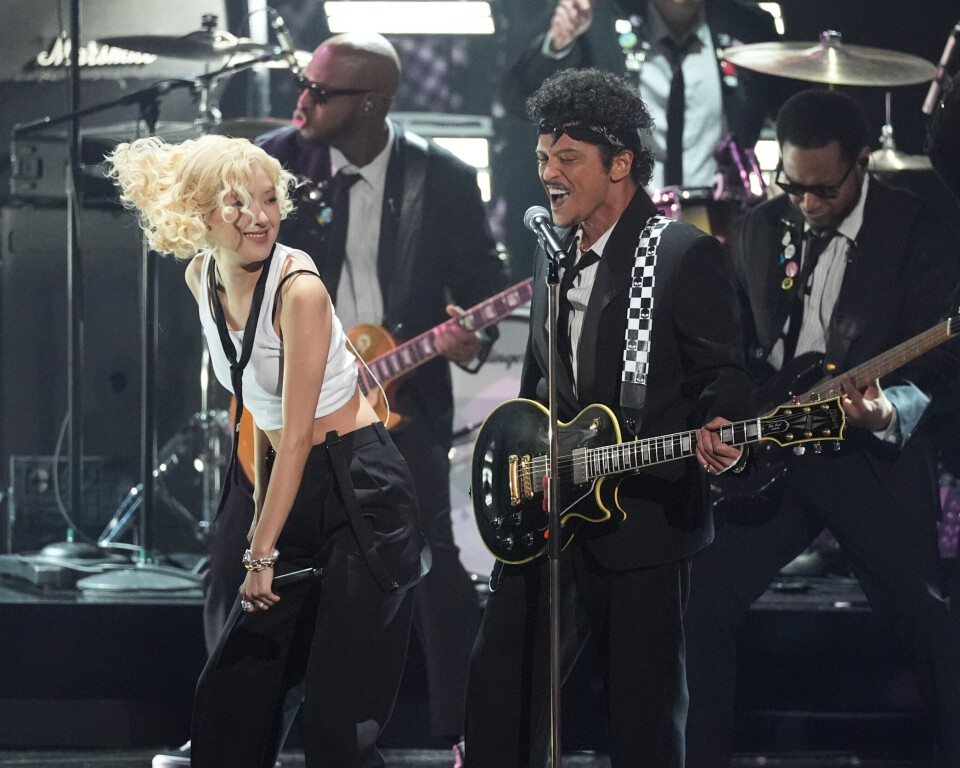
Rosé, left, and Bruno Mars perform "APT." (2024) during the 68th annual Grammy Awards on Feb. 1, in Los Angeles.AP/YONHAP
BTS may still reign as the most powerful symbol of K-pop’s global reach, but the story of Asian music no longer begins and ends with Korea’s biggest stars.
From India’s expanding music market and Southeast Asia’s emerging pop scenes, local music is increasingly being consumed globally precisely because it remains local, says Mira Chatt, Asia chief of the International Federation of the Phonographic Industry (IFPI).
Mira Chatt, Regional Director for Asia at the International Federation of the Phonographic Industry (IFPI), speaks during an interview with the Korea JoongAng Daily on July 7 in western Seoul.SHIN HA-NEE
“We’re seeing a moment of success that’s probably unparalleled globally,” Chatt said during an interview with the Korea JoongAng Daily in western Seoul on Tuesday, referring to K-pop’s rapid rise on the global stage. “It has been a lesson, I think, for the music industry that language is not in any way a barrier to consumption.”
Chatt, the IFPI’s Regional Director for Asia, arrived in Seoul on July 6 for a week-long visit to meet with Korean music industry players and government officials. She described K-pop’s global growth over the past decade — most recently marked by Rosé and Bruno Mars’s 2024 hit “APT.” topping the IFPI’s Global Single Chart as the first song featuring non-English lyrics to do so — as the “culmination of a decades-long story.”
Mira Chatt, Mira Chatt, regional director for Asia at the International Federation of the Phonographic IndustryIFPI
That momentum can also be seen in album sales. Chatt noted that 15 of the top 20 albums on the IFPI’s 2025 Global Album Sales Chart came from Korea, adding that the global appetite for hyperlocal music is now extending across Asia, from India to Thailand and Vietnam.
“What fans are looking for is not a globalized, generic experience,” she said. “They’re looking for local.”
The IFPI represents some 8,000 members, including record labels worldwide, and publishes widely cited music market data. Chatt was appointed to lead the organization’s Asian operations in September of last year, after serving as a career diplomat in the Canadian Foreign Service and as head of government affairs and public policy for YouTube India.
Her appointment to the role comes amid a surge in visibility of Asian music on the global stage, while the industry faces sweeping technological change driven by AI.
“Now that we find ourselves in a time of an explosion of innovation through AI, there has never been a more important time to uphold existing copyright frameworks,” Chatt noted.
As AI reshapes how songs, voices and images can be created and commercialized, the director said the industry must ensure that technological innovation does not come at the expense of human creativity.
“We don’t see these two things as being at odds,” she stressed. “It’s not a zero-sum game.”
Below are excerpts from the interview, edited for length and clarity.
When you were first appointed about a year ago, what was the first thing you wanted to understand about the Asian music industry?
Looking at the landscape across Asia, we of course see an enormous amount of diversity in the music markets. And we also see an increasingly global reach.
There are lots of markets within Asia that look up to Korea as a model to understand how K-pop came to be, what kind of support it needed, what kind of investment has been made by the music labels. This is a project of decades, not one that just exploded in the last few years.
Rosé’s 2024 hit “APT.” topped the IFPI’s Global Single Chart last year. What does this kind of achievement from K-pop tell us about Asian music in the global mainstream today?
Everybody is excited about K-pop. “APT.”, of course, was super exciting, but it’s not the only story — 15 of the IFPI’s top 20 global sales albums in 2025 were from Korea. It’s the culmination of a decades-long story. When we look at it from a policy perspective, from an investment perspective, we see a comprehensive ecosystem that gave rise to this.
It has been a lesson, I think, for the music industry that language is not in any way a barrier to consumption. There are K-pop fans who don’t speak a word of Korean until they start listening to K-pop songs on repeat, because they’re connecting with the artist, with the artist’s experience, with the emotion of the song and with culture in that comprehensive consumption experience.
Singer Rosé and Bruno Mars star in the music video for "APT." (2024).THE BLACK LABEL
Do you feel the global music market has become more open to non-Western, non-English music?
Absolutely. K-pop is perhaps one of those examples, as we see that across Asian music categories and non-Asian music categories.
Staying in the region, Indian music has opened itself up. It has had decades of popularity coming out of its film music, out of Bollywood music, riding on the popularity of Indian cinema. But now, nonfilm music and international collaborations are taking off.
Within Southeast Asia, you have some really interesting and exciting stories coming out of Thailand, as well as Vietnam. That’s quite exciting and proves the point that K-pop has already proven: language and culture are absolutely global. What fans are looking for is not a globalized, generic experience. They’re looking for local.
And then Latin America — Latin music has had a really big year. We’ve seen that across artists, Bad Bunny and many others.
So, yes, K-pop was sort of the proof point and the model, but other types of local music are really soaring. It’s super exciting.
Bad Bunny performs at the Super Bowl 2026 halftime show in California on Feb. 8.AP/YONHAP
Many music labels, including K-pop companies, have begun to experiment with AI in their content and production. How do you see this development?
Music companies and the music industry and artists are already embracing AI, engaging in new opportunities on the creative side, as well as for fan engagement and artist development.
The thing that we’re really pleased about is that licensing is already working. That means there are new partnerships and new agreements signed between AI companies and music rights holders, which is really important.
What we’re hoping for and working toward is to ensure that innovation through AI for music continues to happen on a level playing field, which will allow both sides to continue growing together, hand in hand.
We know that consumers also expect that kind of transparency. We as music listeners want to know if and when AI is being used. At a policy level, we want to ensure that there are appropriate recordkeeping and transparency that respects the rights of creators.
So it’s not innovation versus copyright. Both things can thrive together, so that consumers, fans, artists, and tech companies can all grow together.
A still from the AI-generated music video for G-Dragon’s “Home Sweet Home” (2024), created in collaboration with Microsoft using SoraGALAXY CORPORATION
What role does the IFPI hope to play in shaping the music industry’s response to AI in Asia?
The IFPI, at a global level, represents the interests of our members, which involves trying to support their objectives across the board. When it comes to policy, that means having conversations with governments about hard things that are evolving.
For Asia in particular, this space is moving really fast. The IFPI spends a lot of effort in explaining how the music industry works so that policymakers can make responsible decisions about how innovation and creativity can be supported together.
I think the danger would be if one was prioritized over the other. If we find ourselves at a moment anywhere in the world where innovation is being prioritized over human creativity, that would be a crisis of conscience for our industry.
If you look ahead five years from now, what would you like Asia’s recorded music market to look like?
The dream scenario is continuing on this path where we see an enormous amount of domestic consumption, but also export — both in the region and globally — of local music.
We’re talking about, as a region as a whole, more mature markets and a region that continues to lead the world in its creativity and in its consumption. By that, I mean all of the exciting ways that Asia specifically consumes music across that ecosystem — streaming, physical, live events, fandom, super-fandom.
And I think the way we see that happening is broadly with the existing copyright frameworks in place. That’s what allows all of that to happen.
If we see too many threats to creativity and consumption, then all of that magic disappears.