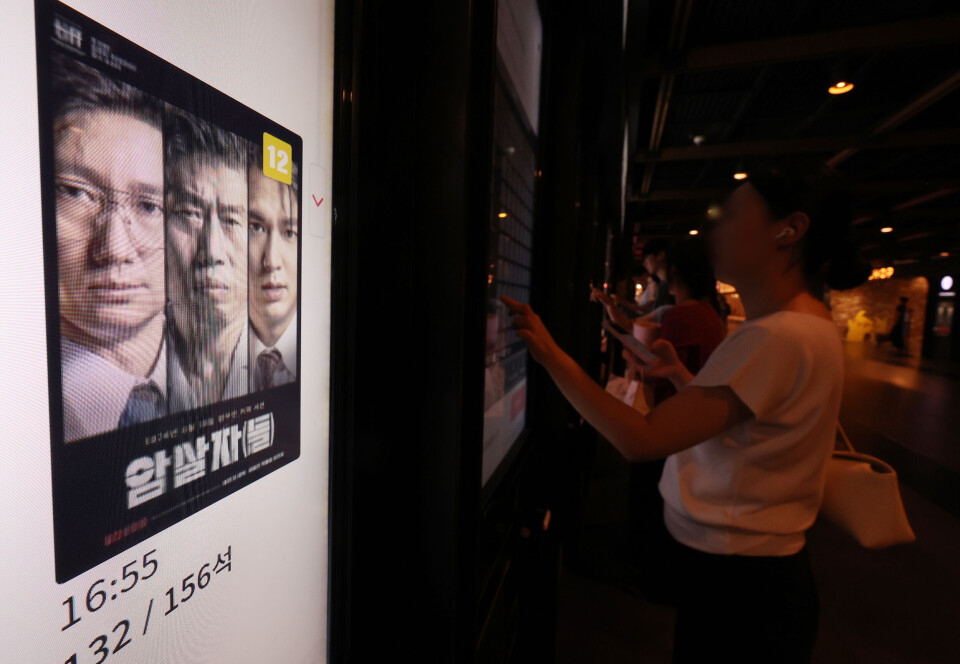
A moviegoer purchases a ticket next to a digital poster for “The Assassin(s)" at a movie theater in Seoul on Sept. 28.NEWS1
The makers of "The Assassin(s)," a film about the 1974 killing of first lady Yuk Young-soo, have been reported to police for alleged defamation.
Lee Jong-bae, a former People Power Party (PPP) member of the Seoul Metropolitan Council, filed the complaint with the Seoul Metropolitan Police Agency on Tuesday. The complaint accuses director Hur Jin-ho and the production team of defamation by spreading false information, an offense under the Criminal Act.
The film is inspired by the real-life shooting at a Liberation Day ceremony on Aug. 15, 1974, when Mun Se-gwang, a second-generation Korean resident of Japan, fired at then-President Park Chung Hee in an attempt to assassinate him.
Investigators at the time concluded that Mun acted on orders from Pyongyang and the pro-North General Association of Korean Residents in Japan. The film builds its premise on longstanding suspicions that he may not have acted alone.
"Even the film's title is not 'Assassin' but the plural 'Assassin(s),' which suggests that someone other than Mun Se-gwang may have carried out the assassination," Lee said. "The film lines up scene after scene that raises suspicions about the involvement of the state's power agencies at the time. As a result, audiences come to perceive that former President Park Chung Hee may have been behind the incident or involved in the crime."
Starring Yoo Hai-jin, Park Hae-il and Lee Min-ho, the film opened last Wednesday and led the box office through the Chuseok holiday. It has since drawn criticism from the PPP and others who say it distorts history, a claim the production team has rejected.
"This is not a film made to establish a new historical conclusion or to deny or distort existing facts," the production team said.
"'The Assassin(s)' is a feature film that takes a historical event from 1974 as its motif," the team said in a statement Monday. "It reconstructs the event by adding cinematic imagination to the various records written about it at the time. Nowhere does the film define any particular person as the one behind the incident, and it does not present its hypotheses or dramatic settings as historical fact."
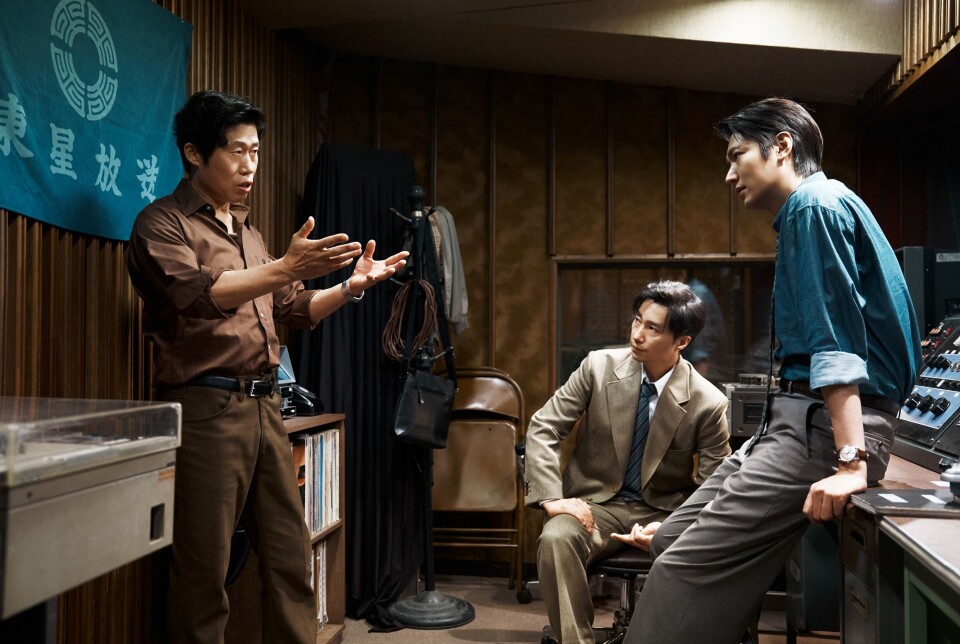
A still from the mystery thriller film “The Assassin(s)”HIVE MEDIA CORP
Hive Media Corp, which produced and distributed the film, also denied claims that Chinese capital was invested in the film that had been circulating in online communities.
"The Assassin(s)' is a work independently planned and produced with domestic capital, led by local production staff and creators," the company said in a statement Tuesday. "There has been no inflow of Chinese capital whatsoever into the production or investment process of the film and the company."
"We are very much aware of the different opinions and issues raised against the film recently, and we respect the criticism and the different opinions people have against the film," the company continued.
"But as information about investment and production capital matters can be objectively verified, we hope that information different from the truth does not spread and perpetuate any further."
This article was originally written in Korean and translated by a bilingual reporter with the help of generative AI tools. It was then edited by a native English-speaking editor. All AI-assisted translations are reviewed and refined by our newsroom.