'I feel a responsibility to leave a record': Shisei Kuwabara’s six decades of sacrifice behind the lens
A new documentary follows the 90-year-old Japanese photojournalist’s many years documenting Korea’s transformation and the personal cost borne by his family.
KIM JU-YEONKIMJU-YEONLIFESTYLE & ENTERTAINMENT REPORTER
Shisei Kuwabara has spent more than six decades behind the camera. The Japanese photojournalist is acclaimed for his persistent, long-term coverage of subjects ranging from Minamata disease to Korea’s turbulent modern history. That persistence didn't necessarily come from a sense of duty toward his subjects, but rather from a responsibility to document what he witnessed, he said.
“Just like all of you,” he said, looking around at the reporters gathered for a roundtable interview on Thursday. “I feel a responsibility to leave a record.”
Now entering what his wife and longtime interpreter, Kazuko Kuwabara — also known by her Korean name, Cho Hwa-ja — described as their “final chapter” of life, Kuwabara has found himself on the other side of the lens. The documentary “A Portrait of Photography,” directed by Ko Hee-young, traces the 90-year-old photojournalist’s career through his photographs, diary entries and recollections, while also following him at work in Japan and Korea, climbing ladders and hauling heavy camera equipment as he continues to document his subjects.
Shisei Kuwabara in the documentary "A Portrait of Photography"SOOM:BE
Shisei Kuwabara in the documentary "A Portrait of Photography"SOOM:BE
Shisei Kuwabara in the documentary "A Portrait of Photography"SOOM:BE
In Japan and abroad, Kuwabara is perhaps best known for his award-winning work on Minamata disease, the mercury-poisoning disaster caused by industrial wastewater. He began documenting patients and their families in 1960 and continued for decades.
But as he recalls in “A Portrait of Photography,” Korea became the single biggest subject of his career. “Of all the subjects I worked on, I pressed the shutter most often in Korea,” he says in the film, estimating that he took hundreds of thousands of frames there.
Shisei Kuwabara in the documentary "A Portrait of Photography"SOOM:BE
Much of that work captured a country in transition, emerging from the 1910-45 Japanese colonial rule and the 1950-53 Korean War into decades of authoritarian government and, eventually, democracy.
His subjects included student protests against the normalization of diplomatic ties with Japan; the dispatch of Korean troops to Vietnam; and Koreans living in Sakhalin, many of whom had been brought there under Japanese colonial rule and were left stranded after World War II.
“Korean society felt very closed off,” he said of his early impressions of the country. “That began to change with democratization in the 1980s.”
“Now, when you’re talking about the countries at the forefront of democratization in Asia, you can’t leave Korea out,” he said at the roundtable.
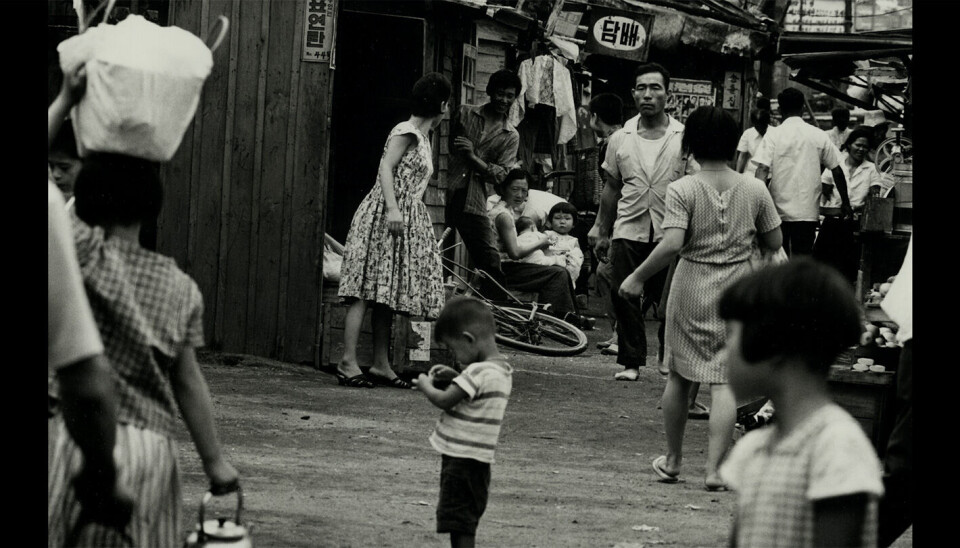
A photo taken by Shisei Kuwabara in Korea as shown in "A Portrait of Photography"SOOM:BE
The Thursday interview took place in Eulji-ro, not far from Cheonggyecheon, a stream that runs through downtown Seoul and its surrounding neighborhood, which Kuwabara also famously documented over decades.
Today, Cheonggyecheon is known as an urban retreat in the center of the capital city. But when Kuwabara first photographed it, the area still bore the scars of postwar Korea, with makeshift homes crowding the banks. His candid images of everyday life there became part of a broader visual record of Korea’s rapid industrialization and economic transformation.
Back in 1964, when he first came to Korea, "the economy was still in very poor shape. It was a time of widespread poverty,” he said.
“At the time, Gimpo was still the only airport, and when I made my way into central Seoul, even the roads had not yet been paved. When cars picked up speed, you could feel the dust blowing up around you.
“When I took those photographs [in Korea], I felt that the scenes before me carried the blood, sweat and tears of the Korean people," he said.
Shisei Kuwabara with his wife in "A Portrait of Photography"SOOM:BE
“A Portrait of Photography" also reveals a more candid side of Kuwabara: his prosthetic eye, the ailments that have come with age and years of heavy smoking, and the toll his work took on his family. His wife, in the documentary, recalls the anxiety she felt when he traveled for assignments, including to Vietnam to cover its brutal civil war, not knowing whether he was “dead or alive," while his son speaks bluntly about a father who was far from an ideal parent.
Shisei Kuwabara in the documentary "A Portrait of Photography"SOOM:BE
Kuwabara's wife, in Thursday's interview, described their marriage as one shaped by long absences and sacrifice. “I would describe my life in just two phrases,” she said. “Absolute loneliness in a foreign country. [...] Endless hardship.”
Born in Korea, she first met Kuwabara in 1969 at the car company where she worked, when the photographer visited on assignment.
But ultimately, after seeing Kuwabara establish himself in the world of photography, she came to accept the demands of his work.
“I thought, ‘This is someone who has to keep going out and taking good photographs,’” she said.
Seeing “A Portrait of Photography” near what she called the “final chapter” of the couple's lives gave her a new perspective on those decades.
“I thought, ‘So this is how my life comes to a close, in a single film,’” she said. “I felt deeply rewarded.”
"A Portrait of Photography" premiered at the DMZ International Documentary Film Festival in September 2025. It releases in theaters on Wednesday.